
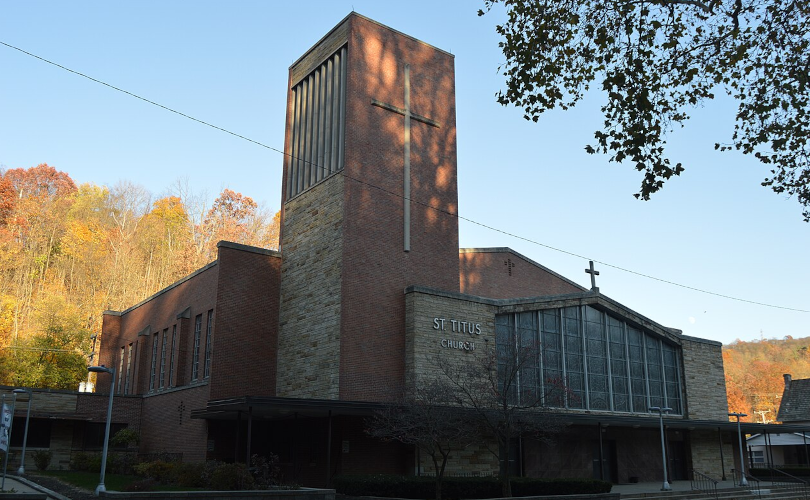
• A Pittsburgh-area Latin Mass community faces a hard stop after nearly two decades. • Parishioners say the small liturgical community helped build something much bigger than weekend worship. • The decision leaves some faithful without a realistic nearby option for the traditional rite. • The parish also played a role in major Catholic events in Aliquippa and beyond. • The last Mass at St. Titus is set for early September.
A longtime member of the Traditional Latin Mass community at St. Titus Church in Aliquippa, Pennsylvania, says the parish is about to lose more than a liturgy. After nearly 19 years of worship, fellowship, and local Catholic witness, the community is watching its final chapter unfold under a decision that ends permission for the ancient form of the Mass at the parish. For families who built their Sunday rhythm around St. Titus, the news landed with real force.
The parishioner, who has been part of the community since its earliest days and asked to remain anonymous, described the disappointment as deep and immediate. Even with restrictions in place, the Latin Mass group stayed active and steady, drawing people who valued the reverence, the continuity, and the sense of belonging. The concern now is not just about losing a service, but about losing a spiritual home that many believed still had life left in it.
The decision came after Bishop Mark Eckman said he would not seek another extension for the Traditional Latin Mass at St. Titus. That means the parish will not continue with the special permission that had allowed the older form of the Roman Rite to remain in place. The bishop framed the move as a transition toward the post-conciliar liturgy, while the community saw it as the end of something that had already been pushed down to the margins.
What makes the change sting even more is how much the community had already shrunk under earlier restrictions. Before the limits tightened, the parish had offered the traditional Mass every Sunday. After the changes, it was reduced to a smaller schedule, yet it still brought in a committed crowd that kept showing up through every season, every pressure point, and every shift in diocesan policy.
The parishioner said the group grew well beyond its original base of Knights of Columbus families and eventually connected with roughly 350 households over the years. Even now, the congregation remains far from tiny, with attendance that still reflects serious devotion rather than casual interest. On First Fridays and Sundays, people continue to make the trip because the Mass matters that much to them.
For some, though, the bigger issue is access. Once St. Titus no longer offers the Latin Mass, the nearest options will be in Pittsburgh, at churches served by the Institute of Christ the King Sovereign Priest and the Society of St. Pius X. That may sound manageable on paper, but for parishioners without the ability to drive or spare the extra time, the difference is huge.
That is where the human cost starts to show. Some faithful can still find the traditional liturgy elsewhere in the diocese, but others are not in a position to make the trip. For them, St. Titus was not just the closest option, it was the only one they could realistically attend. Once that door closes, it closes hard.
Still, the St. Titus community was never only about its own walls. Over the years it helped spark wider Catholic life in the region, including events that reached into Aliquippa and the Diocese of Pittsburgh. The parishioner pointed to that broader impact as proof that the community gave back in ways that went far beyond the sanctuary.
One major example was the movement that helped bring the Institute of Christ the King Sovereign Priest into the diocese. A request for a priest to celebrate the Latin Mass grew into a relationship that later helped lay the groundwork for a permanent presence in Pittsburgh. That kind of ripple effect is the sort of thing people notice only after the fact, when they realize a local parish helped shape something larger.
The community also played a visible role in public devotional life. It helped organize the consecration of the City of Aliquippa to the Sacred Heart of Jesus and the Immaculate Heart of Mary, and that event brought together both Latin and Byzantine worship. The parish later helped renew that consecration, showing the same instinct for public Catholic witness that had marked its earlier efforts.
There were also annual Masses tied to the Battle of Lepanto and special liturgies honoring Blessed Karl of Austria. Those events gave the parish a sense of momentum and identity that reached beyond one rite or one season. “It really was a special group,” the parishioner said, and the line carries the weight of a community that now knows exactly how irreplaceable those years felt.
The final Latin Mass at St. Titus is scheduled for the first Friday in September. As that date gets closer, the parish stands at a quiet edge, with memories still fresh, routines already breaking apart, and a church that once served as a gathering point now slipping toward silence.
