
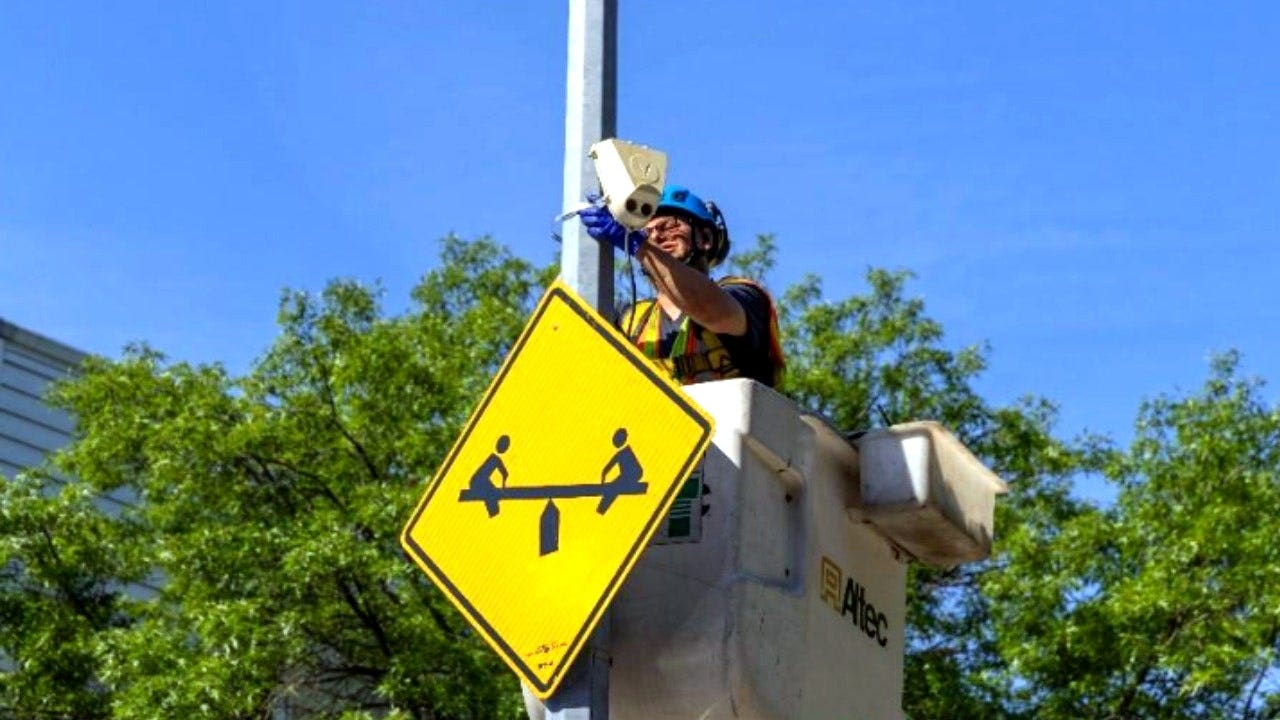
New York City is rolling out a network of smart street sensors designed to count people and vehicles, spot risky close calls and feed planners real-world data to redesign dangerous spots—but the plan raises real privacy questions about what gets recorded, how long it stays and who sees it.
The city plans to expand from a 20-intersection pilot to roughly 100 locations, mounting devices on poles and signs to watch how streets are actually used. These sensors use computer vision to label what they see—pedestrians, cyclists, cars, scooters—and the promise is continuous, automated measurement rather than a few hours of manual counting. That shift could change how officials spot trouble and set priorities.
The advantage over old-school traffic studies is obvious: no more short snapshots based on one day or one observer. Weather, school schedules or nearby construction can skew a single count, but a steady sensor provides patterns across weeks or months. That lets planners find recurring problems instead of reacting after a crash happens.
Sensors can do more than tally bodies and wheels. They measure speeds, capture turning movements and map the flow through intersections, revealing behaviors that planning maps rarely show. Maybe pedestrians cut mid-block every morning because the official crosswalk is inconvenient, or cyclists swerve around parked delivery trucks, or buses slow where curb space gets clogged. Those details point to targeted fixes.
One of the most useful outputs is near-miss detection—dangerous close calls that never make it into crash reports. Think of a car door swinging into a bike lane or a driver turning while someone is crossing. Those moments expose patterns of risk, and repeated close calls at the same spot give planners a stronger reason to act before someone is hurt.
AI DASHCAMS ENHANCE TRUCKER SAFETY WHILE RAISING PRIVACY CONCERNS
Privacy is the sticking point. The city says video is processed in real time and discarded, keeping only anonymous counts and deliberately obscuring faces and plates. In theory, the system records movement trends, not personal identities, but promises alone won’t erase skepticism. People reasonably want to know exactly what is kept, for how long and who can access it.
Transparency matters as much as the tech. If taxpayers fund sensors, the public should be able to inspect the findings and see whether the devices deliver safer crossings, better bike lanes or faster buses. Publishing clear, easy-to-find reports and open datasets builds trust and helps people judge whether the sensors are improving life on the street.
WASHINGTON COURT SAYS FLOCK CAMERA IMAGES ARE PUBLIC RECORDS
The rollout in New York will be watched by other cities deciding whether to follow. If this approach helps planners act faster and reduce danger near schools, intersections and transit corridors, similar sensors will likely appear elsewhere. But widespread adoption should wait for solid rules on collection limits, deletion policies and public review processes.
Good policy means more than technical assurances. Rules should spell out what the sensors collect, what gets deleted, who reviews raw data and how the public can access summaries or dashboards. Without that framework, even helpful technology can feel like another layer of surveillance, and skepticism will slow any real benefits.
For everyday people who walk, bike or ride transit, the sensors promise concrete changes: better crosswalk placement, protected bike lanes backed by evidence, altered signal timing and redesigned curb use where delivery trucks cause hazards. But those wins depend on planners using the data transparently and on clear limits that keep personal details out of the system.
Would smart street sensors make you feel safer, or make public streets feel a little too watched? Let us know by writing to us at Cyberguy.com
