
Wind turbine blades do not have to end up as industrial waste once they are retired. Instead of being buried in landfills, these giant fiberglass parts are showing up in construction, public spaces, and even art, where their size and toughness actually become the point. The result is a surprisingly practical second act for equipment that was once only seen as part of the power grid.
Recycling them is possible, but it is not exactly simple or cheap, which is why creative reuse has become such a smart path. Companies have found ways to cut the blades into new materials, reshape them into building products, or leave enough of the original structure intact to serve a fresh purpose. That blend of reuse and reinvention has made decommissioned blades useful in places people walk, play, and gather every day.
One of the most useful applications is in construction, where blade material has been turned into lightweight concrete blocks and barriers. These pieces are easier to move than standard concrete, which makes them appealing for projects that need strength without the bulk. In Iowa, for example, Mercy College of Health Sciences used these composite barriers during campus work, showing that old turbine parts can still pull their weight in a modern buildout.
Builders have also treated blade sections like structural accents rather than scrap. In Lund, Sweden, a parking garage used decommissioned blades as curtain walls, the outer shell that helps define a building without carrying the full load. That project paired the recycled blades with solar panels and pollinator-friendly landscaping, making the whole site feel less like a parking structure and more like a deliberate sustainability statement.
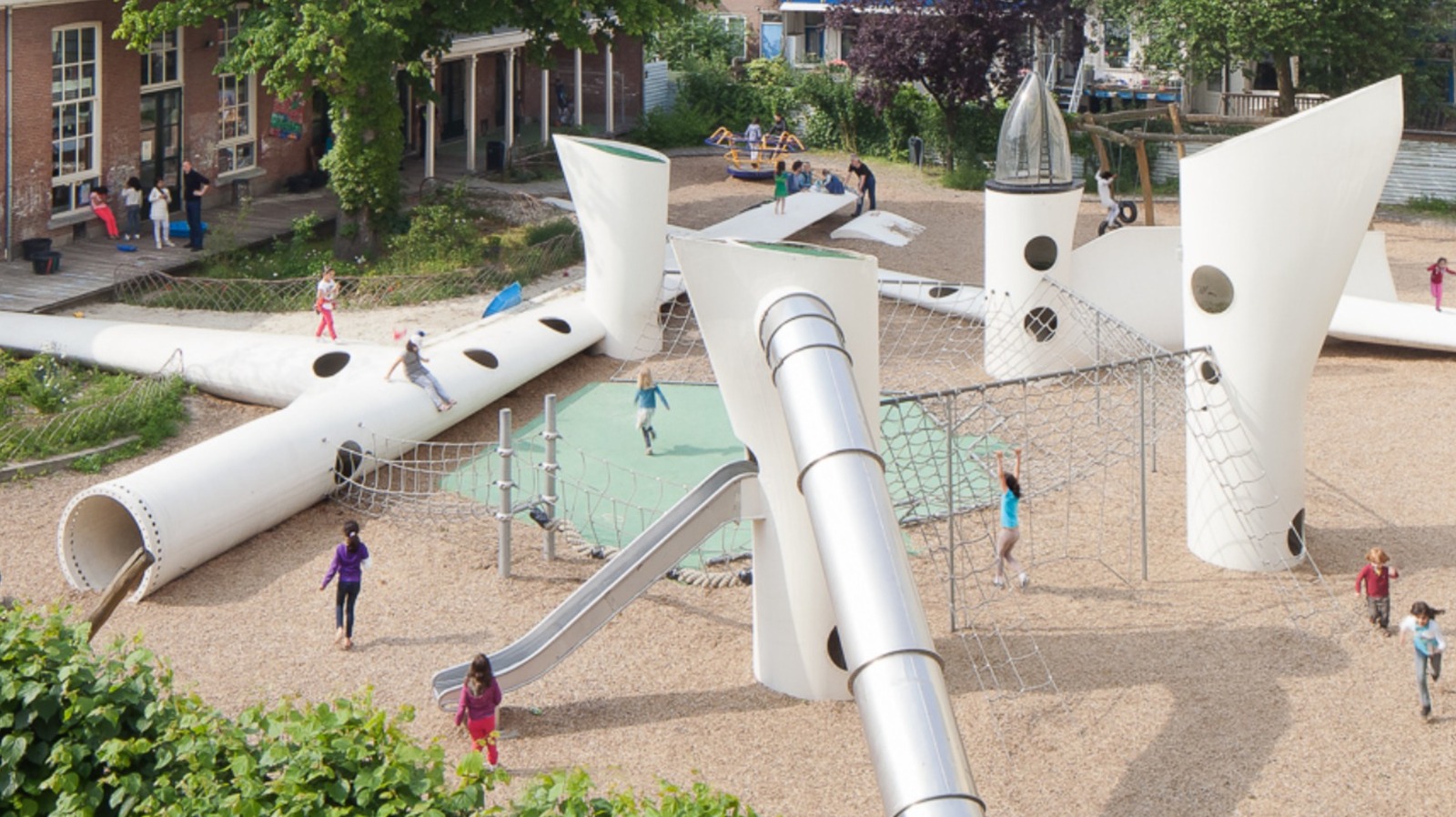
Some of the most eye-catching reuse happens when the blades are turned into playgrounds. Their long curved forms can become tunnels, forts, and climbing spaces, which gives kids a place to explore while also showing what reuse can look like in real life. Superuse Studios has pushed that idea far enough to turn 27 blades into playgrounds and other installations across the Netherlands, with a big drop in carbon emissions compared with building new from scratch.
Footbridges are another place where the blades fit in better than anyone might expect. In Cork, Ireland, the Midleton to Youghal Greenway Bridge uses two LM13 blades as supports instead of traditional steel girders, and the bridge has remained open to the public with ongoing monitoring. A second BladeBridge project in Northern Ireland followed with a similar idea, proving that these long, durable parts can do more than sit in storage while engineers debate what to do next.
There is also room for the blades to become everyday amenities, not just major structures. Chopped sections have been turned into public planters, including at DTE’s Warren Service Center in Detroit, where a little cutting and shaping created a durable container with drainage and a false bottom. BladeBridge has taken the concept further with bench-planter hybrids, mixing seating and greenery in a way that makes public spaces feel a lot more inviting.
Then there is the art side, where the scale of the blade becomes part of the message. Wyoming artist Chris Navarro used cut-up pieces to build a snow wall sculpture aimed at hope and renewal, while Nayan Kulkarni’s huge “Blade” installation in Hull, England, placed a 246-foot turbine blade right in the middle of the city. The machinery required to set that piece in place was intense, but that is exactly what made it unforgettable, because once these blades leave the wind farm, they can still dominate a landscape in all the right ways.
