

–>
Trump touts economic benefits of data center contracts
President Donald Trump details how data centers are transforming local economies while speaking at the Environmental Protection Agency’s headquarters.
Imagine if during World War II, protesters had gathered outside factories making tanks and planes, and tried to shut them down. Or that just before Pearl Harbor, when American industry was “hyperscaling” its defense infrastructure in order to make the country ready for war, cities and counties had placed restrictions on new plant and shipyard openings and tried to dictate what could be produced where — as long as it wasn’t near them.
Any commonsense observer in 1940-1941 would know the only beneficiaries of these obstructionist tactics were our nation’s enemies.
That was one kind of war. Today we face another kind, an artificial intelligence (AI) war with China. The aims of both combatants, in looking to dominate the technology that will rule the future, couldn’t be more different. While U.S. companies and the Trump administration see AI as a tool to make the world more prosperous and individuals freer and more autonomous, China’s goal in the AI sector is developing the tools to further enslave their own population while shaping a global hegemony “with Chinese characteristics,” i.e. total control by Beijing.
BLANCHE URGED TO INVESTIGATE ALLEGED FOREIGN INFLUENCE IN FIGHT AGAINST DATA CENTERS
China and the U.S. are the only two countries poised to dominate the future of AI. Between them, they control 90% of AI compute capacity; yet America’s share comes to 75% compared to just 15% for China. It’s true China has focused on key applications in industrial use of AI, and also in treating AI as a decisive military and strategic asset. But the U.S. is still dominant in generative AI and AI innovation, and is moving fast to make up ground in the industrial and military spheres.
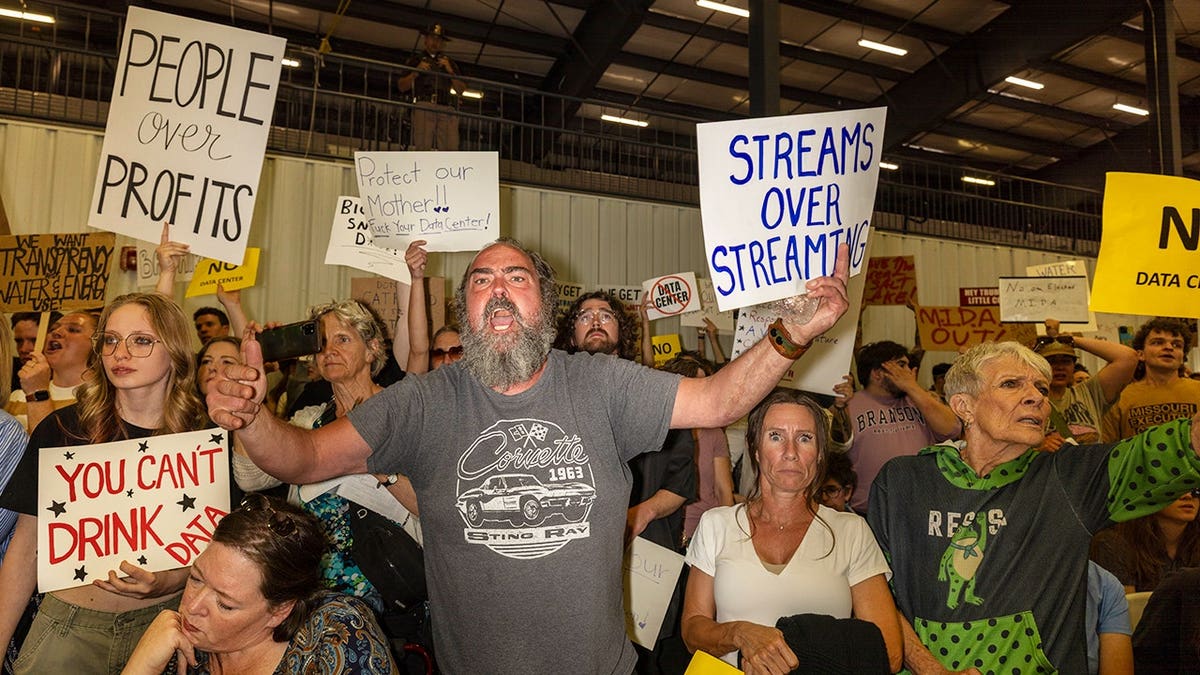
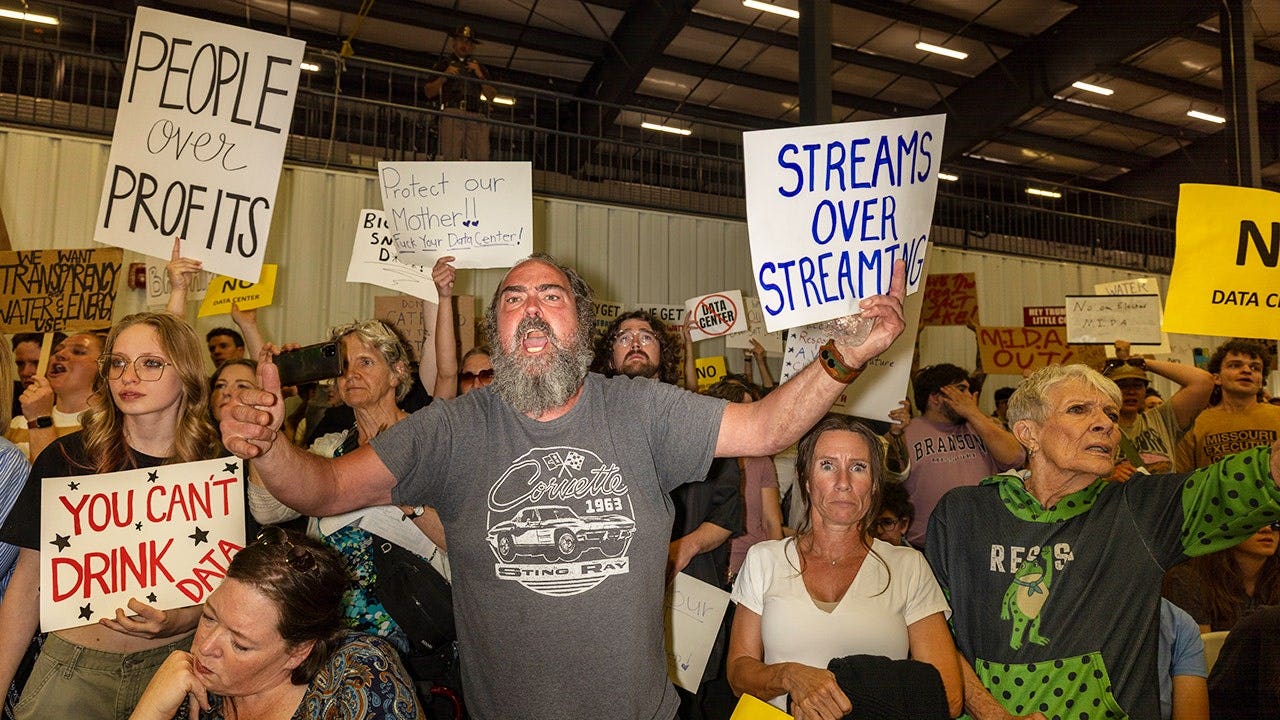
Protesters react as the Box Elder County Commission approves a large AI data center project in Tremonton, Utah, on May 4, 2026. Activists opposed the proposed 40,000-acre development over concerns about water use, energy demand and environmental impact. (Natalie Behring/Getty Images)
But not if the power needed to drive and expand our advantage economically and strategically, isn’t there.
How big is the data center ban movement? Some 78 local jurisdictions across the country have set up temporary moratoriums or bans on new data centers. While New York is the only state to actually impose a new construction moratorium, 14 other states are considering similar measures, including red states like Florida, Oklahoma, and Georgia.
MARXIST ORGANIZER LEADS CAMPAIGN AGAINST VIRGINIA AI DATA CENTER AS FOREIGN INFLUENCE CONCERNS MOUNT
If this movement grows and gets the backing of a major political party like the Democrats, and temporary bans become permanent, the only clear winner will be China, just as banning building defense plants in World War II would have benefited Nazi Germany and imperial Japan.
It’s not just the future of our economy that’s at stake: in Georgia’s case alone, some 552,000 jobs and $850 million in tax revenue if a ban goes into effect. It’s also our national security. I’d argue, even freedom itself.
Yet the ban movement itself is built on myths and lies.
- Far from raising electricity costs as data center opponents claim, creating new data centers will actually lower them by spreading costs over a larger volume of sales.
- Far from using too much drinking water, many data centers use no water 96% of the time, while others don’t use water at all. As for those that do, golf courses consume significantly more water than data centers: more than 500 billion gallons a year nationally compared to data centers at 230 billion gallons.
- Far from wrecking the local economy, data center construction spawns tens of thousands of jobs. A new study by the liberal Brookings Institution found that when a new data center arrives in a community, construction employment jumps 11%, and information sector employment — IT services, telecommunications, software — grows by 22%. Wages also rise by 3%-4% for both existing workers and new hires.
If this movement grows and gets the backing of a major political party like the Democrats, and temporary bans become permanent, the only clear winner will be China, just as banning building defense plants in World War II would have benefited Nazi Germany and imperial Japan.
Likewise, far from being a drain on the public fisc, tax revenues soar with the additional economic growth an AI-supporting data center helps to create.
Nor are the benefits just for billionaires and Big Tech. As a key driver of economic growth and productivity, AI will enable a host of startups and small businesses to compete in the marketplace, including the new recruits to a resurgent U.S. manufacturing sector.
By nearly every estimate, the onset of AI and its supporting data centers will add trillions of dollars to the U.S. economy — as much as an additional 1.5%-3.7% of GDP growth annually.
Those are the economic benefits. But AI, and the data centers that will enable its uses to grow and intensify, are also essential for our national security.
One side is AI’s obvious military uses, such as “killer drones” and other battlefield applications, as the war in Ukraine is demonstrating. But AI is also a powerful tool for detecting cyber threats, analyzing vast amounts of intelligence data and organizing the logistics for military readiness, not to mention making manufacturing in our defense industrial base more efficient and streamlined, and ready to take on China’s head-on.
Either way, the decisions we make now about the future of data centers will have a decisive impact on the future of freedom. It’s crucial that Americans choose the right path, one that truly benefits us and future generations; not the bureaucrats of the Chinese Communist Party.
–> <!–>


