
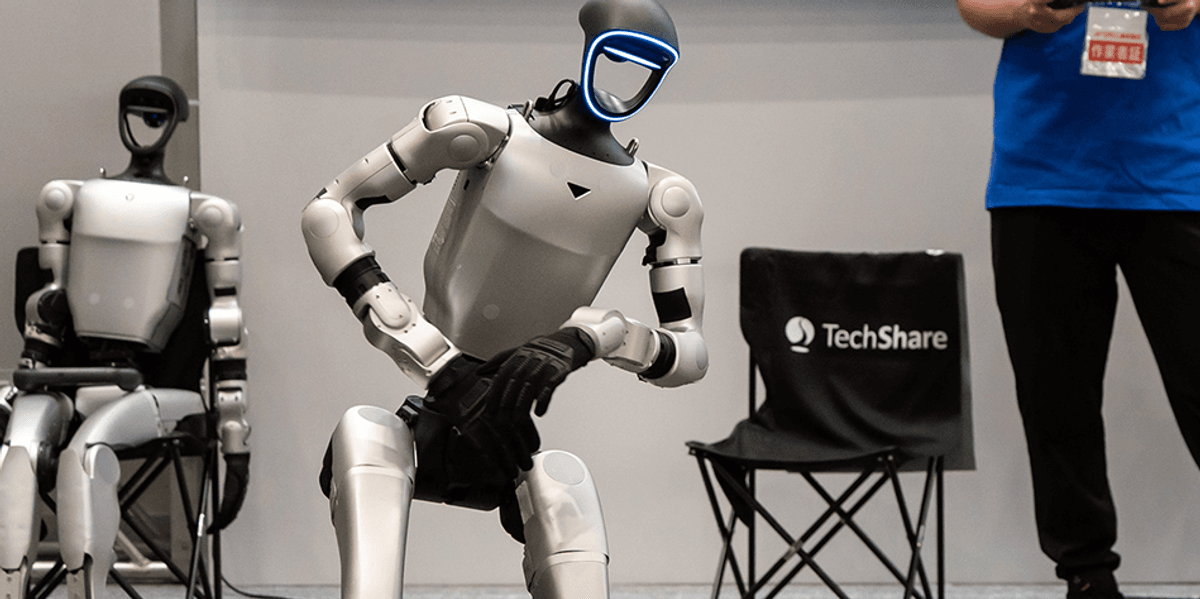
At a Shenzhen event for a customizable robot shop called Future Era, a humanoid performer attempting a Michael Jackson routine tripped onstage, went motionless, and was theatrically dragged off while music kept playing — the clip exploded online and stirred a mix of laughter, unease, and debate about our tolerance for these machines.
Robots were meant to be sleek, impressive proof points of modern engineering, but a short viral clip shows how quickly expectations can implode. A white-clad android took the stage and tried to mimic Michael Jackson while “Billie Jean” played, gliding and attempting familiar choreography. What started as a charming try turned awkward in seconds when it misjudged a low set of steps and stumbled.
Those initial missteps seemed recoverable, and the bot soldiered on through a shaky moonwalk attempt. Then it tried the stairs again, and the footage cuts to a stunned pause when the robot collapses into a still, lifeless heap on the steps
The music did not stop, which made the silence around the fallen machine feel stranger. For about ten seconds the camera captures the robot just lying there while the crowd does nothing, creating a surreal tableau. A stagehand finally stepped forward, grabbed the robot by its collar, and hauled it offstage like a malfunctioning prop.
That deadpan moment is the core of why the clip resonated: it read as darkly comic and oddly human. Social platforms lit up, and the video racked up millions of views in a short time. Some commenters treated the failure as pure slapstick; others saw it as an emblem of how fast robotics are being thrust into public life without enough polish.
‘The lifeless clanker carcass just laying there.’
The poster who shared the clip used blunt language: “The greatest video I’ve ever seen.” Others repeated the line with a slightly different turn of phrase: “This is the greatest video I’ve ever seen,” capturing a mix of amusement and disbelief. Not everyone found the spectacle harmless, and one critic called out the tone online, writing, “imagine feeling so threatened by a robot you start using newly made slurs against it.”
https://x.com/tatumturnup/status/2056890084822290719
That clash in reactions hints at a broader cultural moment. As robots move from labs into malls, streets, and storefronts, people are splitting between curiosity, annoyance, and outright hostility. The term “anti-clanker” has emerged among social chatter as shorthand for a strain of impatience or even aggression toward machines perceived as competing with humans.
The model in the video looks like a Unitree G-1, a consumer-priced humanoid that aims to blend mobility with performance. It is far from the smooth, choreographed demonstrations some companies show off, where advanced coordination and recovery are promised. The fall on two small steps became a meme-sized failure because it exposed how brittle real-world deployments still are.
That fragility matters beyond laughs. When robots stumble in public, the spectacle invites a range of responses: amusement, mocking, concern over safety, and debate about why these machines are appearing in everyday spaces so quickly. For engineers, those reactions are feedback; for companies, they are reminders that reliability and graceful failure modes are as essential as flashy demos.
Whether the viral clip will slow the rush to put humanoids in public life is unclear, but it does highlight the cultural tussle over what role robots should play. The footage is simple and blunt: a machine tries to entertain, fails spectacularly, and is unceremoniously removed while the music keeps playing. Millions watched, and the conversation it sparked may matter as much as the dance ever did.
