
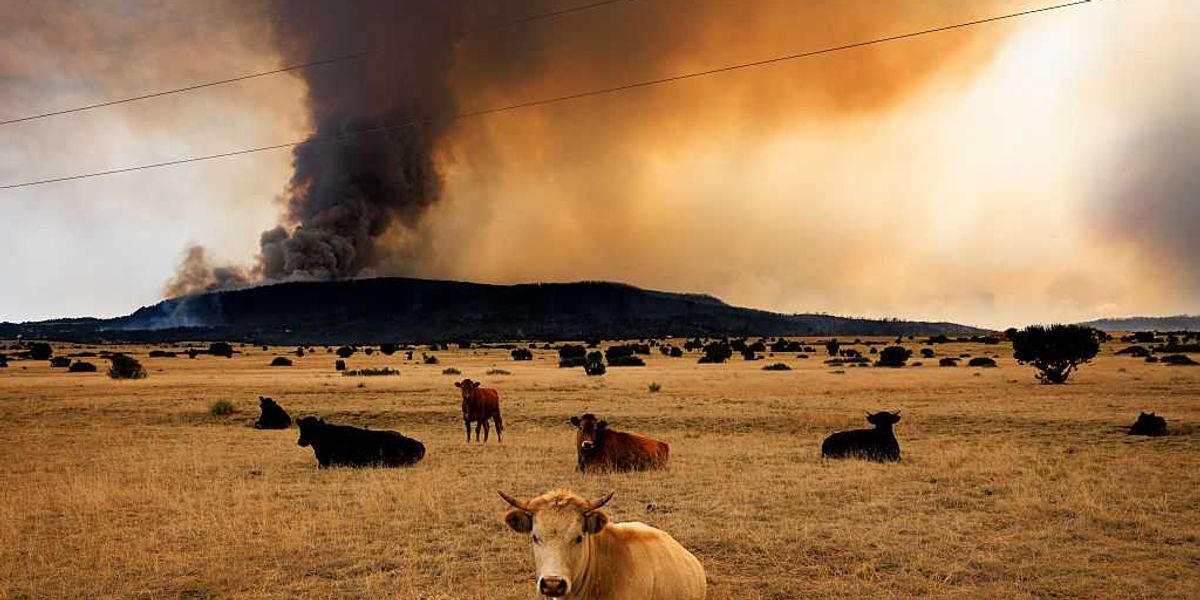
Checklist: climate science and wildfire claims, cows and ranchers, global warming and environmentalism, Canada’s role in the argument, and the real-world gap between slogans and what people actually live with.
The climate conversation has a way of turning every problem into a sermon, and that’s where the whole thing starts to wear thin. One minute it’s wildfire smoke, the next it’s a sweeping claim about cows, ranchers, and the fate of the planet. Meanwhile, the people actually living on the land are left dealing with heat, drought, fire risk, and the daily grind of keeping things moving.
That’s the part the loudest voices always seem to miss. Ranchers are not sitting around dreaming up ways to wreck the environment, and farmers are not out there for fun trying to make the world dirtier. They are working with weather, soil, animals, and market pressure, which means they already know plenty about reality without needing a lecture from somebody in a conference room.
When wildfire smoke fills the sky, it is easy for activists to toss out simple answers and point fingers in every direction. But real wildfire seasons are messy, and the causes are usually a mix of dry conditions, bad land management, lightning, human mistakes, and long stretches of neglect. Reducing all of that into a one-note story about climate politics does not make anyone smarter, and it definitely does not make the fires go away.
Then there is the cow blame game, which has become its own kind of climate theater. Livestock get treated like cartoon villains, as if the entire problem of global warming can be pinned on a handful of barns and pastures. That kind of thinking might sound dramatic on social media, but it falls apart fast when you look at the bigger picture of how food is produced and how rural communities actually survive.
Canada gets pulled into this conversation too, often as a stand-in for whatever point the environmental crowd wants to make that day. But Canada is not some abstract science project, and neither are its ranchers, forests, or small towns. People there live with smoke, weather swings, and all the same pressures that shape life across North America, which is exactly why simplistic blame never lands right.
The bigger issue is how environmentalism often turns into a moral performance instead of a practical effort. It is one thing to care about clean air, healthy land, and responsible stewardship. It is something else entirely to use those concerns as a cudgel against the very people who feed families, manage open space, and keep rural economies from sliding off a cliff.
There is also a strange habit in this debate of treating ordinary people like they are the obstacle. The person raising cattle, hauling equipment, or trying to make it through a brutal fire season is not the villain in some grand climate drama. He or she is usually the one absorbing the costs while someone else gets the microphone and a round of applause.
That disconnect is why so many folks roll their eyes when the climate crowd starts talking like they have discovered a hidden truth. The truth is usually sitting right there in plain sight: land needs care, fire prevention matters, weather is complicated, and food does not appear by magic. If you want better outcomes, you need more honesty and less hand-waving.
Ranchers have never been strangers to conservation, even if activists pretend otherwise. Good land management, smart grazing, and practical wildfire prevention are not fashionable talking points, but they are real. The people closest to the problem often understand it better than the people shouting from the outside, and that ought to count for something.
So when the next round of climate outrage comes rolling in, it might help to remember who is actually carrying the load. The land, the cattle, the smoke, the weather, and the people trying to make sense of it all are not props in a polished political story. They are the story, and they keep showing up long after the slogans fade.

3 Comments
I tell all the Climate Alarmist Rabble-rouse Minions to shut the hell up you jackasses because if you want to find fault and scream at something scream at the Sun! The Electromagnetic Solar Radiation is the absolutely predominate climate actuator that’s been proven with detailed scientific studies of Polar Core Ice Data from over the millions of years that directly influences and overwhelming controls our Earth Weather and Atmospheric Condition! Man-made effects from the entire human race and combined with all animal plant life is negligible in comparison to the Direct Emission Effects by the Sun! That equates to 3.83×10^26 joules of energy every second being produced by the Sun’s fusion process! This energy produced primarily reaches Earth in three wide bands of electromagnetic spectra—short wavelength (X-rays, ultraviolet), medium wavelength (visible light), and long wavelength (infrared). Over the millennia Earth has had a wide variety of climate changes from subtropic patterns to ice ages that no human beings can control or regulate at all!
These people who scream bloody murder and are political activists or pawns for the elitists not experts of anything, so they should shut the hell up and stay home! And Bill Gates is one of those Psychopathic Elites!
The environmental wackos blame every disaster on climate change. When most if not all wild fires are caused by poor land mangement, stupid government regulations and Mother Nature. Is there climate change yes, is it cause by humans ,NO. The E-wackos are just a bunch of big government socialists who seek power control and couldn’t care less about the planet.
Exactly! Greta Thunberg the how dare you girl was just a hand puppet of the WEF and Globalist Cabal and those powers that be who think we citizen plebs are all of bunch of human lemmings they can indoctrinate and totally control!