
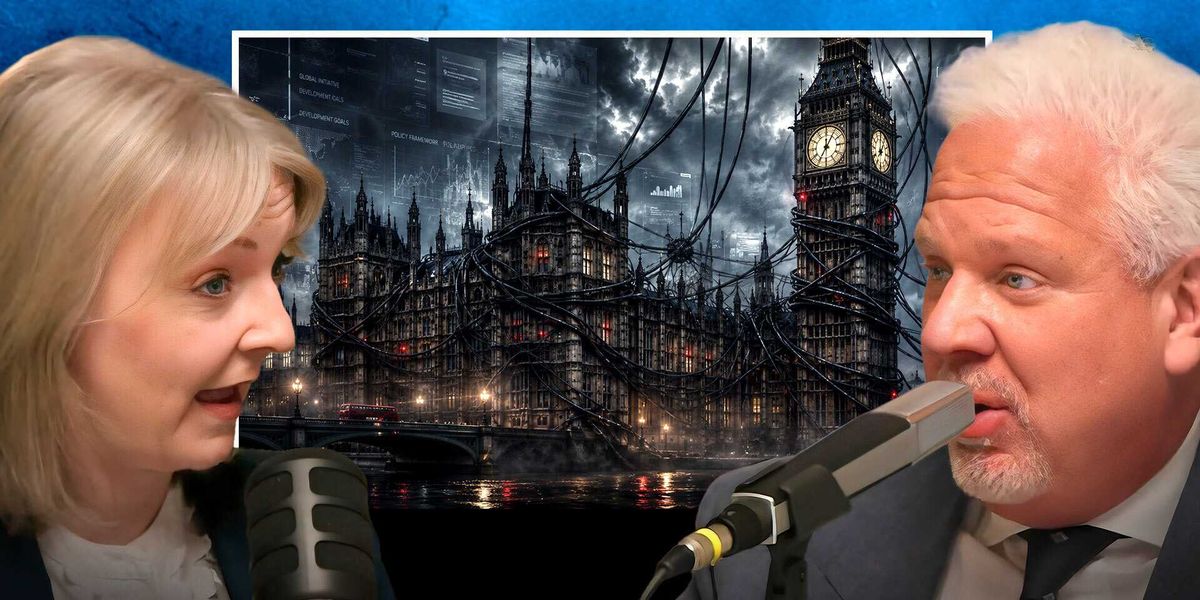
Liz Truss warns that Britain has slid into a bleak place under Labour, arguing the country faces a fresh debt crisis, uncontrolled immigration, and a politicized bureaucracy that Thatcher would barely recognize. She tells Glenn Beck that reversing this requires more than a single leader: it needs a movement and a tough, anti-system figure willing to take on the elites. The conversation pulls no punches about institutions, ideology, and what it will take to push Britain back toward free markets and common-sense governance.
Conservatives have started calling the United Kingdom a “prison island,” a shorthand for what they see as a loss of liberty, an open-border mindset, and economic drift. The critique is blunt: free speech is under pressure, migration feels unmanaged, and policy choices seem to favor ideology over practical results. That combination, Truss argues, makes the nation feel smaller and more controlled.
Former prime minister Liz Truss told Glenn Beck that Margaret Thatcher “would be ‘horrified’ by what the U.K. has become.” The point lands as a stark contrast between the decisive market reforms of the past and what Truss sees as timid, centralized decision-making today. It’s a rallying cry for anyone who still measures government by how much it respects individual freedom and national sovereignty.
Truss paints a dire fiscal picture: “We are now on the verge of a debt crisis. If you remember, she was brought in to solve the debt crisis in the ’70s, and we’re now back to where we were in 1979 when she got into office,” says Truss. That’s not a throwaway line; it’s a comparison meant to wake people up to the scale of the problem. For voters who remember the economic pain of uncontrolled borrowing, it’s a stark warning.
She doesn’t stop at numbers. “But she’d also be horrified by what’s happened on immigration, by the way that we have given all these powers on human rights to these unelected international bodies,” she adds, pointing to what she sees as a surrender of control over borders and legal standards. To Truss, handing away authority to faceless institutions is part of the same drift that has hollowed out public accountability. Conservatives hear that as an explanation for why so many decisions now feel distant and defensive.
When Glenn asks, “We got Trump. … Who is on the horizon that you see … in Europe who has the skill to be able to stand the heat?” he presses the practical question: who can actually win and then dismantle the entrenched structures? Truss admits the political conditions are different and tougher than in Thatcher’s day. The bar for success is higher now because the challenge isn’t just elected opponents; it’s systems and institutions that resist change.
She names potential stars but is cautious: “In Britain, there’s obviously Kemi Badenoch, there’s Nigel Farage. Are they tough enough to take on what is an even deeper state than Mrs. Thatcher faced?” she asks, noting that Thatcher “did not face the unaccountable Bank of England” or the “fake Supreme Court” created by former PM Tony Blair. That line directly frames today’s institutions as new obstacles, not merely a continuation of old ones.
Truss doubles down on how different the bureaucratic culture has become. “They didn’t face all this. So it’s even worse now,” says Truss, “and the bureaucrats have become radicalized. They’re transgender activists, they’re environmental activists. So dealing with that is huge.” Those words target the activist tilt inside parts of the public sector and the cultural battles that now shape policy choices.
Her prescription mixes leadership and grassroots energy: the country needs an “anti-system leader” like Donald Trump to recapture the nation from “the elites who’ve been running [it] into the ground.” But she adds a caution that echoes through the interview: “You also need a movement of people,” says Truss, insisting that leaders without public momentum will be bottled up. “As soon as Labour got in, it’s like ‘let’s just close the door on all that. We’ve got the money now, we can go back to being socialist. In fact, we can introduce more and more progressive ideology into our state,’ and that’s what’s happened,” she explains.
That diagnosis is a call to action wrapped in sharp political judgment: change requires both a disruptive personality and an organized constituency willing to contest power at every level. If you want to dig deeper into Truss’s argument and hear the full exchange, watch the clip above.
