
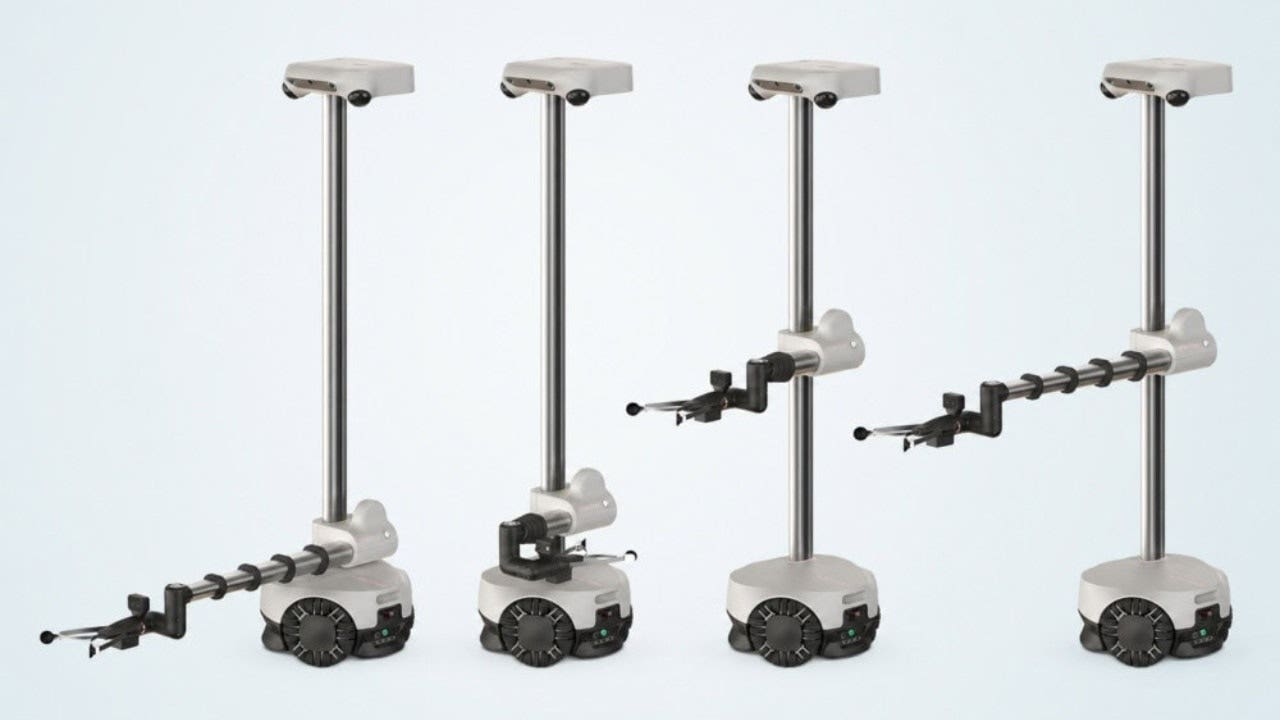
Stretch 4 is a compact wheeled assistant built to do the everyday stuff humanoid robots struggle with: move safely through cluttered homes, reach for objects, and give people with mobility challenges more independence. It trades flashy bipedal theatrics for a practical rolling base, a reach-capable arm, richer sensors, and safety features designed for real living spaces. Researchers and care organizations are the first customers, which makes sense given the price and current certifications. This piece walks through the design choices, the use cases, and why a simple idea might make a big difference.
Hello Robot rejects the race to mimic people and instead focuses on usefulness. Homes are full of rugs, cords, pets, and tight corners; legs add complexity and fall risk in that environment. A rolling robot sidesteps balance problems and concentrates engineering on perception, manipulation, and safe navigation. That pragmatic pivot is what Stretch 4 delivers.
HOME ROBOT AUTOMATES HOUSEHOLD CHORES LIKE ROSIE FROM ‘THE JETSONS’
The robot’s physical layout is straightforward: a slim wheeled base, a lifting column, and an articulated arm with a wrist camera. That setup lets Stretch 4 slide under tables, approach a shelf, and lift or hand over objects without needing to imitate human gait. Simplicity here equals reliability, and reliability matters most when a machine operates around people and medical gear. The company emphasizes mapping, navigation, and grasping demos that actually work in lived-in rooms.
Wheels also enable practical accessibility benefits. Homes adapted for wheelchairs already have thresholds, ramps, and layouts compatible with rolling platforms. If a person relies on wheeled mobility, a robot that rolls integrates with that environment more naturally than an upright biped. The question becomes less about which robot looks more human and more about which one helps more effectively.
HUMANOID ROBOTS ARE GETTING SMALLER, SAFER AND CLOSER
Where humanoids get attention for looking familiar, they pay for it with complex control systems and higher safety demands. Stretch 4 avoids those trade-offs with fewer moving parts and a design that borrows tech from powered wheelchairs. That omnidirectional base lets the machine move sideways and pivot without awkward repositioning, which is a real advantage in narrow corridors and crowded rooms.
WHEELED WONDER ROBOT DOG SHOWS OFF CRAZY DANCE MOVES IN ALL KINDS OF TOUGH TERRAIN
Omnidirectional wheels are a standout upgrade in this version. They improve maneuverability in tight spaces and reduce the need for dramatic turns that could spook people or pets. The company developed the base to emphasize controlled, smooth motion rather than dramatic moves for camera-friendly demos. That choice supports safer positioning when reaching across beds, sofas, or around medical equipment.
Sensors are another place Stretch 4 steps up. The robot uses lidar, wider-field cameras, and a wrist-mounted depth sensor to get richer spatial information than a cheap camera-only rig. That extra data helps it spot cords, uneven rugs, and small obstacles, and guides delicate grasping. In a home, where conditions change by the minute, seeing clearly is essential to avoid mishaps.
THE NEW ROBOT THAT COULD MAKE CHORES A THING OF THE PAST
Autonomy exists on a spectrum, and Hello Robot keeps humans in the loop. Stretch 4 supports supervised control as well as semi-autonomous actions, which is a realistic compromise for early home deployments. Caregivers and users can intervene or guide tasks while the system handles repetitive motions. This reduces the trust barrier that fully autonomous machines still face.
The initial customer set reflects that reality. Stretch 4 is sold for research and enterprise use and is aimed at labs, care organizations, and pilot programs rather than average households. The price and current certifications limit broad consumer adoption for now, but pilot testing in real homes will drive the next design and safety improvements. Those early trials are where engineers learn how a robot behaves around pets, clutter, and real human routines.
BERKELEY LAUNCHES A LIGHTWEIGHT OPEN-SOURCE HUMANOID ROBOT
Stretch 4’s strongest near-term impact may be for people with severe mobility impairments. Tasks like picking up a dropped phone or moving a cup can directly change daily independence. A stable, wheeled robot that reliably handles those chores can be more valuable than a humanoid that looks human but struggles to operate safely in messy real-world settings. Practical help beats flashy demonstrations when the goal is meaningful assistance.
Safety features such as force limiting, collision avoidance, tilt avoidance, and a dedicated run-stop control reflect the environment it’s meant for. Those measures, combined with richer sensing and an omnidirectional base, make a conservative but sensible pitch: a robot that helps without becoming another hazard. If Stretch 4 proves itself in real homes, the industry may start to rethink how much humanoid form really matters versus how well a machine can do the tasks people actually need done.
