
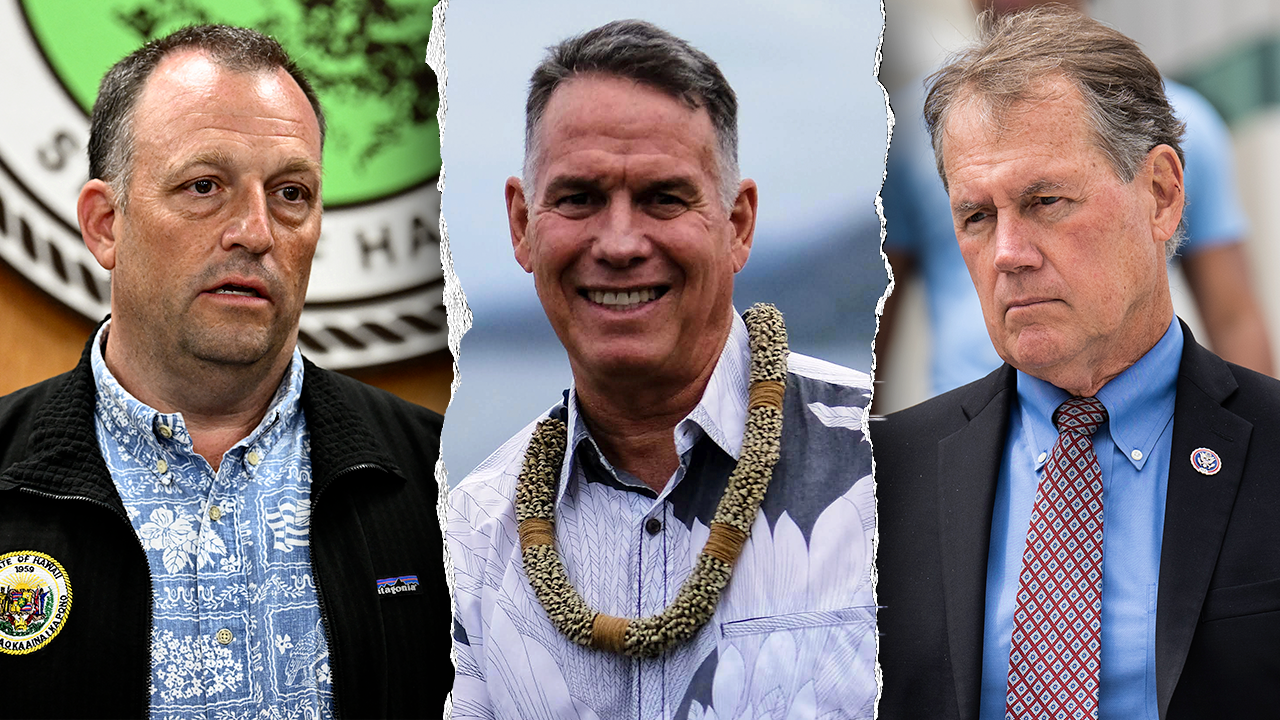
Hawaii’s primary is bringing two big races into sharp focus: a governor’s contest where Josh Green is expected to cruise, and a congressional fight that has turned into a test of how far the state’s Democratic base is willing to go. Republicans are also trying to break a long losing streak in the governor’s office, while progressives are aiming at one of the state’s most established Democrats.
Voters head to the polls Saturday to sort out who moves on to November in the race for governor and in the battle for Hawaii’s 1st Congressional District. Green, first elected in 2022, is sitting comfortably in the Democratic primary against three opponents who have little name recognition and even less cash on hand.
One of those challengers, George “Teva” Lucas-Tadeo, has been putting out sharply left-wing ideas online, including a government-run grocery store and legal marijuana. David “Duke” Bourgoin is back for another shot after getting crushed in 2022, when he pulled in just 590 votes compared with Green’s massive total.
Lauren Kapoliahiʻiaka Shim is also in the Democratic mix. She runs Aloha AI Incorporated, but like the others, she has not built the kind of campaign infrastructure that usually signals a real threat to an incumbent governor.
The money gap tells the story fast. Green has raised about $3.5 million, while none of his challengers had brought in any funds as of June 30, according to local campaign finance reporting. That leaves Green in a position that looks more like a formality than a fight, even with a few names on the ballot.
The Republican side, though, has something real at stake. Gary Cordery, who owns a contracting company called Kingdom Builders, and entrepreneur-investor Ken Fujiyama are vying for the chance to take on Green and try to end nearly two decades of Democratic control of the governor’s mansion.
That is a tall order in a state where the last Republican governor was Linda Lingle, who served from 2002 to 2010. Still, Republicans have plenty of material to work with, especially on the issues that hit families every day: housing costs, taxes and the growing sense that the state is getting harder to live in.
Cordery has leaned hard into those pain points. He has pitched 15,000 new homes for working families, wants state land used for housing and says the general excise tax on food and medicine should go away, a move that would put real relief in people’s pockets.
Fujiyama is pushing a broader housing plan of his own, centered on developing 100,000 residential lots and working with major landowners to get more property into the pipeline. Both Republicans are trying to make the case that the island economy needs less bureaucracy and more common sense.
Green enters the general election side of the race with a strong approval rating and a political environment that still favors Democrats. He is also getting a boost from the state’s usual partisan lean, which makes any Republican comeback attempt difficult, even when frustration over affordability is running high.
But the other race on the ballot has drawn outside attention for a different reason. In the 1st Congressional District, state Sen. Jarrett Keohokalole is challenging Rep. Ed Case, a veteran Democrat who has held the seat since 2019 and is now seeking a seventh term.
Case is making the familiar argument that seniority matters, especially when Hawaii wants more influence in Washington. His pitch is that sitting on the Appropriations Committee gives the state leverage that a newcomer simply would not have on day one.
Keohokalole is going in the opposite direction, trying to tap into the energy of the party’s left flank. Backed by Sen. Bernie Sanders’ group Our Revolution, he is running on Medicare for All, opposition to ICE and resistance to President Donald Trump’s tariffs.
He is also trying to paint Case as out of step with Democratic voters, especially after the congressman voted with House Republicans to pass Trump’s SAVE America Act. That measure would require proof of citizenship to register to vote, and it has become a fresh flash point in a race where party loyalty is under the microscope.
Because the district is so heavily Democratic, the primary may matter more than the general election. Whoever wins the nomination will likely start November with a clear edge, and that makes Saturday’s turnout count for a lot more than a routine primary usually would.
Polls close at 7 p.m. local time, and both contests are set up to show very different sides of Hawaii politics. One is about whether the governor keeps walking into an easy path, while the other is about whether a longtime Democrat can hold off a challenger who wants to pull the party sharply left.
