
Autonomous race cars are moving beyond the test stage and onto some of the world’s most famous circuits, where they are starting to run faster, race harder and expose just how far the technology has come. The big twist is that the action is no longer limited to solo runs, because the cars are now battling each other in real competition, which raises a fresh question that has nothing to do with lap times: can fans care when there is no human driver in the cockpit?
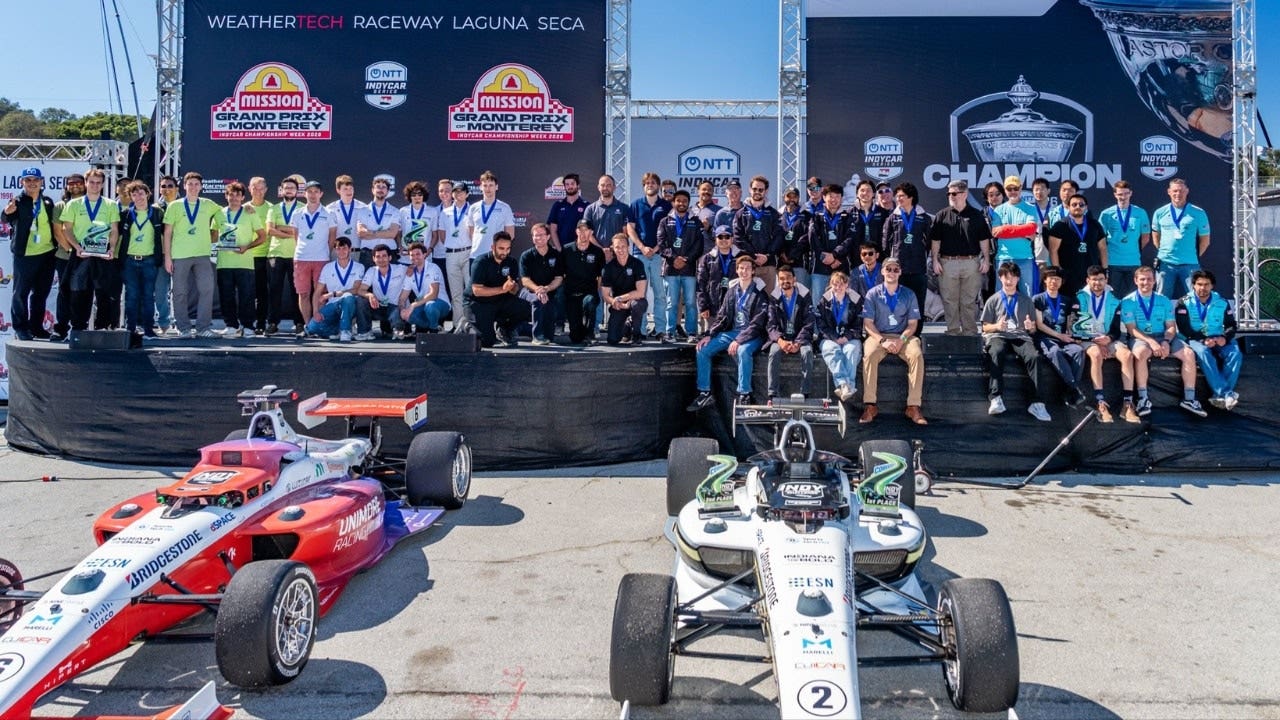
That question got a sharper edge when the Indy Autonomous Challenge showed up at WeatherTech Raceway Laguna Seca in California on Sept. 3. Purdue AI Racing set an autonomous track record and finished second in a head-to-head passing contest, while Italy’s Unimore Racing grabbed the win. Two days later, Europe got its own milestone when the Abu Dhabi Autonomous Racing League staged its first race outside Abu Dhabi at Italy’s Imola Circuit, where Team Kinetiz charged from fourth on the grid to win the 12-lap event.
What makes these races more than a tech demo is the way they are spreading across continents. Autonomous competition now has a footprint in the U.S., Europe and Abu Dhabi, and that gives the whole scene a more serious edge. The cars are no longer just proving they can move, they are proving they can travel, adapt and compete in different racing environments.
The Laguna Seca event also pushed the format forward by bringing passing to a road course for the first time in the Indy Autonomous Challenge. Instead of a simple pack race, two autonomous cars took on attacking and defending roles, forcing the software to judge spacing, timing and risk at speed. That is where things get interesting, because racing is not just about going fast, it is about making split-second decisions before another car makes them for you.
Imola turned up the pressure again. Five teams, including Kinetiz, Constructor Racing, PoliMOVE, Unimore Racing and two-time A2RL champion TUM, lined up with identical EAV-25 race car hardware based on the Dallara Super Formula SF23 platform. With the hardware equalized, the real fight shifted to the software, where each team’s code had to locate the car, read the scene around it and decide what to do next without a driver stepping in.
That is a lot to ask, and the race showed how fragile it can be. TUM ran into trouble on the formation lap and headed back to the pits, while Unimore, which had started from pole, looked strong before a mechanical problem slowed the car dramatically. PoliMOVE then struck the slowing machine from behind, ending both races in a crash that opened the door for Kinetiz to take control and win by 10.963 seconds over Constructor Racing.
The wreck was messy, but it also said plenty about the state of autonomous racing. A car can look sharp when the track is clear and the plan is simple, yet real racing becomes chaos the moment one vehicle loses speed or changes line unexpectedly. That is the kind of problem self-driving systems have to solve if they are ever going to operate safely in the real world, where surprises are the rule rather than the exception.
The speed is no joke, either. At Imola, PoliMOVE reached roughly 157 mph with no one behind the wheel, and testing showed the fastest autonomous lap coming within 0.85 seconds of a benchmark lap set by Super Formula driver Juju Noda. In Abu Dhabi last year, former Formula 1 driver Daniil Kvyat still had the edge, but the gap had already narrowed to 1.58 seconds, which says a lot about how quickly the machines are catching up.
Still, speed alone does not make a sport stick. Racing has always been about people as much as machines, and fans love having a driver to follow, argue about and root for through the highs and lows. Take the person out of the car and the emotional hook changes, leaving the teams, engineers and algorithms to carry the drama.
That could still work, at least for part of the audience. Tech fans may be drawn to the engineering battle, where every tenth of a second comes from smarter code, cleaner planning and sharper reaction time. Purdue’s run at Laguna Seca and the multi-car fight at Imola suggest autonomous racing is moving from a curiosity into something more competitive, and that means the spotlight is shifting from whether the cars can race to whether the audience wants to keep watching them do it.
There is also a bigger reason these events matter. Racetracks give researchers a brutal, controlled setting to push autonomous software to its limits, where simulation gets tested against real speed, real pressure and real mistakes. That does not mean a winning race car is ready to handle city streets, but it does mean the same basic problem is being stress-tested in a way that can sharpen the technology fast.
