
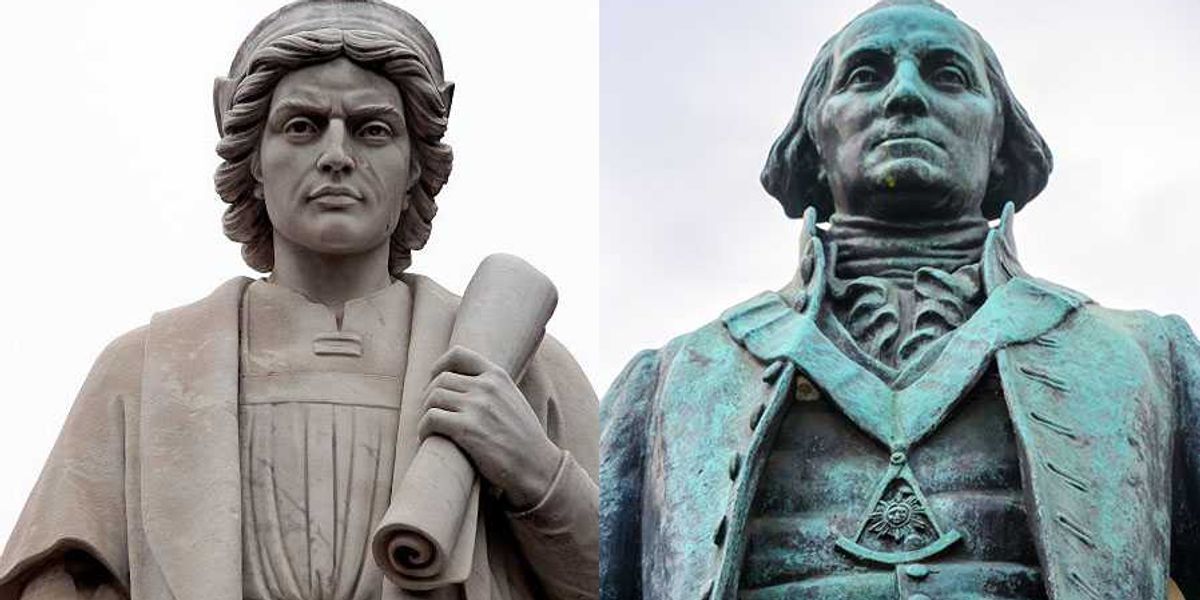
This piece looks at how recent iconoclasm tried to erase public memory, focusing on the toppled monuments to George Washington and Christopher Columbus, the stories those removals tell, and how communities and leaders responded to restore honor to those figures.
In recent years a motivated faction set out to scrub large swaths of American memory, targeting statues, names, and works of art. They tore down public memorials to force a new narrative, often without a public mandate. Their actions sparked a fierce debate about history, memory, and who gets to decide which figures deserve public honor.
Two figures became focal points of that conflict: George Washington, the general who led the colonies to independence, and Christopher Columbus, whose voyages opened the Atlantic world to European settlement. Both men were attacked in 2020, their likenesses dragged down in cities where their monuments once stood as civic touchstones. The uproar that followed revealed how connected many Americans remain to those founding stories.
‘Washington laid the groundwork for the steady march toward emancipation and liberty.’
The purpose of these statues is not to make a statement that these men are saints, but rather to honor their achievements and place in history. I want to briefly touch on Washington. Besides his leadership in the American Revolution and founding our country, Washington was remarkable in his commitment to republicanism. He refused an offer to be King, in the 18th century, in the age of absolute monarchs. This was the same time as Catherine the Great, Frederick the Great, and the height of the French ancien regime (before its demise during the French Revolution). He and the other founders created one of the first democratic bodies since the Roman Senate. True, our democracy was imperfect in the 1790s (and is today). But, Washington laid the groundwork for the steady march toward emancipation and liberty we have seen through 230 years of American history.
Pompeo Coppini, an Italian-born sculptor who made his life in America, created a bronze Washington that once stood in Portland. It was commissioned to mark a sesquicentennial moment and presented by civic leaders of the time. That statue was dragged down and defaced during a night of unrest, then hauled into storage instead of being immediately restored to its place.
The night it fell, vandals scrawled slogans on the toppled figure and left it broken on the pavement. City officials later said the statue would return to the public after relocation, repair, and fresh interpretive signage. For many residents the episode was proof that mobs, not deliberative communities, were deciding which elements of history were acceptable.
Christopher Columbus suffered a similar fate in Baltimore where a Carrara marble statue dedicated by the Italian-American community was ripped from its base. Protesters dragged the broken pieces into the harbor after breaking the figure apart and celebrating its removal. The incident became a symbol of cultural fury aimed at any monument tied to exploration and European expansion.
‘Christopher Columbus was the original American hero.’
When that marble statue was destroyed, local groups salvaged fragments and Italian-American organizations raised funds to rebuild a replacement. With private support and help from artists, a new rendition was created and eventually gifted to the federal government for display near the executive offices. That response showed how civic groups can reclaim symbols that matter to their communities when official channels fail.
These events tell more than one story at once: they reveal what communities once chose to honor, what a minority now seeks to erase, and which historical figures still shape national identity even after a statue falls. Public memory is contested, and the battles over monuments are as much about power and narrative as they are about statues themselves.
Across cities, no arrests were made in many of these episodes, and in some cases officials signaled acquiescence to the demands of the demonstrators. That lack of consequence deepened the divide and encouraged private citizens and organizations to step in to preserve or restore memorials. The pattern underscores a lesson: when institutions waver, communities often take responsibility for defending their history.
History is messy and our public landscape reflects that complexity, but tearing down memorials does not erase the ideas or the achievements that shaped the nation. Instead, communities keep arguing, rebuilding, and sometimes relocating history so it can be seen, understood, and debated in the open rather than erased in the dark.
On the street in Baltimore during that July night, an activist over a megaphone, “Get him in the harbor. Get rid of this n****r,” and the crowd obeyed. The image of people trampling marble became a rallying cry for those who saw themselves as defenders of tradition and for those demanding a new reckoning with the past. What followed was a tug-of-war over memory, authority, and who gets to shape a city’s story.
Monuments can be restored, replaced, or recontextualized, but the underlying debates continue. Communities and leaders will keep contesting the past, and how they resolve those fights will say as much about our future as any statue ever did.
https://x.com/louiskraussnews/status/1279579607637917699?s=20
