
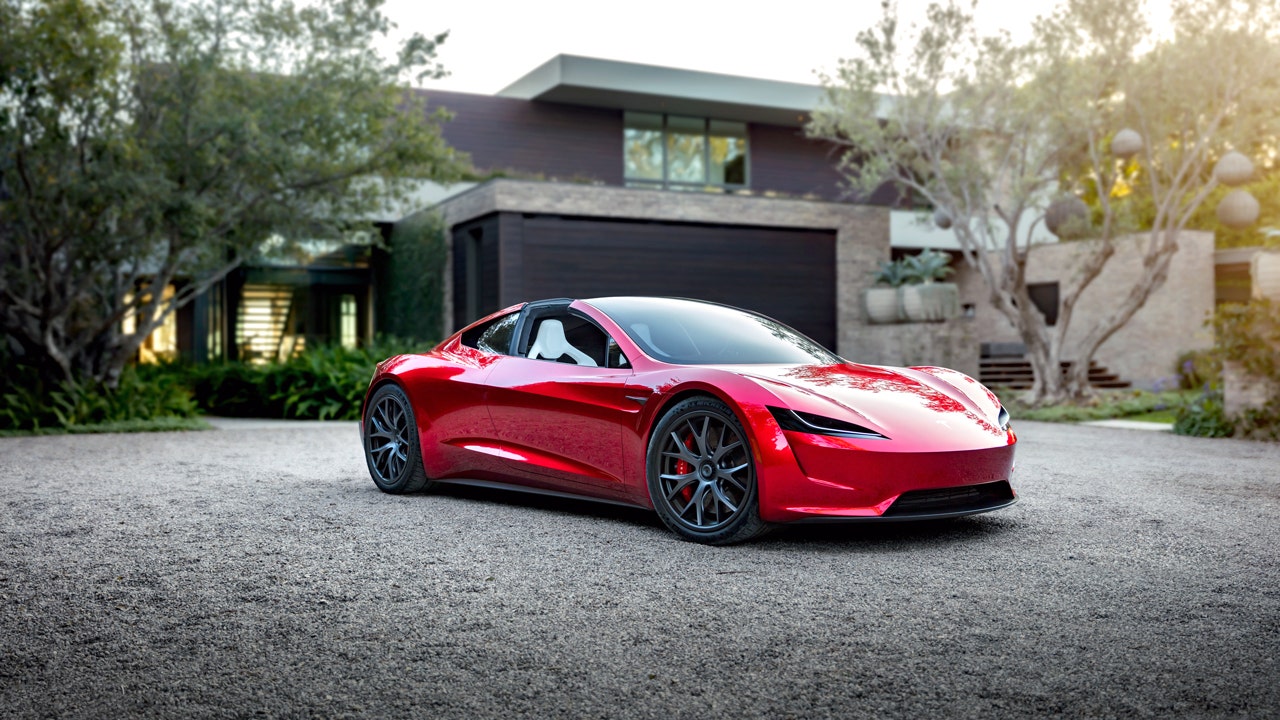
Tesla is finally rolling out the curtain on its next-generation Roadster, a long-delayed electric sports car that has spent years building up hype, doubt, and big promises. The reveal lands with Elon Musk still talking up extreme speed, SpaceX ties, and a car that is meant to stand out more as a statement piece than a volume seller.
Tesla first showed off a prototype Roadster in 2017 and said deliveries would start in 2020, a timeline that clearly did not hold. The price has stayed pegged at $200,000, with reservations set at $50,000, which keeps the car squarely in the luxury lane even before a wheel turns.
Musk has long brushed off the Roadster as a financial sideshow, calling it a “small potato situation” that would not “move the needle in a major way financially.” That does not make it unimportant, though, because halo cars can shape how people see a brand and what they believe its tech can do.
That is the real role the Roadster is chasing. It is not about chasing mass-market sales numbers or trying to carry Tesla’s revenue on its back, but about showing off engineering muscle in a way that grabs attention fast.
Morningstar analyst Seth Goldstein put it plainly when he said Tesla does not currently have a halo car and that the Roadster will be Tesla’s new one. That kind of vehicle matters because it becomes the flashy proof point, the thing people point to when they want to talk about what the company can really pull off.
Musk has also dangled some jaw-dropping performance claims. Back in 2017, he said the four-seat Roadster could go 620 miles on a single charge, and later said on X that the car had been redesigned.
He has since pushed the acceleration claim even harder, saying the new Roadster could hit 0 to 60 mph in less than a second. Musk said that was the “least interesting part” of the package, while describing the car as a collaboration between Tesla and SpaceX, which gives the whole project a bigger sci-fi feel.
That sort of talk is classic Tesla. The company has always leaned on spectacle as much as specs, and the Roadster fits right into that playbook with a mix of luxury, speed, and futuristic branding that keeps people watching.
The original Roadster still matters in this story too. Released in 2008 and sold through 2012, it was Tesla’s first EV and was built on a Lotus Elise chassis, helping lay the groundwork for the vehicles that followed.
From there, Tesla grew into the Model S and Model 3 sedans, along with the Model X and Model Y SUVs. The Roadster may have been a niche car, but it helped set the tone for a company that kept pushing the idea that electric vehicles could be desirable, fast, and anything but dull.
Now Tesla is trying to balance that legacy with a broader pivot toward artificial intelligence, self-driving technology, and robotics. The company has also launched Cybercab, a two-seat robotaxi with no steering wheel, pedals, or mirrors, while moving more resources toward Optimus humanoid robots.
Goldstein expects Tesla to sell about 2,000 Roadsters a year, which is tiny compared with the 1.6 million vehicles the company sold last year. Still, a car like this does not need massive volume to matter, especially when its job is to serve as the kind of machine that gets people talking long after the reveal ends.
The event is set for Thursday night at a SpaceX test site in McGregor, Texas, starting at 8:55 p.m. ET. For Tesla, that setting feels intentional, almost like a stage built for drama, speed, and the kind of headline-grabbing moment the Roadster has been promising for years.
