
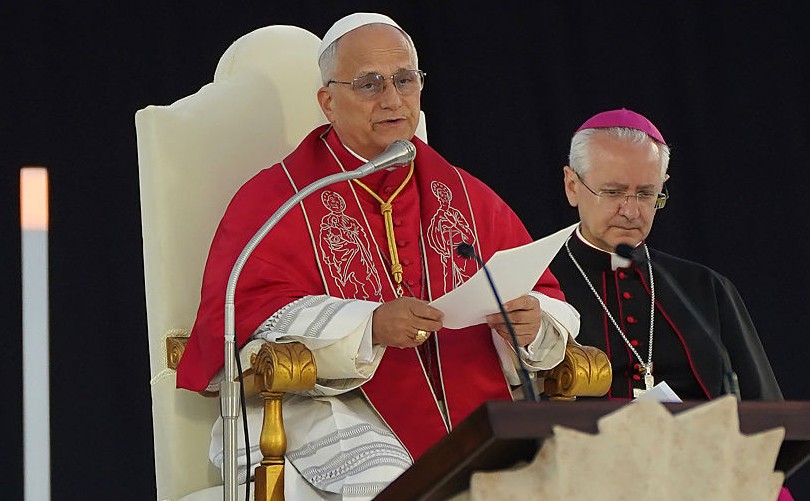
Pope Leo XIV’s meeting with Sarah Mullally has stirred up a new legal push in France, where some academics are trying to recast the Catholic priesthood question as a civil rights issue. Their argument goes straight at the Church’s male-only ordination practice, setting off a clash between religious freedom and modern anti-discrimination law.
French legal scholars are using that audience with the Anglican leader as a springboard to press a much bigger claim. They say the Catholic Church’s refusal to ordain women should be treated as sex discrimination under European legal standards, not just as an internal matter of doctrine.
In a recent piece in La Croix, the academics argued that the Church’s position on Holy Orders cannot simply be insulated from scrutiny because it is religious. In their view, equality law reaches into every corner of social life, even places that have long governed themselves by their own rules.
Their language is blunt. “The exclusion of women from ordained ministries constitutes, from the standpoint of ordinary anti-discrimination law, a differentiation that is difficult to justify,” the French legal scholars wrote.
They also framed Leo XIV’s reception of Mullally as symbolically powerful, saying it brought fresh attention to the gap between Anglicanism and Catholicism on women in church leadership. The meeting reportedly created “astonishment” and “hope” among the authors, who saw it as a reminder that some Christian communities have moved in a very different direction.
From there, they tied the issue to the Church’s regular prayers for priestly vocations. In their telling, that language still points to a role “reserved for men only for the priesthood,” which they say keeps the debate alive in a way civil law cannot ignore.
Instead of challenging Catholic teaching on theological grounds, the scholars want the argument shifted into the courtroom. They say the real issue is equality between men and women, along with the prohibition of discrimination, and they believe European civil judges should be the ones to weigh it.
Their legal theory leans on the idea that reserving ordination to men is a form of direct discrimination because women are barred outright from offices tied to teaching, governing, and sanctifying authority. Since the rule is based on sex and applied without exception, they argue it fits the standard legal definition with little room for debate.
They also point to the broader duty of states to confront discrimination wherever it appears, even when it is embedded in long-standing institutional practice. That part of the argument is meant to widen the lens beyond the Church and toward the reach of public law itself.
Still, the scholars know they are running into a wall called religious freedom. They acknowledge that European human rights law gives religious communities wide room to set their own internal rules and decide who can hold religious office.
But they insist that protection is not unlimited. Citing European Union principles, they say differences in treatment tied to religion must be essential, legitimate, justified, and open to real judicial review, which they believe leaves the door open for legal pressure.
That leads to the sharpest part of their case. They claim that using sex as a condition for priestly ordination turns biology into a credential, and they say that creates a hierarchy among believers based on gender.
They go even further, treating the dispute as a test for democratic societies more broadly. If religious autonomy is allowed to override universal rights too easily, they warn, then equality becomes selective instead of truly universal.
Their closing line leaves little doubt about where they stand. “Ultimately, one thing is certain: equality between women and men is intended to apply to all social spaces – including those that claim religious autonomy.”
The Catholic Church, for its part, has been just as clear in the opposite direction. In 1994, Pope John Paul II stated in Ordinatio Sacerdotalis that “the Church has no authority whatsoever to confer priestly ordination on women,” adding that this judgment “is to be definitively held by all the Church’s faithful.”
That leaves the current fight in a familiar place, with civil lawyers pushing outward and church teaching holding its ground. As the legal argument gathers new energy, the tension between secular equality claims and religious authority is only getting louder.
