
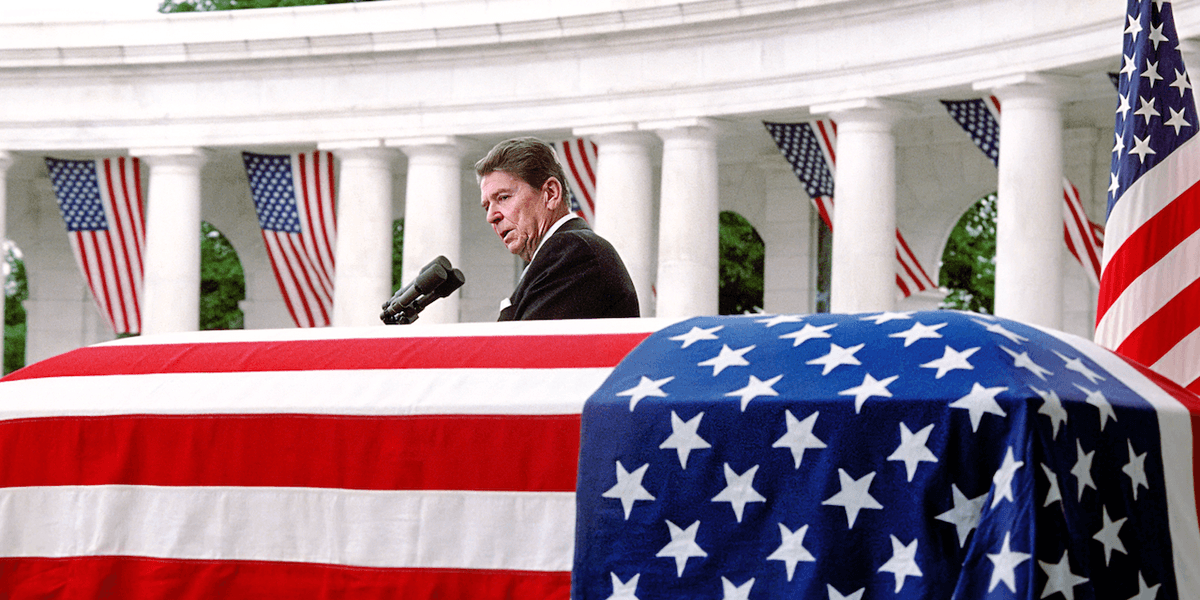
Ronald Reagan’s 1984 Memorial Day remarks at Arlington, during the interment of an unknown Vietnam service member, pushed a country toward repair. The speech reached into the quiet places where hurt had settled and offered an insistence that America would face the missing and honor their sacrifice. This piece looks at how that moment, the words spoken, and the ceremonies that followed helped mend a national wound.
The ceremony was simple but heavy with meaning, the kind of public ritual that lets a nation grieve and give thanks at once. Reagan told the crowd, “We write no last chapters,” and he continued, “We close no books. We put away no final memories. An end to America’s involvement in Vietnam cannot come before we’ve achieved the fullest possible accounting of those missing in action.” Those lines were meant to shift the conversation from blame to responsibility.
A decade after the final U.S. troops left Vietnam on March 29, 1973, some service members who fought in Southeast Asia couldn’t forget the harsh treatment that fellow Americans heaped upon them. Some were spat on while others received the middle finger or were called “baby killers.” They served their country and were blamed for the United States not defeating the North Vietnamese.
Reagan realized old wounds can’t go unattended. Two years after the dedication of the Vietnam Veterans Memorial in Washington, D.C., Reagan used his oratorical gifts to promote a better understanding of what Vietnam veterans endured.
The president continued a tradition from past wars and awarded the Medal of Honor to the Vietnam Unknown. That nice moment was not enough for Reagan. He reached out to military families residing in a continual, painful limbo because of a loved one MIA. Reagan told them that a grateful nation understood their plight.
The speech did more than eulogize; it invited a nation to look inward and act outward. Volunteers had read nearly 58,000 names on the Vietnam Veterans Wall in 1982 over the course of three days, and the sight of citizens honoring those names helped change the tenor of public memory. Small moments mattered: a newspaper reported a dinner where former Marines were applauded by young college students, and one former Marine said, “The whole week, it was worth it just for that.”
‘The Vietnam Unknown never heard such cheers.’ That line captured the shock and relief of veterans who at last felt seen by much of the country. It’s the kind of sentence that sticks because it turns silence into sound; it marks a public correction where scorn once stood. For many families who had lived with unanswered questions, the cheers were a visible sign of national repentance.
Reagan kept returning the focus to the people left behind, to those living with waiting and not knowing. He said, “They live day and night with uncertainty, with an emptiness, with a void that we cannot fathom,” and he spoke as a leader who wanted government and citizens alike to recognize that pain. That plain acknowledgment mattered in Washington and across small towns where military families waited for news.
At the heart of his remarks was a humane curiosity about the life taken too soon and the life left to wonder. “About him we may well wonder, as others have: As a child, did he play on some street in a great American city? Or did he work beside his father on a farm out in America’s heartland? Did he marry? Did he have children? Did he look expectantly to return to a bride?” Those questions were meant to restore dignity by imagining a full life.
Reagan capped his words with a prayerful thanks that kept faith and gratitude close together. He closed with, “Today, we simply say with pride, ‘Thank you, dear son. May God cradle you in His loving arms.'” The line is spare and intentional, a public benediction that named the debt owed to men and women who served.
That 1984 ceremony wasn’t a magic fix for decades of division, but it marked a turning point. By insisting on honoring the missing and consoling the families, Reagan helped steer a national conversation away from contempt and toward closure. The memory of that day still matters for anyone who believes a country owes its warriors clear-eyed respect and a promise to find the truth.
