
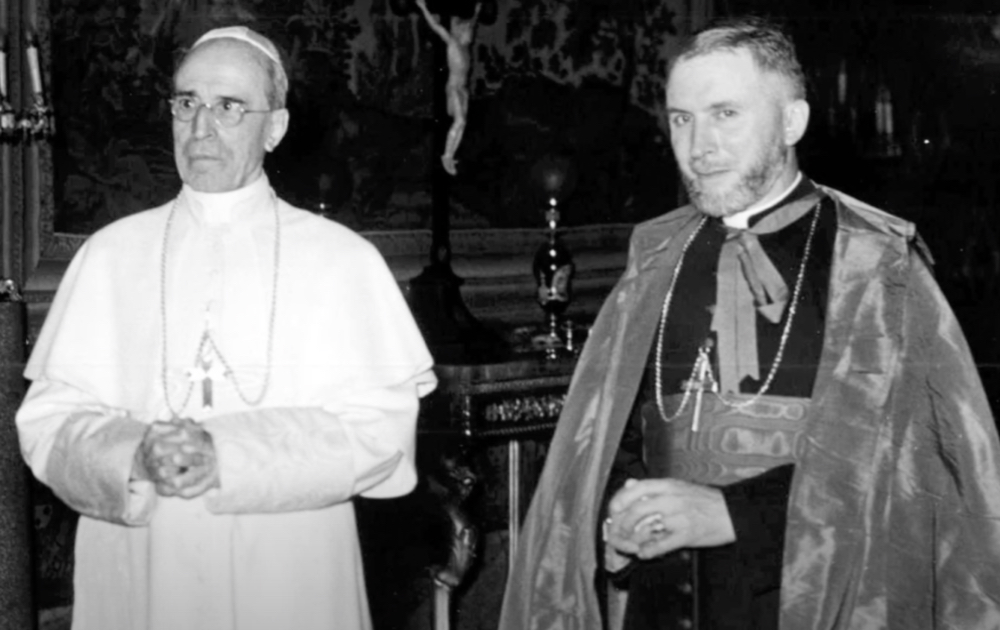
USCCB accuses Archbishop Lefebvre of acting like an ‘antipope’
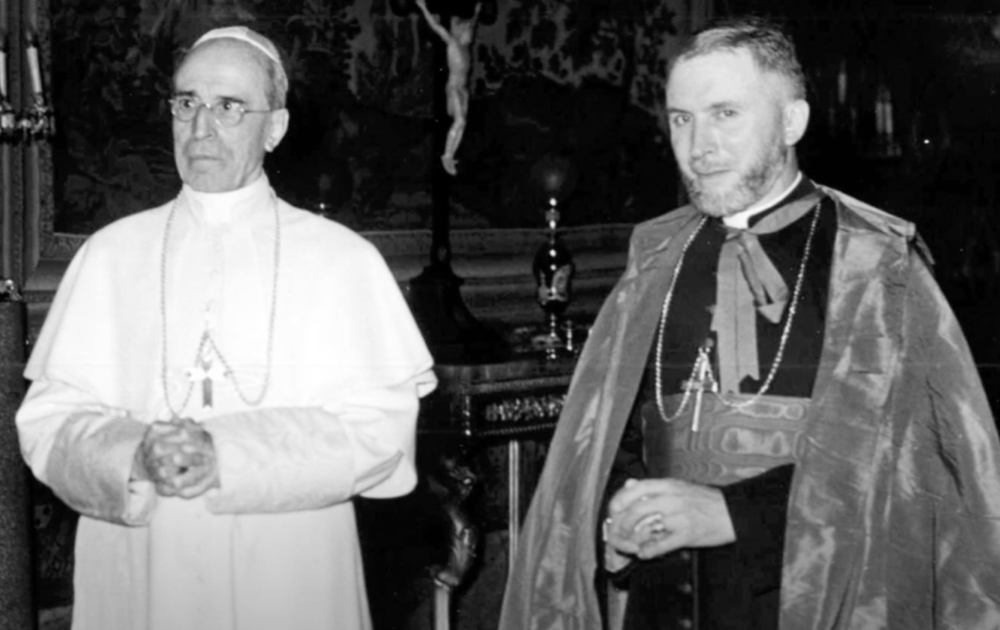
Did Archbishop Marcel Lefebvre act like an “antipope”?
This week, the United States Conference of Catholic Bishops (USCCB) has published an article drawing attention to this charge made against him by Paul VI back in 1976.
The USCCB article draws from notes taken at a meeting between Paul VI and Lefebvre. It depicts a long-suffering pope, who spent “years of correspondence and efforts” trying to reason with a recalcitrant archbishop. Its publication this week suggests the author is drawing parallels with the recent decision of the SSPX leadership to proceed with episcopal consecrations.
But was there any justice in Paul VI’s charge? And what are the real parallels with the situation in the Church today?
{“@context”:”http://schema.org/”,”@id”:”https://www.lifesitenews.com/analysis/usccb-accuses-archbishop-lefebvre-of-acting-like-an-antipope/#arve-iframe-“,”type”:”VideoObject”,”embedURL”:”https://lsntv.lifesitenews.com/watch/peRNhVWDY-cYNrYRMD3Cwg?allowfullscreen=true”,”name”:”USCCB accuses Archbishop Lefebvre of acting like an ‘antipope’”,”thumbnailUrl”:”https://www.lifesitenews.com/wp-content/plugins/advanced-responsive-video-embedder/src/img/thumbnail.avif”,”uploadDate”:”2026-07-18T18:44:21-04:00″,”description”:”Did Archbishop Marcel Lefebvre act like an u201cantipopeu201d? This week, the United States Conference of Catholic Bishops (USCCB) has published an article drawing attention to this charge made against him by Paul VI back in 1976. The USCCB article draws from notes taken at a meeting between Paul VI and Lef”}
Paul VI’s accusation
Archbishop Lefebvre and Paul VI met at the summer residence of Castel Gandolfo on 11 September 1976, after rising tensions between the Vatican and the Society of St Pius X.
Paul VI challenged Lefebvre’s resistance to the program of Vatican II and accused him of behaving like an “antipope”.
He said:
You said it and wrote it. I would be a modernist pope. By applying an ecumenical council, I would betray the church. Do you understand that if this were so, I would have to resign and invite you to take my place and lead the church?
And he continued:
Unfortunately, the position you have taken is that of an antipope.
The historical context
To understand Paul VI’s remarks, we need to understand the position of Archbishop Lefebvre in the summer of 1976, after a decade of crisis following the close of Vatican II in 1965 and the promulgation of the new liturgy in 1969.
The decade had seen a radical falling away from the Catholic faith. Bishops and clergy were preaching heresy with impunity, priests were abandoning the priesthood, religious were leaving their monasteries and convents, rules of religious orders were being changed beyond recognition, Catholic devotions were mocked and suppressed, churches were vandalized and altars and relics desecrated, orthodox seminary formation could scarcely be found, and ordinary Catholics were fleeing their parishes on an unprecedented scale.
In this context, Archbishop Lefebvre – former Archbishop of Dakar, Apostolic Delegate of North Africa, and Superior General of the Holy Ghost Fathers – had come out of retirement to help young seminarians looking for an orthodox priestly formation. This had led, in November 1970, to the foundation of the Society of St Pius X. Its seminary at Ecône was soon attracting young men from all over the world.
The success of Ecône was threatening to those who were committed to the program of Vatican II and who insisted there could be no return to the “pre-conciliar church.” A thriving traditional seminary exposed the failure of the Vatican II project.
In 1974, an “apostolic visitation” arrived at the seminary. Paul VI’s representatives disturbed seminarians by suggesting truth could change and by casting doubt on the bodily resurrection of Our Lord – one of the most fundamental dogmas of the Catholic faith. They also told these young men, who were preparing for a life of celibacy, that there would soon be married priests.
Archbishop Lefebvre refused to participate in the destruction of the Church
On 21 November 1974, following the visitation, Archbishop Lefebvre issued a now famous declaration in which he made clear his refusal to participate in the ongoing destruction of the Church. After affirming his loyalty to the Catholic faith, he wrote:
We refuse, on the other hand, and have always refused to follow the Rome of neo-Modernist and neo-Protestant tendencies which were clearly evident in the Second Vatican Council and, after the Council, in all the reforms which derived from it.
All these reforms, indeed, have contributed and are still contributing to the destruction of the Church, to the ruin of the priesthood, to the abolition of the Sacrifice of the Mass and of the sacraments, to the disappearance of religious life, to a naturalist and Teilhardian teaching in universities, seminaries and catechetics; a teaching derived from Liberalism and Protestantism, many times condemned by the solemn Magisterium of the Church.
He continued:
This Reformation, stemming from Liberalism and Modernism, is poisoned through and through; it derives from heresy and ends in heresy, even if all its acts are not formally heretical. It is therefore impossible for any conscientious and faithful Catholic to espouse this Reformation or to submit to it in any way whatsoever.
The only attitude of faithfulness to the Church and Catholic doctrine, in view of our salvation, is a categorical refusal to accept this Reformation.
This attitude of fidelity to the authentic Magisterium brought him into direct conflict with those in power in the Vatican. In 1975, the local bishop declared the SSPX suppressed, and in June of 1976 Lefebvre was suspended, that is, forbidden from ordaining priests and saying Mass. He ignored this suspension.
On 29 August 1976, Lefebvre celebrated Mass at Lille in northern France. Rather than the few hundred participants expected, more than six thousand people assisted at the Mass, which was widely reported in the French and international press, bringing the name of Archbishop Lefebvre to a wider audience.
This Mass provides the immediate context for Lefebvre’s meeting with Paul VI on 11 September.
The Mass at Lille
Lefebvre opened his sermon by asking why so many people “have come from long distances” to attend. It was, he answered:
To manifest your Catholic faith; to manifest your belief; to manifest your desire to pray and to sanctify yourselves as did your fathers in faith, as did generations and generations before you.
That is the real object of this ceremony, during which we desire to pray, pray with all our heart, adore Our Lord Jesus Christ Who in a few moments will come down on this altar and will renew the sacrifice of the Cross which we so much need. [1]
In the sermon, he disavowed the accusation being made in the Vatican, which would be repeated in substance by Paul VI on 11 September, that he was making himself “head of the traditionalists”. He said:
I do not want to be head of the traditionalists, nor am I. Why? Because I also am a simple Catholic. A priest and a bishop, certainly; but in the very conditions in which you find yourselves, reacting in the same way to the destruction of the Church, to the destruction of our faith, to the ruins piling up before our eyes.
He continued:
All we want is to be allowed to profess our faith in Our Lord Jesus Christ.
So, for that reason, we are driven from our churches. The poor priests are driven out for saying the Old Mass by which all our saints were sanctified: Saint Jeanne d’Arc, the holy Cure of Ars, the little Therese of the Child Jesus were sanctified by this Mass; and now priests are driven brutally, cruelly, from their parishes because they say the Mass which has sanctified saints for centuries.
It is crazy. I would almost say it is a story of madmen. I ask myself if I am dreaming. How can this Mass have become some kind of horror for our bishops and for those who should preserve our faith?
But we will keep the Mass of Saint Pius V because the Mass of Saint Pius V is the Mass of twenty centuries. It is the Mass of all time, not just the Mass of Saint Pius V; and it represents our faith, it is a bulwark of our faith, and we need that bulwark.
In order to preserve the Catholic faith he rejected what he called “the adulterous union of the Church with the Revolution”, that is, with Liberalism.
Lefebvre rejected this union:
Error and truth are not compatible. We must see if we have charity towards others, as the Gospel says: he who has charity is one who serves others. But those who have charity should give Our Lord, they should give the riches they possess to others and not just converse with them and enter into dialogue on an equal footing. Truth and error are not on the same footing. That would be putting God and the Devil on the same footing, for the Devil is the father of lies, the father of error.
And he noted:
There will be no peace on this earth except in the reign of Our Lord Jesus Christ.
The Mass at Lille on 29 August must have been at the forefront of Paul VI’s mind when he confronted Lefebvre on 11 September.
The attitude of Paul VI
We have seen above that Paul VI accused Lefebvre of setting himself up as an “antipope.” Before asking whether this accusation is just, I would like to draw attention to two striking characteristics of Paul VI’s remarks.
First, we see evidence of the self-pity and self-absorption that many of Paul VI’s contemporaries noticed in his personality. [2]
Paul VI was meeting Lefebvre at a time of unprecedented crisis for the Church and of immeasurable confusion and suffering for ordinary Catholics worldwide.
He was the man primarily responsible for this crisis, and for this suffering. He had guided the course of Vatican II and confirmed its documents; he had promulgated the New Mass and other revised rites; he had appointed heretical bishops to sees worldwide; and he had refused to discipline the bishops and superiors perpetrating the horrors outlined above.
Paul VI bore the primary responsibility for everything which took place. And yet he presents himself as the victim and Lefebvre – who was trying to alleviate the harm Paul VI’s actions had caused – as the aggressor:
We are suffering deeply. You contributed to making it worse with your solemn disobedience, with your open challenge against the pope.
In contemporary parlance this is called “gaslighting.”
Yet the USCCB article states that “confronting a rebel archbishop’s accusations and acts of defiance was the heaviest cross St. Paul VI had to bear in his pontificate”.
If Archbishop Lefebvre’s persistence in the Catholic faith was Paul VI’s greatest cross, what does that say about his attitude to the real dissent from the Catholic faith that marked the rest of the episcopate?
The second point to note is Paul VI’s extraordinary hypocrisy.
During the interview Lefebvre asked for permission for the traditional Mass to continue.
Paul VI flatly refused this request:
We are a community. We cannot permit autonomy in behavior in different places.
Yet at the very time he made these remarks he was tolerating every kind of heresy on the part of his cardinals and bishops and was presiding over the complete disintegration of the liturgical and sacramental life of the Church.
As with his successors, such as Francis and Leo XIV, heretics get “autonomy” while discipline and punishment are reserved for those who want to continue practicing the Catholic faith.
After thirteen years of authorizing radical and destructive changes, Paul VI had the temerity to accuse Lefebvre of not allowing “for any measure in your words, your actions, your behavior.” The accusation would be better made the other way around.
It was not Archbishop Lefebvre but Paul VI who:
- confirmed conciliar documents containing theological errors and ambiguous statements which were inserted in order to undermine the Catholic faith.
- suppressed the rites of the Roman Church and replaced them with rites that had been deliberately made more “Protestant” for ecumenical reasons.
- forced orthodox bishops and cardinals to retire early and replaced them with openly heretical bishops, many of whom also went on to cause moral scandals.
- turned a blind eye to dissent throughout the world, while persecuting those who remained faithful to the Catholic faith.
- deliberately worked to change the constitutions of the last remaining Catholic states in order to dethrone Jesus Christ – with divorce, contraception, abortion and other evils soon following.
- publicly renounced the papal tiara and placed his episcopal ring on the finger of an Anglican “archbishop.”
Paul VI did all these things. By contrast Archbishop Lefebvre was simply practicing the same religion as his ancestors. As he recalled some years later, in his Open Letter to Confused Catholics:
On August 29, 1976, the whole of France was excited on hearing that I was going to say Mass at Lille. What was so extraordinary about a bishop celebrating the Holy Sacrifice? I had to preach before a panoply of microphones and each of my remarks was greeted as if it were a striking declaration. Yet what did I say beyond what any other bishop could have said?
There lies the key to the enigma: the other bishops had been for a number of years no longer saying the same things. How often, for example, have you heard them speaking of the social reign of Our Lord Jesus Christ?
My personal experience never ceases to amaze me. These bishops for the most part were fellow students with me in Rome, trained in the same manner. And then, all of a sudden, I found myself alone. But I have invented nothing new; I was carrying on.
Paul VI and Archbishop Lefebvre… against whom would the accusation of “antipope” be more just?
Did Archbishop Lefebvre think Paul VI was an antipope?
Archbishop Lefebvre always publicly recognized Paul VI and his successors as popes, but he was also open to the possibility that he might be mistaken on this point.
This is an important fact to be aware of because it is a warning against adopting simplistic positions based on loyalty to individuals, rather than adherence to theological principles.
For example, in an interview published by the French newspaper Le Figaro on 6 August 1976, Lefebvre said:
To the degree that the Pope departs from [Catholic] tradition, he becomes schismatic, he breaks with the Church. Theologians such as Saint Bellarmine, Cajetan, Cardinal Journet and many others have studied this possibility. It is not something inconceivable.
But it is the Second Vatican Council and its reforms, its official orientations, which concern us more than the personal attitude of the Pope, which is difficult to discern.
This Council represents, both in the opinion of the Roman authorities as in our own, a new Church which they call themselves the ‘Conciliar Church’.
And, in crucial words, he said:
[I]f it appears certain to us that the faith which was taught by the Church for twenty centuries cannot contain error, we have much less of an absolute certitude that the Pope be truly Pope. Heresy, schism, ipso facto excommunication, and invalid election are some causes which could make it happen that a Pope never was one or would cease to be one. In this obviously very exceptional case, the Church would be in a situation similar to that which occurs after the death of a sovereign pontiff.
And in 1977, one year after his meeting with Paul VI, he said:
The question is therefore definitive: is Paul VI, has Paul VI ever been, the successor of Peter? If the reply is negative: Paul VI has never been, or no longer is, pope, our attitude will be that of sede vacante periods, which would simplify the problem.
Some theologians say that this is the case, relying on the statements of theologians of the past, approved by the Church, who have studied the problem of the heretical pope, the schismatic pope or the pope who in practice abandons his charge of supreme Pastor. It is not impossible that this hypothesis will one day be confirmed by the Church.
Archbishop Lefebvre remained open to the possibility that the Church would one day recognize an extended vacancy of the Holy See, even though he never adopted this position as his own.
What is the significance of these events for today?
It is almost fifty years since Archbishop Lefebvre met with Paul VI, but in many ways the situation facing the Church has changed very little. We have a putative pope openly teaching heresy, appointing heretics worldwide, collaborating with the liberal order in opposition to Christ the King, and working to suppress the authentic Catholic religion.
And we have Catholics looking to this putative authority for permission to practice the Catholic faith and receiving only stones and snakes in place of bread and fish.
The cycle continues; and more than sixty years after the end of Vatican II it is surely time for a deeper exploration of the causes of, and solutions to, our predicament.
There are no political solutions to this crisis. The solutions are theological.
The deliverance of the Church is not going to be achieved by negotiating with public heretics as if they hold legitimate authority in the Church, or by begging for crumbs from the Modernist table.
Deliverance will come from God. Explanations will come from theology.
The true solution to the crisis will be found by returning to the fundamental questions raised by Archbishop Lefebvre, though never satisfactorily resolved by him.
What happened at Vatican II? Did the Council teach errors or even heresies? How could that have happened? What are the implications for those who hold and teach these errors? And how should Catholics respond?
These are the questions we must continue to explore – without being dissuaded by fear – and with more urgency than ever before.
References
| ↑1 | Extracts from the sermon in English can be found here: https://www.sspxasia.com/Documents/Archbishop-Lefebvre/Apologia/Vol_one/Chapter_13.htm/ . |
|---|---|
| ↑2 | See Romano Amerio, Iota Unum, section 69 for discussion of his personality. |
function footnote_expand_reference_container_1154211_1() { document.getElementById(‘footnote_references_container_1154211_1’).style.display = “inline”; document.getElementById(‘footnotes_container_label_expand_1154211_1’).style.display = “none”; document.getElementById(‘footnotes_container_label_collapse_1154211_1’).style.display = “inline”; document.getElementById(‘footnotes_container_button_plus_1154211_1’).style.display = “none”; document.getElementById(‘footnotes_container_button_minus_1154211_1’).style.display = “inline”; } function footnote_collapse_reference_container_1154211_1() { document.getElementById(‘footnote_references_container_1154211_1’).style.display = “none”; document.getElementById(‘footnotes_container_label_collapse_1154211_1’).style.display = “none”; document.getElementById(‘footnotes_container_label_expand_1154211_1’).style.display = “inline”; document.getElementById(‘footnotes_container_button_minus_1154211_1’).style.display = “none”; document.getElementById(‘footnotes_container_button_plus_1154211_1’).style.display = “inline”; } function footnote_moveToReference_1154211_1(p_str_TargetID) { footnote_expand_reference_container_1154211_1(); } function footnote_moveToAnchor_1154211_1(p_str_TargetID) { /* defined to keep using standard row templates */ }

Comments