
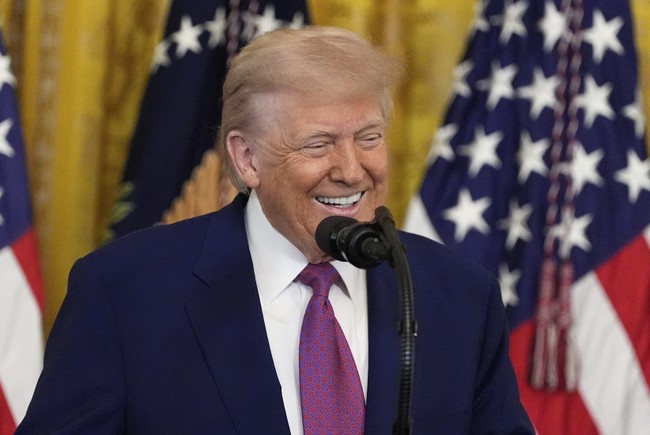
President Donald Trump made headlines Tuesday night with the announcement of a groundbreaking trade deal with Japan, following news of a similar agreement with Indonesia earlier in the day. Speaking to Republicans at the White House, Trump declared that he had just “signed the largest trade deal in history” with Japan, calling it a “great deal for everybody.” This agreement is expected to channel substantial revenue into the U.S., a significant win for American businesses.
In his characteristic style, President Trump mentioned that the tariffs implemented succeeded beyond what most people expected. “We concluded the one deal [with Japan] and now we’re going to conclude another one because they’re forming a joint venture with us in Alaska for the LNG,” he remarked, highlighting the collaborative spirit of these negotiations. This venture is set to boost economic ties and energy collaboration between the two nations.
Taking to Truth Social, Trump elaborated on the Japanese deal, stating it involves a $550 billion investment into the U.S., with America receiving 90% of the profits. This move, he emphasized, will create hundreds of thousands of jobs, marking an unprecedented economic collaboration. The deal opens up Japan to U.S. trade, including cars, trucks, and agricultural products, with reciprocal tariffs set at 15%.
The announcement with Japan was followed by a statement from the White House regarding a framework for a reciprocal trade agreement with Indonesia. The press release underscored the strengthening of bilateral economic relationships, promising unprecedented market access for exporters from both countries. This agreement builds on the U.S.-Indonesia Trade and Investment Framework Agreement from 1996.
Key elements of the Indonesia deal include the elimination of 99% of tariff barriers on U.S. exports to Indonesia. This is a strategic move to enhance U.S. economic interests in the region. The U.S. will also reduce its tariffs on Indonesian goods to 19%, with a possibility of further reductions on specific commodities.
The agreement also outlines negotiations for rules of origin to ensure benefits accrue primarily to both nations. It aims to address barriers to U.S. agricultural products in Indonesia, exempting them from import licensing regimes and ensuring transparency in geographical indications. This strategic partnership is expected to bolster trade and economic ties significantly.
Furthermore, Indonesia will eliminate restrictions on industrial commodities exports to the U.S., including critical minerals, which are vital to U.S. industries. These developments mark a significant stride in strengthening America’s global trade relationships. The full details of the deal can be accessed through official channels.
Editor’s Note: Under President Trump’s leadership, these trade deals showcase a revitalized American economy. Support our efforts to continue reporting on these successes and counter the misinformation from Democrats. Join our membership with a special promo code for a discount.
This narrative aligns with the economic vision of conservative leaders like Ronald Reagan, emphasizing the benefits of robust international trade relationships. These deals reflect an approach rooted in free-market principles and a commitment to American prosperity. The agreements with Japan and Indonesia reinforce the U.S. position in global trade, a key aspect of Trump’s economic strategy.
The impact of these trade deals is expected to be significant, fostering job creation and economic growth. They demonstrate a focus on securing favorable terms for America, ensuring that the nation remains competitive on the world stage. This approach aligns with the conservative belief in strong, mutually beneficial international partnerships.
As these agreements come into effect, they are anticipated to enhance America’s economic standing and strengthen ties with key global partners. The focus on reciprocal tariffs and market access underscores a balanced approach to trade, benefiting American industries and workers. This strategy is a testament to the enduring principles of conservative economic policy.
These developments highlight the importance of leadership that prioritizes national interests while fostering international cooperation. The trade deals with Japan and Indonesia are a testament to the effectiveness of Trump’s negotiation tactics. They reflect a commitment to achieving economic wins that align with the values of conservative economic theory.
America’s trade policies under this administration have consistently aimed at securing advantageous terms for the nation. These recent agreements are a continuation of that strategy, focusing on long-term economic benefits. The emphasis on reciprocal trade reflects a pragmatic approach to international economics, a hallmark of conservative policy.
In summary, these trade deals are a notable achievement for President Trump and the American economy. They underscore the importance of strategic international partnerships and the benefits they bring to the nation. The agreements with Japan and Indonesia are a reflection of a well-executed economic plan, rooted in conservative principles.

1 Comment
This is called “common sense”!
If I’m an able bodied athlete who identifies as disabled. Does this mean I can compete in the Paralympics?
If I’m an adult athlete who identifies as a child. Does this mean I can compete in little league sports?
This is exactly the same thing as men competing in female sports. STOP THE INSANITY!
What part of extremely UN-fair do the globalist slaves not get?