
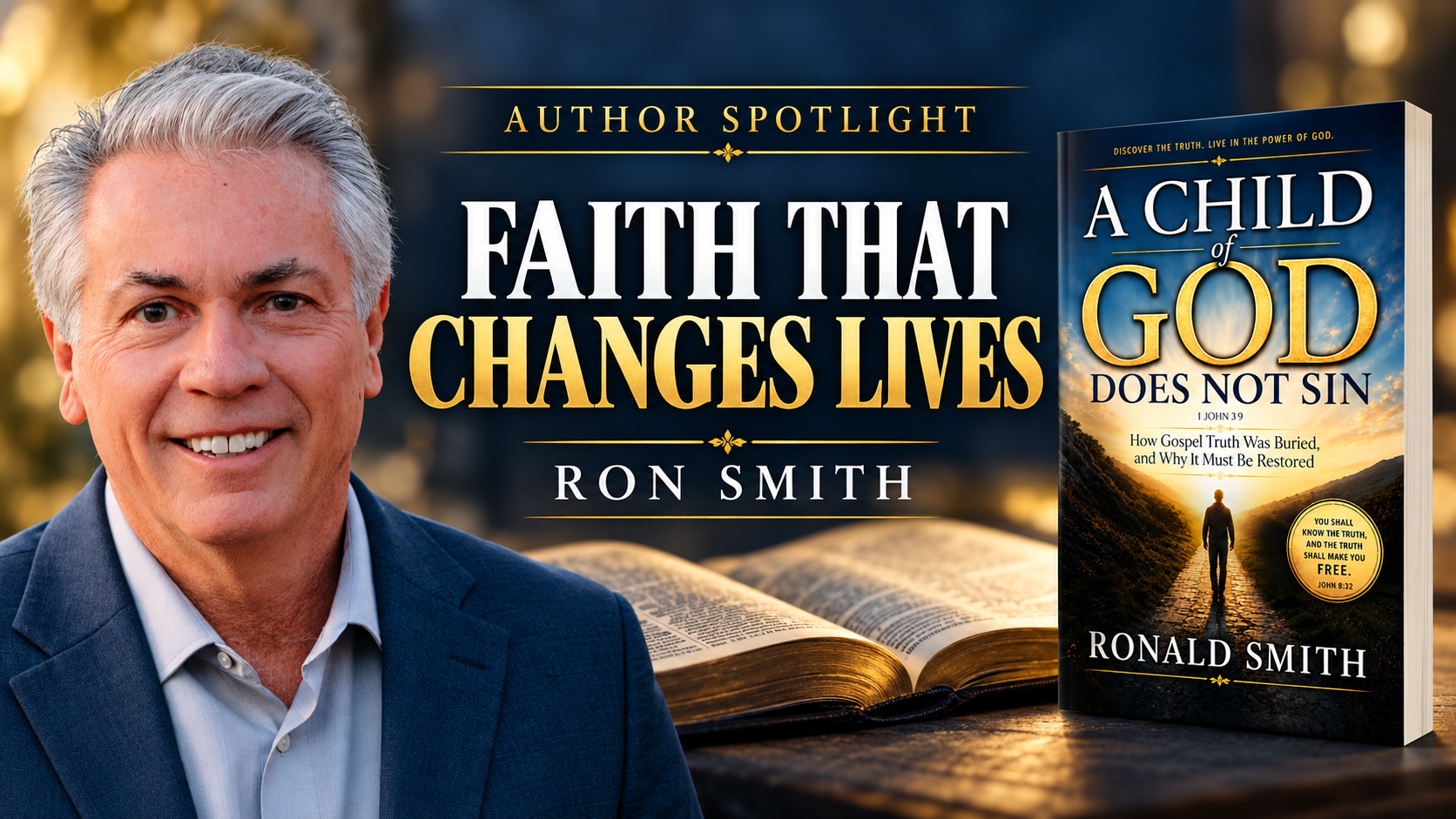
Ron Smith sold advertising, raised six kids, and helped conservative causes raise money. All the while, one question from a Muncie diner wouldn’t let him go. Now it’s a book.
Ron Smith has sat through somewhere between two and three thousand sermons in the last three decades. He’s counted. And in all of them, he says, he never once heard a pastor preach on 1 John 3:9 — the verse that says whoever is born of God does not sin.
Nobody argued against it, either. That’s what bothered him most. The verse wasn’t attacked. It was simply ignored, as if the church had quietly agreed to step around it. For a man trained as a journalist, that kind of silence was a story.
That story is now A Child of God Does Not Sin: How Gospel Truth Was Buried, and Why It Must Be Restored, a new book that Smith has been studying for 33 years and writing, on and off, for 18 of them.
Readers are responding. Since its Amazon debut on October 1, the book has broken into Amazon’s Top 10 Christian Salvation Books, where it ranks No. 8 among new releases. It has also climbed to No. 1 in Amazon’s Methodist category, a fitting spot for a book built on the teaching of John Wesley.
A Phoenix Kid with a Reporter’s Instinct

Author Ronald Smith
Smith grew up in Phoenix and met his wife, Nancy, on the track team at Sunnyslope High School. He was an All-State hurdler and a quarterback; she was a state champion sprinter. Both went on to graduate from Northern Arizona University, where Ron earned a degree in journalism with a minor in public relations.
His first job out of college was in the PR office of a large school district. It didn’t last. When leadership repeatedly asked him to shape stories in ways that protected the institution rather than informed the public, he resigned. That decision pushed him into sales and marketing, where he went on to sell more than $200 million in advertising over his career.
But the instinct that made him walk away from that PR job never left. It would come back years later, pointed at something much bigger.
Boulder, a Bus Ride, and Twelve Wednesdays
In 1991 the Smiths moved to Muncie, Indiana, to work in a family advertising business with two of Ron’s brothers. Two years later he went with his church’s men’s group to a Promise Keepers gathering in Boulder, Colorado, where roughly 60,000 men filled a stadium in worship.
His first reaction, he admits, was suspicion. He watched the crowd the way a reporter would, looking for the angle. He couldn’t find one. By the end of the weekend he was convinced those men had something with God that he didn’t.
On the bus home he asked his associate pastor, Dave Neckers, to disciple him. A few weeks later the two sat down at the Sunshine Cafe in Muncie for the first of twelve Wednesday morning meetings. They started at Genesis. A few weeks in, Smith asked a question that would shape the next three decades: if we can pray to be healed of cancer, why can’t we pray to be healed of sin?
Neckers, a graduate of Asbury Theological Seminary, told him he could. What Smith was describing had a name — Christian Perfection, the doctrine John Wesley preached across 18th-century England. Then he added the line Smith has never forgotten:
“Today, most people in the church don’t believe it.”
— Dave Neckers, at the Sunshine Cafe in Muncie
“The Person You’re Waiting On Is You”
That sentence set off the journalist in him. Instead of asking whether the doctrine was true, Smith went straight to a different question: how did the church stop believing it?
For years, chasing the answer became his hobby. He read nearly all of Wesley’s sermons, much of Billy Graham, Ray Comfort, and dozens of other theologians. He taught it in a Sunday school class until he was asked to stop — at a Methodist church, of all places. He and Nancy led a college-age Bible study at home and watched young people stuck in a cycle of sin and confession, knowing he had something to tell them and no room to say it.
Then came Ohio, two more children, youth sports, a corporate career. The manuscript went on and off the shelf. He wrote the first eight chapters in 2008. He kept waiting for a real theologian or pastor to write the book so he wouldn’t have to.
Nobody did. Eventually, Smith says, he sensed God telling him plainly that the person he was waiting on was himself. A book by a family friend, Debra Boblitt, finally pushed him to pull the scattered files together and finish.
Through all of it, Nancy was there. While Ron built a career and chipped away at the manuscript, she held together a household of six children and led countless school fundraisers along the way. She lived with the question as long as he did, and her support through 18 years of stops and starts was critical to getting the book finished, and to the success it’s seeing now.
✦ ✦ ✦
Back to the Valley — and Into the Fight
Smith’s other calling runs on the same instinct. During their years in Ohio, Ron and Nancy grew alarmed at the direction of the country and began writing and broadcasting about the issues of the day. When the pandemic lockdowns hit, they moved home to the Valley and got involved in local politics.

It’s a fitting second act for a man who spent his career in advertising and marketing. And it shares a thread with the book: both grew out of Smith’s conviction that some things are worth standing up and saying out loud, even when the room would rather you didn’t.
✦ ✦ ✦
Book Review
A Child of God Does Not Sin
★★★★★
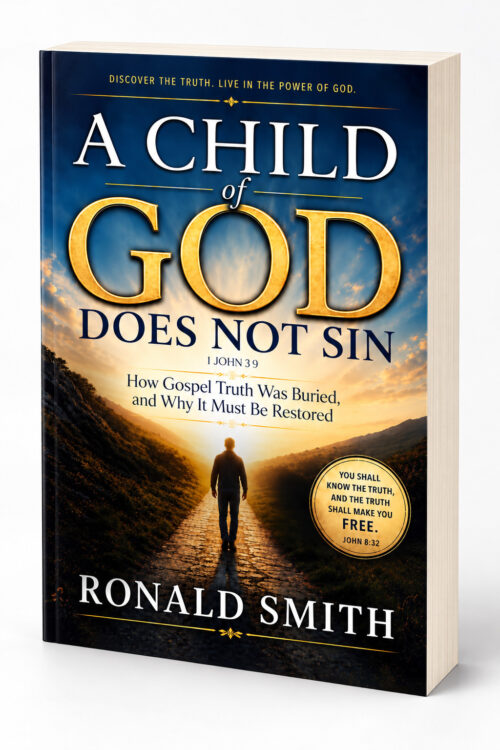
Most Christian books about sin are really books about coping with it. They offer comfort for the failure, reassurance about grace, and a plan to do a little better next week. Ron Smith’s book does something rarer. It asks whether the cycle itself was ever supposed to be normal.
The premise is right there in the title, drawn from 1 John 3:9. Smith takes the verse at face value and follows it through the New Covenant. His argument is that holiness, power, and real victory over sin aren’t extra credit for a spiritual elite. They’re the inheritance of every believer — and the church set that inheritance down somewhere along the way.
Whoever has been born of God does not sin, for His seed remains in him; and he cannot sin, because he has been born of God.
— 1 John 3:9 (NKJV)
What Makes It Work
It reads like an investigation, not a sermon. Smith’s journalism background shows. He isn’t content to say the doctrine faded; he wants to know why. He traces the drift to commercial, institutional, and theological incentives that rewarded a softer standard over time, including a popular study Bible whose commentary reclassified parts of the New Testament as not applying to today’s church (the subject of Chapter 8). He’s careful to say not everyone involved acted in bad faith. Many simply passed along what they’d been handed.
It anticipates the pushback. Smith learned the hard way that you can’t say “a child of God does not sin” without someone quoting a counter-verse before you finish the sentence. So the book takes the hard passages head on — Romans 7, 1 John 1:8, “judge not” — and separates willful disobedience from mistakes, ignorance, temptation, and ordinary human weakness. Chapter 3’s treatment of imputed versus imparted righteousness is the section early readers keep mentioning.
It’s personal without being self-absorbed. The book carries the honesty of a layman who spent decades wrestling with this between work, kids, and church life. That’s a big part of its appeal. It doesn’t feel handed down from a pulpit. It feels like a friend across the table at a diner, which is exactly where it started. Fittingly, the foreword comes from Dave Neckers, the pastor who sat across that table.
It’s built to be used. Beyond the argument, the book includes a list of 56 core Scripture references and an appendix for personal and group study, which makes it a natural fit for small groups and Sunday school classes.
It’s hopeful. For all its pointed critique of the modern church, this is not a book about pressure or perfectionism. Smith presents grace as power for daily life, not just a pardon for the past.
Who Should Read It
Believers worn out by the failure-and-guilt loop. New Christians who want to start with the whole gospel. Bible students who want the text taken seriously, word for word. Pastors and small-group leaders who have never touched 1 John 3:9 and wonder why. And anyone in the Wesleyan holiness tradition who wants to see its central doctrine argued for a new generation.
Readers from traditions that hold believers will keep struggling with sin until glory will find the book provocative, and Smith seems to welcome that. Even if you finish it unconvinced, you’ll have a hard time hearing that verse the same way again.
“I’ve never read one so much of what I learned contradicted what I thought I knew.”
Mike W., San Diego, CA
“Reading it for the second time…life changing perspective I never saw until this.”
Julie Y., Glendale, AZ
“Not in a recondite, preachy way, but rather a deep dive into a tenet of faith…”
Tonja M., Marathon, FL
“I love how real and raw it is.”
Alyssa M., Phoenix, AZ
Rev. Lawrence P. Brown, author of Holiness Illustrated, praises the book for clearly defining its terms and defending the doctrine of regeneration chapter by chapter, and closes his endorsement with a call for a new holiness revival.
The Verdict
Bold, readable, and impossible to shrug off. Ron Smith set out to answer one question from a Muncie diner and came back with a book that challenges how most of the church talks about sin.
If you’ve ever suspected the Christian life was meant to be more than an endless loop of falling and confessing, start here.
Get It at Beacon Book Club Buy on Amazon
Paperback ships in 5–8 business days from Beacon Book Club
About the author: Ronald Smith is a Northern Arizona University journalism graduate, longtime sales and marketing executive, and co-founder with his wife, Nancy, of Camelback Fundraising. The couple lives in Scottsdale, Arizona, and has six children and two grandchildren. Learn more at donotsin.com.
