
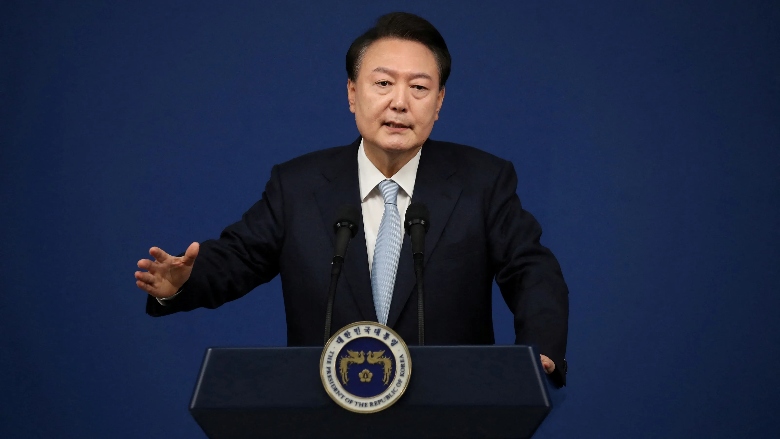
In a dramatic sequence of events, South Korean President Yoon Suk Yeol has withdrawn a controversial martial law declaration issued earlier this week. The decision comes on the heels of intense domestic opposition and a travel alert from the U.S. State Department warning American citizens in South Korea of the fluid and uncertain situation.
The crisis erupted late Tuesday when President Yoon announced martial law, accusing opposition parties in the South Korean National Assembly of collaborating with North Korea to destabilize his government. Within hours, military personnel filled the streets of Seoul, underscoring the gravity of the situation.
The martial law order allowed the military to take over civil functions and clamp down on dissent, which sparked immediate backlash from lawmakers and citizens alike. Opposition parties, led by the Democratic Party of South Korea, condemned Yoon’s decision as an authoritarian overreach and mobilized to challenge it in the National Assembly.
Shortly after the martial law declaration, the U.S. Department of State issued an urgent travel advisory for Americans in South Korea.
“The U.S. Embassy and Department of State are closely tracking President Yoon’s recent declaration of martial law. The situation is fluid. Please monitor local news sources for updates as the situation progresses,” the alert stated.
The advisory heightened international attention on the unfolding crisis and likely added pressure on Yoon to reconsider his decision.
In a bold move, opposition lawmakers scaled fences and clashed with security forces to enter the National Assembly building, determined to hold a vote overturning the martial law declaration. After a brief standoff with police, opposition leaders successfully convened and voted 190-0 to annul Yoon’s order.
However, the military initially rejected the vote, stating that only the President and Defense Minister had the authority to change the country’s status. This defiance set the stage for a deeper constitutional and political crisis.
As tensions escalated, reports surfaced that military personnel had raided parliament offices, ostensibly to enforce arrest warrants for prominent opposition leaders, including Lee Jae-myung of the Democratic Party, Han Dong-hoon of the ruling People Power Party, and Woo Won-shik, Speaker of the National Assembly.
These actions fueled fears of an authoritarian crackdown and drew condemnation from civic groups and international observers. Many viewed the raids as an attempt to silence dissent and cement military control under the guise of enforcing the law.
Adding to the pressure on Yoon was a split within his own party, the People Power Party. The party’s refusal to back the martial law declaration and its alignment with opposition calls for a return to civilian governance likely influenced Yoon’s decision to withdraw the order.
Observers noted that Yoon’s waning support within his party made it increasingly untenable for him to maintain the martial law declaration without risking a broader political collapse.
Facing mounting opposition at home and abroad, Yoon announced the withdrawal of martial law on Wednesday, less than 24 hours after its imposition. His decision awaits Cabinet approval, which is widely expected to pass.
The withdrawal marks a significant political retreat for Yoon, whose hardline approach was meant to address alleged security threats but instead plunged the nation into turmoil.
The U.S. State Department welcomed the lifting of martial law, with officials emphasizing the importance of democratic processes and civil liberties in South Korea.
Domestically, opposition leaders hailed the withdrawal as a victory for democracy but cautioned against complacency. “This episode highlights the fragility of our institutions and the importance of vigilance in defending our rights,” Democratic Party leader Lee Jae-myung said in a statement.
Meanwhile, civic groups and citizens continued to demand accountability for the military’s role in the crisis, particularly the alleged raids on parliament offices and attempts to arrest opposition leaders. Protests in Seoul called for an independent inquiry into the events leading up to and following the martial law declaration.
Though martial law has been revoked, the political fallout is likely to persist. President Yoon’s approval ratings have taken a hit, and his ability to govern effectively in the face of a divided parliament remains uncertain.
Additionally, the episode has underscored tensions within South Korea’s political landscape, with critics accusing Yoon of leveraging national security concerns to suppress dissent. The opposition has vowed to pursue legislative and judicial measures to prevent similar actions in the future.
As South Korea navigates the aftermath of this unprecedented crisis, questions linger about the durability of its democratic institutions and the resilience of its political leadership. The world will be watching closely to see how the nation moves forward.
