
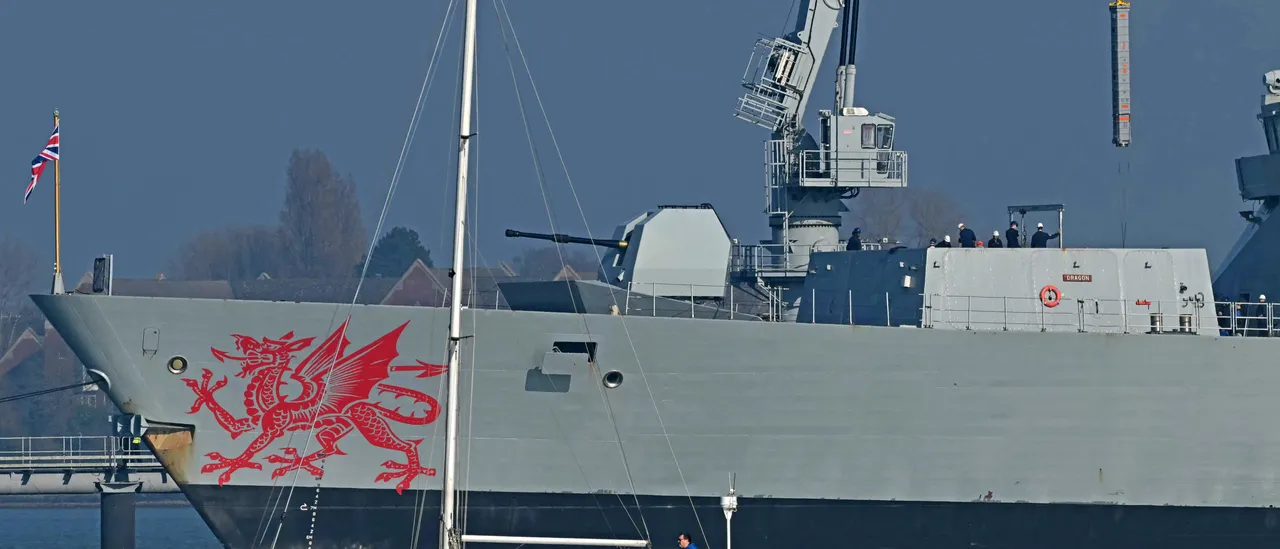
The Royal Navy’s planned deployment of the air-defense destroyer HMS Dragon to counter Iranian drone threats was delayed while the ship remained in Portsmouth for maintenance, a pause union leaders blame on a new nine-to-five work pattern at the dockyard that leaves out-of-hours cover only to volunteers.
The ship that was refitted for an aerial-defense mission sat in dry dock as engineers completed welding and systems work during regular business hours. Union officials argue the shift to restricted working windows came with a big contract change, effectively ending round-the-clock staffing and forcing the Navy to rely on overtime and goodwill to meet urgent missions.
const observer = new MutationObserver((mutations) => { const adDivToHide = document.querySelector("#dailycaller_incontent_1"); if (adDivToHide && dc_noads_page) { adDivToHide.classList.add("hide-premium", "hide-free"); observer.disconnect(); console.log("Ad div found and hidden"); } }); observer.observe(document.body, { childList: true, subtree: true });Prospect General Secretary Mike Clancy was blunt, saying the work pattern leaves national security exposed because it depends on staff volunteering extra hours. “Our members are stepping up to help, but such a vital service shouldn’t be dependent on goodwill from staff. Out-of-hours support should be locked into the contract,” Clancy said.
Ministry of Defence officials acknowledged the ship needed a range of maintenance tasks and weapons reconfiguration before sailing to the Mediterranean and Cyprus, but the delay has real strategic costs. Military partners already have assets in the region, and the destroyer’s later arrival leaves Britain trailing allies by days or even weeks during a fragile and escalating confrontation.
(new Image()).src = 'https://capi.connatix.com/tr/si?token=739c4263-c671-4316-b7cf-ecd244900844&cid=9c4d09f1-aa3e-4da1-ad63-362d562ecfad'; cnx.cmd.push(function() { cnx({ playerId: "739c4263-c671-4316-b7cf-ecd244900844" }).render("59f64f116598417b8d610477330f5a3e"); });Serco Marine Services, the private firm handling port operations, issued a firm rebuttal that its core day runs from 7 a.m. to 7 p.m. and that its teams have met Royal Navy requests on time. The company insisted, “HMS Dragon is being prepared to sail, with the full support of our dedicated teams in Portsmouth. Serco has fulfilled every task requested by the Royal Navy on time and to the agreed standard.”
Union sources, however, say the written contract narrowed coverage in practice: “some specific tasks in the contract are 9-5 on weekdays.” They say the new £1 billion contract reduced essential cover and pushed weekend or out-of-hours effort onto volunteers, a setup that breaks down when speed and unpredictability matter most.
Defense Minister Al Carns confirmed the ship would not depart until the required maintenance was complete and the re-missioning of its systems was finished. Officials describe the work as adapting a ship built for different tasks into an air-defense platform, but critics argue this is a bureaucracy-and-budget problem masked as technical necessity.
const observer2 = new MutationObserver((mutations) => { const adDivToHide2 = document.querySelector("#dailycaller_incontent_2"); if (adDivToHide2 && dc_noads_page) { adDivToHide2.classList.add("hide-premium", "hide-free"); observer2.disconnect(); console.log("Ad div2 found and hidden"); } }); observer2.observe(document.body, { childList: true, subtree: true });The delay is unfolding against the backdrop of a wider military campaign that has already seen the United States and allies strike Iranian-linked targets. President Donald Trump said Saturday that the United States had launched Operation Epic Fury alongside Israel’s Operation Lion’s Roar, initiating a massive air campaign targeting Iranian nuclear facilities and military infrastructure, and Tehran responded with attacks across multiple theaters.
A modern military posture needs predictable, guaranteed logistics and maintenance, not ad-hoc overtime arrangements and public-relations denials. If the goal is deterrence, Britain must demand dockyard contracts that prioritize readiness and have enforceable out-of-hours coverage so a crisis doesn’t stall because someone didn’t sign up for overtime.
const observer3 = new MutationObserver((mutations) => { const adDivToHide3 = document.querySelector("#dailycaller_incontent_3"); if (adDivToHide3 && dc_noads_page) { adDivToHide3.classList.add("hide-premium", "hide-free"); observer3.disconnect(); console.log("Ad div found and hidden"); } }); observer3.observe(document.body, { childList: true, subtree: true });An aerial shot of HMS Dragon in port underscores the symbolic and practical consequences of the pause, showing a ship built to protect airspace sitting idle while the clock on regional operations ticks. The image is a reminder that procurement, contracting, and contract oversight are part of national defense, and when those systems fail the frontline pays the price.
Parliament and the Ministry of Defence face a choice: defend cost-cutting contracts that limit surge capacity, or demand that private partners guarantee continuous support for missions where hours and timing determine survival. The public and the service personnel deserve policies that treat readiness as non-negotiable and put national security ahead of budget optics.
