
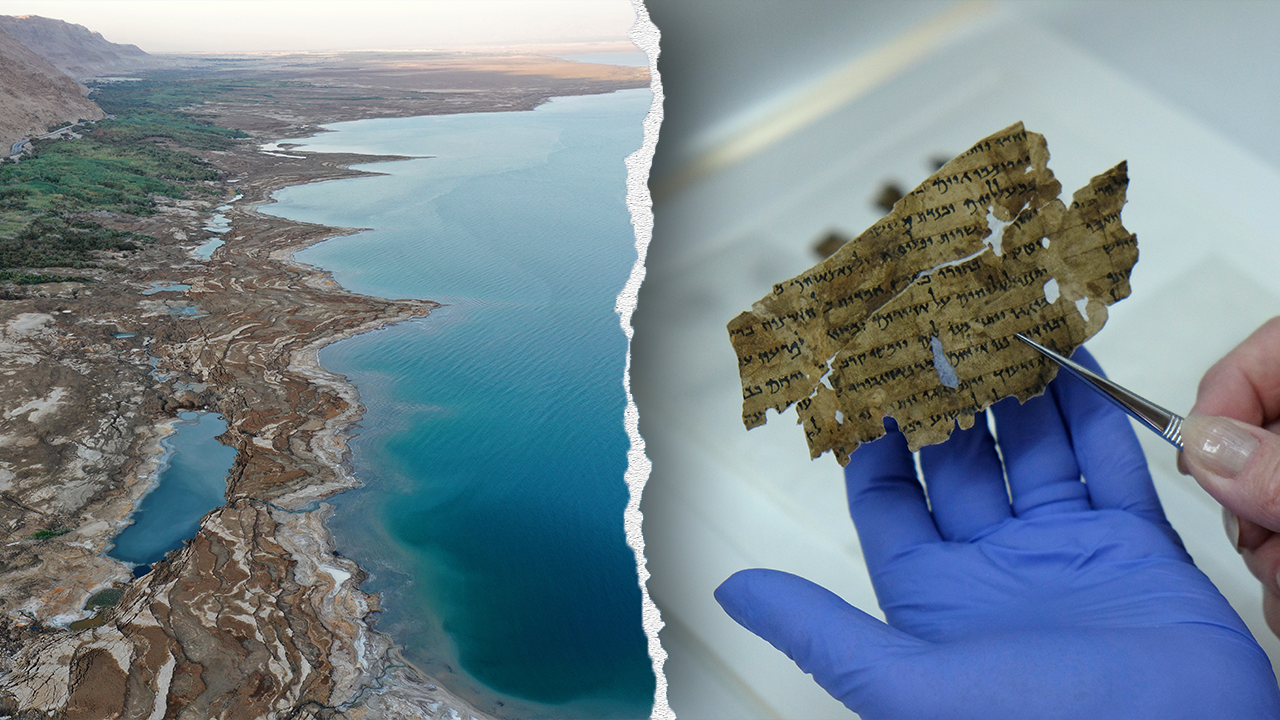
The Dead Sea Scrolls are more than a famous archaeological find. They open a hard, direct window into Jewish life in the land of Israel long before modern politics entered the picture, and they cut through the tired claim that Jewish connection to the land is some recent invention. That is why the scrolls keep landing with such force in debates about history, faith, and legitimacy.
For anyone trying to understand the Middle East without slogans, the scrolls matter because they show continuity. They reveal a Jewish presence rooted in the region more than 2,000 years ago, along with the prayers, laws, and beliefs of communities that lived, argued, and worshiped there. That kind of evidence does not shout, but it does not need to.
The modern story of the scrolls began in 1947, when Bedouin shepherds stumbled on ancient manuscripts near Qumran by the Dead Sea. More caves were later explored, and the finds added up to thousands of fragments from hundreds of texts dating to the last centuries before the Common Era and the first century A.D. The sheer age of the material makes one thing plain: these were Jewish writings from the land itself.
Many people think of the collection as a stack of biblical copies, and that is only part of the picture. The Great Isaiah Scroll is one of its best-known treasures, but the full cache also includes rules for religious communities, legal discussions, hymns, wisdom literature, prayers, and writings about the end of days. It is a living snapshot of how ancient Jews organized faith and daily life.
That is what makes the scrolls feel so much bigger than a museum display. They let modern readers step into the intellectual world of Second Temple Judaism and see how people understood purity, authority, scripture, and redemption. This is not abstract history, it is a record of a people thinking and living in a specific place.
The connection to the time of Jesus is part of what gives the scrolls their electric pull. Luke describes Jesus reading from the scroll of Isaiah in a synagogue, and today there is an Isaiah manuscript from near the Dead Sea that predates his era. No one can prove Jesus held that exact scroll, but the overlap between the texts and that world is impossible to ignore.
That overlap matters even more when the conversation turns to faith traditions that came later. Islam, for example, speaks often about the Children of Israel, names Moses more than any other prophet, and gives deep respect to figures such as David, Solomon, Aaron, and Joseph. In that sense, the scrolls are not foreign debris from a dead civilization, but part of a broader religious landscape that still echoes today.
That is why denying ancient Jewish history feels so backward. It is one thing to criticize a government or argue over policy, but it is something else entirely to pretend a people did not live there, pray there, and write there for centuries. Historical denial does not create justice, and it certainly does not create peace.
The scrolls push back against that kind of denial with quiet authority. They say Jewish communities copied Hebrew Scripture in this land, debated their laws in this land, and built religious life in this land long before Islam and long before modern nationalism. Archaeology cannot win a political argument by itself, but it can expose bad faith fast.
For Muslims especially, that truth should not be threatening. Recognizing the Jewish people’s ancient bond to the land does not erase Palestinians or their suffering, and it does not weaken Islam. It simply asks for honesty, the rarest currency in this debate and maybe the most important one.
There is also something deeply personal in the way the scrolls draw people in. They invite study of Hebrew and Aramaic, the communities behind the manuscripts, and the religious world that shaped so much of the region’s history. Even from a distance, the pull of those texts is hard to shake, because they still feel alive.
That is the real power of the Dead Sea Scrolls. They do not bend to headlines, protests, or talking points, and they do not care who is shouting loudest on any given day. They sit there, ancient and stubborn, reminding anyone willing to listen that history is bigger than whatever argument happens to be loudest right now.

1 Comment
THE HOLY FATHER GOD “BLESSED ABRAHAM”:….. And told him that whoever “Blesses him, HE will Bless them!!! AND, “Whoever CURSES him, HE will “CURSE” them!!! That includes Abraham’s “SEED”!!!!… “EVERY EMPIRE” that has did anything WRONG to the “Jewish” people is “GONE”!!! Including the “BRITISH”!!!! The US is next!!!!!!