
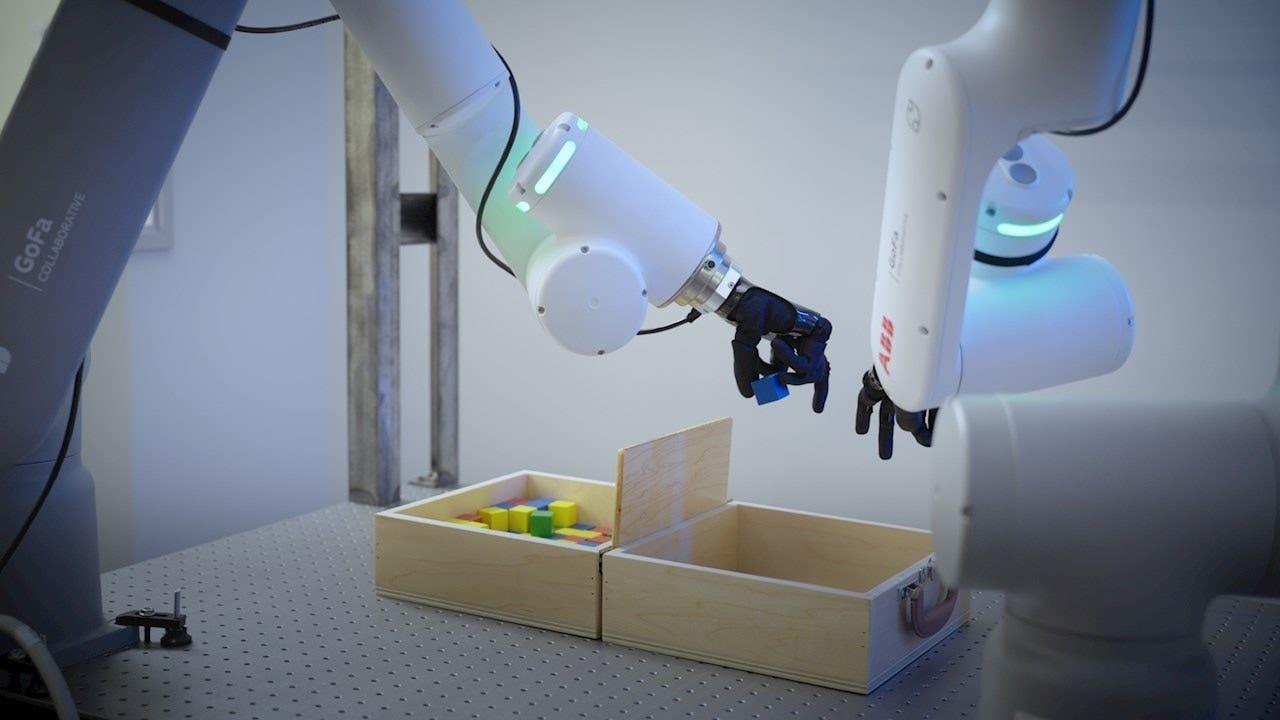
ABB Robotics and PSYONIC are teaming up to teach industrial robots a human sense of touch, using real-world grip and motion data from PSYONIC’s Ability Hand paired with ABB’s GoFa cobot to tackle delicate, varied handling tasks that traditional automation struggles with.
Robots excel at speed and repetition, but they still trip up when an object is fragile, oddly shaped or just a little different from the last piece. Researchers want robots to adapt the way people do: change grip, modulate pressure and shift angle without a programming reset. That shift means moving beyond rigid commands toward machines that learn from human touch patterns.
The heart of the project is PSYONIC’s Ability Hand, a prosthetic tool built for real people. It has multi-articulating fingers, pressure sensors and vibration feedback that help users sense and adjust grip in real time. That real-use data, captured during everyday tasks, could teach robotic arms how to handle objects with nuance instead of brute force.
On the industrial side sits ABB’s GoFa cobot — accurate, repeatable and suited to controlled testing. Putting the Ability Hand’s human-sourced touch data into a cobot’s workflows could produce a hybrid learning loop. The idea is simple: let human dexterity inform machine motion so robots can perform delicate handling in factories and warehouses.
Why does this matter? Because many automation failures come down to touch. A package that’s too soft, a part that shifts on a conveyor or a small tilt in a component can ruin a cycle. Robots that squeeze too hard damage goods; those that apply too little pressure drop them. Teaching robots the in-between feels like the last big frontier of practical dexterity.
Marc Segura captures the gap plainly: human dexterity remains “one of the most difficult things to replicate in industrial-grade robotics.” Closing that gap is the project’s explicit goal. If robots can learn from how people handle items in messy, real settings, they’ll be better at tasks that used to need human judgment.
PSYONIC’s hand was designed to help people, using myoelectric control and compliant mechanics so it conforms to irregular shapes. Its sensors record pressure and contact while vibration feedback gives users a sense of touch. Those same sensing features make it an ideal data source for training robotic grasping strategies outside a sterile lab environment.
Dr. Aadeel Akhtar puts the problem in stark terms: dexterous manipulation is “a data challenge as much as a hardware challenge.” Building better hands helps, but the training data often decides whether a hand is useful on a real floor. Data from genuine human interactions brings complexity and variation that lab demos rarely capture.
The team expects the work to reach into automotive, aerospace, packaging, logistics and life sciences, where robots already play big roles. These fields often deal with fragile components, oddly shaped parts or soft packaging that require a light touch. Better touch-aware robots could reduce custom engineering and speed deployment in those settings.
Industry groups note gains from smarter gripping and integration, lowering setup and engineering time and making automation more flexible. That could mean faster rollouts and fewer niche fixes when production lines change. The payoff is not just speed; it’s the ability to handle variability without constant human reprogramming.
There’s a human side to the technology too. Touch-enabled robots could spare workers from repetitive, ergonomically damaging tasks and leave people to higher-skill jobs like oversight and quality control. At the same time, more capable machines raise questions about how roles and hiring evolve when tasks once deemed too variable to automate become tractable.
If robots are going to learn from human touch, the ethics of data use, workplace impact and safety testing must stay front and center. Collecting real human grip data should come with clear rules about consent, privacy and how that information is stored and applied. Done responsibly, the approach could move robots closer to safe, effective collaboration with people on the factory floor.
