
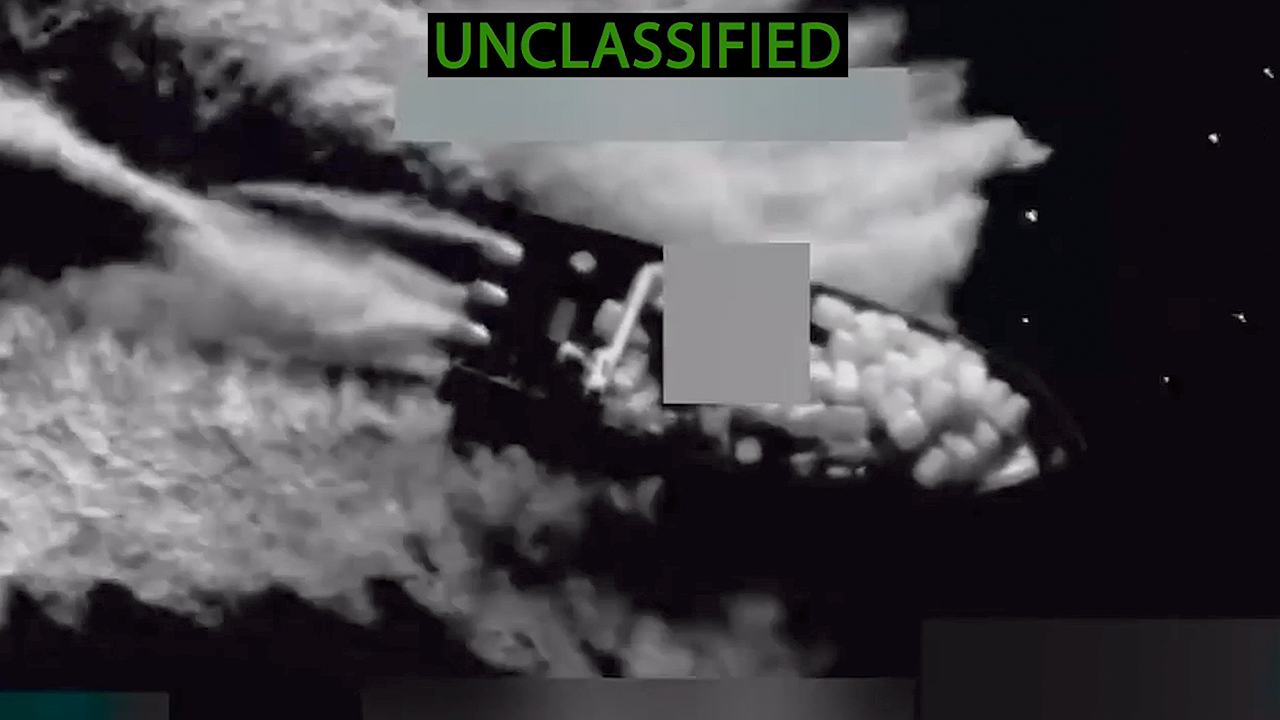
The Pentagon has released fresh unclassified images that put suspected drug-smuggling boats in plain view, and the message around them is anything but soft. The Trump administration says its campaign at sea is hitting trafficking networks hard, forcing criminals to change tactics, and keeping pressure on the people moving narcotics toward the United States.
The pictures, taken over several months in late 2025, show small vessels cutting across open water under military surveillance, with packages visible on board in at least one case. Officials say those boats were linked to trafficking routes and that the strikes carried out against them were part of a broader push to stop deadly drugs before they reach American streets.
“Nearly one year after the first strike, the message to narco-terrorists remains unchanged: if you traffic deadly illicit narcotics and threaten the American people, we hunt you down, we will find you, and we will kill you,” Pentagon press secretary Kingsley Wilson said in a statement provided to Fox News Digital.
Wilson also said Operation Southern Spear has broken up trafficking networks, forced smugglers to adjust their methods, and taken “dangerous narcoterrorists” out of the fight. The Pentagon says the operation has already carried out 67 strikes, starting with the first one on Sept. 2, 2025.
One of the newly released images, dated Oct. 27, shows a suspected drug-smuggling vessel loaded with apparent narcotics. Another, dated Oct. 29, captures a small boat moving through the water, a stark reminder that these encounters are not abstract policy fights but real-time confrontations in busy transit lanes.
A third image, dated Dec. 4, shows yet another suspected smuggling boat at sea. The visual record is being used to back up the administration’s claim that the campaign is targeting vessels tied to narcotrafficking, not random traffic on the ocean.
Officials have framed the mission as a direct response to the flow of drugs into U.S. communities. Wilson said the campaign demonstrates that the United States will use “every lawful tool available to defend our Homeland and protect our communities,” a line that captures how aggressively the administration wants the issue understood.
The military’s latest actions have not slowed the pace of public warnings. Just days before the Caribbean strike, U.S. forces said two people were killed in an Eastern Pacific operation, which marked the first reported strike in more than two months and showed the campaign stretching across major trafficking corridors.
In that Aug. 25 operation, U.S. Southern Command said four alleged smugglers were killed aboard a fast boat moving along known routes in the Caribbean. SOUTHCOM said intelligence confirmed the vessel was involved in narco-trafficking, and Gen. Francis L. Donovan said the task force would “hunt, disrupt, and defeat” cartel networks.
Donovan also said SOUTHCOM is focused on “neutralizing cartel terror and violence throughout the region and into the U.S. homeland.” That language reflects a wider shift in how the administration is treating cartel activity, not as a distant crime problem but as a direct threat with military implications.
The strategy has already moved beyond simple interception at sea. Trump has described the fight as an “armed conflict” with cartels in Latin America, and the administration has also been exploring cooperation with allied nations that could broaden the effort onto land in parts of the region.
War Secretary Pete Hegseth said during a visit to Panama that Colombia, Guatemala and Honduras had agreed to allow joint operations against criminal groups on their soil, though Guatemala later denied that an agreement had been reached. Ecuador began similar missions with the U.S. in March, adding another layer to a campaign that is clearly getting bigger and more coordinated.
