
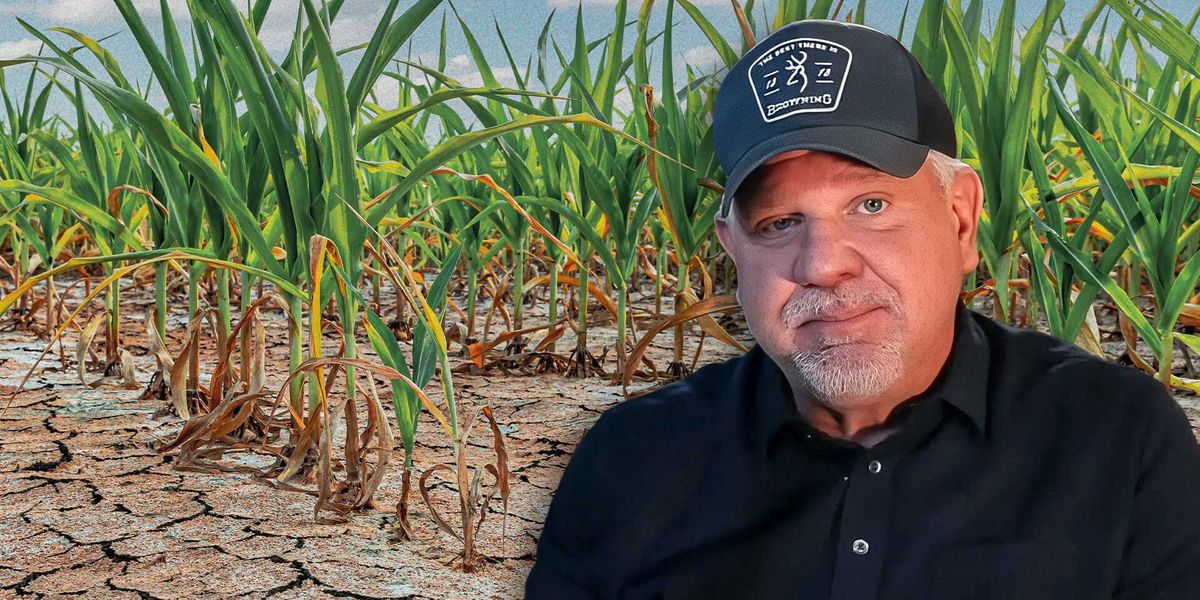
The country is staring at a severe drought that already covers more than half of the lower 48 states, and the practical consequences are starting to show in fields, markets, and communities. This piece looks at what that means for food supplies, what conservative voices are saying we should do about it, and simple steps families can take to reduce risk and rely less on fragile systems.
Across the South and much of the West, water shortages are not theoretical—they are here now and intensifying. Crops from sugar cane to winter wheat are suffering, mountain snowpacks that feed rivers are shrinking, and farmers are being stretched thin trying to keep seed in the ground and animals fed.
Conservative commentator Glenn Beck puts the situation bluntly: “The South is baked. Sugar cane, rice, peanuts, fruit trees [are] choking under severe, extreme, and even exceptional drought. Out in the plains (that’s our bread basket), winter wheat is sitting in dust; it can’t germinate because it doesn’t have the water. In the West, the mountain snow pack is vanishing before our eyes.” His words underline a basic fact: production problems at the farm level have real, fast effects on household budgets.
Markets react to scarcity, and scarcity is what we are likely to see if drought conditions persist through planting and harvest seasons. “Food costs are going up and not a little — a lot. Beef, grains, produce, everything that comes from the fields all across our fruited plain. It’s going to cost more at the grocery store, and it’s coming sooner and faster than most people want to even admit,” Glenn warns, and those price pressures hit hardest on working families and fixed-income households.
That economic squeeze pushes a conservative solution set: more local resilience and less blind dependence on stretched national systems. Glenn implores people to make practical changes now, urging basics like growing what you can and building modest food stores to blunt supply shocks. The point is not panic but preparation—simple, small steps that take pressure off both families and communities when supply chains fray.
Faith and community are central to the response he recommends. “I’m asking you to fast and pray for rain all across the country. I’m asking you to fast and pray for our farmers because our farmers are under extreme stress. … They are probably the most important cog in the chain of this machinery,” he says, tying spiritual practice to civic duty in a way that resonates with many conservative Americans who value both faith and rugged self-reliance.
Beyond prayer, Beck makes plain the second pillar of action: reduce dependence on distant systems and grow local capacity. “It is really important that you become as food independent as possible. If you don’t have food storage, you should. If you have a scrap of yard, plant a garden this spring — tomatoes, beans, potatoes, greens, anything you can grow. Anything,” he urges, and that advice is straightforward and achievable for many households.
Neighborhood-level responses can multiply individual efforts without requiring government intervention. Organize community gardens, learn basic preservation skills, share surplus produce, and create informal networks to help neighbors in need. Those are conservative-friendly approaches that emphasize voluntarism, mutual aid, and hands-on work rather than centralized plans that often move slowly and cost a lot.
Beck frames the crisis in stark cultural terms to mobilize his audience: “This isn’t just about rain or fertilizer prices, market prices. … We are in a spiritual war, and I’m telling you, the very gates of hell will come against us in the days ahead,” he warns, urging moral seriousness alongside practical steps. Whether one reads that literally or as a call to moral clarity, it is meant to prod people into action and community building now.
He also stresses unity over division as a strategic necessity: “This too shall pass, but it will pass a whole lot easier if we stop pulling in different directions and start sticking together; if we stop hating one another and start helping one another; if we start to get to know our neighbors and say, ‘Look, I don’t care how you vote, man, but have you seen the price of food?'” Building practical bridges right now preserves social capital so communities can cope and recover more quickly.
Finally, his closing plea blends the practical with the spiritual: “Plant your seeds in the ground, and plant seeds of love in your heart and in your faith, and get ready because the storm is here.” That sums up a conservative recipe for resilience—prepare materially, bind together socially, and keep faith—so families and towns can weather the shock without surrendering liberty or relying on slow-moving bureaucracies.
