
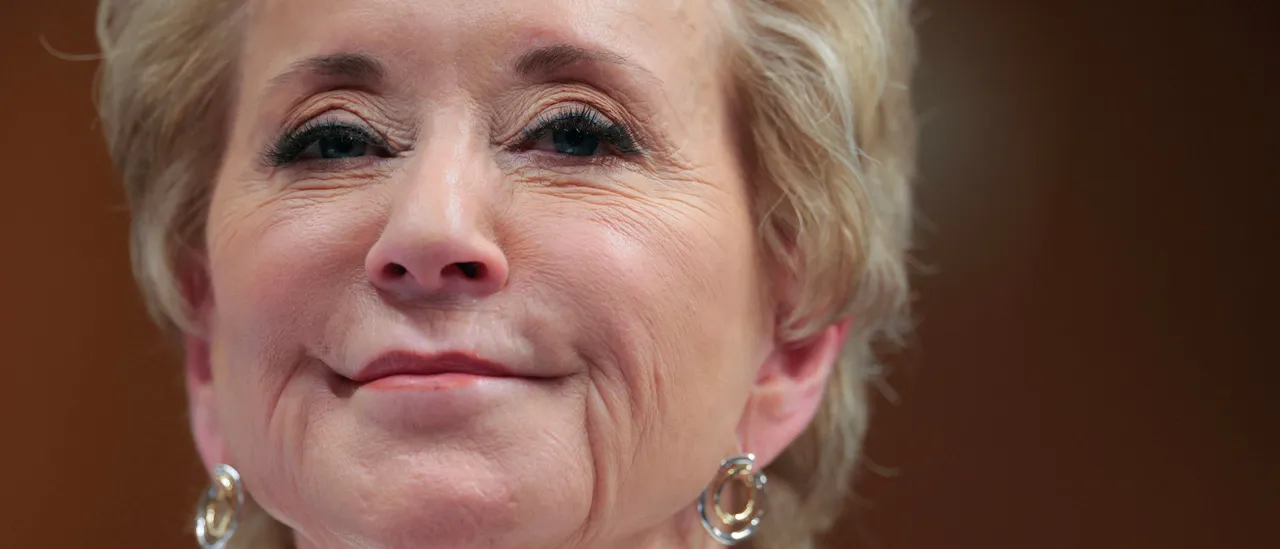
Linda McMahon pushed back hard this week against Democratic claims that pouring more federal dollars into schools will fix the literacy emergency, arguing that money alone is not the answer and that Washington’s role should be rethought. The confrontation unfolded outside the Education Department, where Democrats and union leaders demanded McMahon step down while defenders of reform pointed to stubbornly low reading scores despite high spending. The debate highlights a bigger fight over whether federal control and more cash actually help kids learn or just prop up failing systems.
The Democrats at the press conference leaned on the familiar line that public schools are starved for funds and that more money would solve the problem. That argument ignores a simple fact: the United States spends more per pupil than most developed nations and still lags academically. Pointing at bigger budgets while ignoring curriculum, standards, and accountability is politically convenient but doesn’t answer why outcomes are poor.
McMahon made the blunt point plainly: “If you look around the world, the United States spends more per pupil for education than any other developed country in the world, and we have the poorest results to show for it,” McMahon told the DCNF. “It just shows that throwing money is not the problem.” Those words cut to the heart of the conservative critique—spending more without changing incentives and structures rarely moves the needle on real learning.
Democratic representatives and union officials demanded McMahon quit, calling her tenure destructive and claiming bureaucrats must be in charge to protect students. McMahon dismissed the event as unserious and full of errors, saying the complaints “seemed to be addressing issues that are just incorrect.” The real question is whether centralizing power in Washington or empowering families and local schools will better serve children.
One striking line from the Democratic side was a rejection of testing accountability, with Rep. Mark Takano saying “we haven’t really fully worked out how testing is appropriate in education.” That stance is worrying to many who believe some objective measure of learning is crucial. Without standards and honest assessments, it’s easy to mask decline with better budgets and fancier programs that don’t deliver learning gains.
Takano stressed the pandemic’s impact, noting “We’ve gone through a pandemic. There was tremendous learning loss. My heart went out to all the teachers who had to do virtual teaching. That is just very difficult to do,” and rightly acknowledged the hardship. But the reading crisis predates COVID, and blaming recent disruptions alone avoids tougher questions about curriculum, teacher training, and school choice. Good policy needs to face those preexisting failures head-on.
McMahon argued forcefully about the actual role of the Education Department: “The Department of Education doesn’t educate one child. We don’t hire teachers. We don’t buy books. We don’t set curriculum. We don’t do any of that. We’re simply a pass-through entity of the funds that are appropriated by Congress, and those channels are not going to change, even if the program is located in a different agency.” Her point is that reshuffling federal boxes won’t fix instruction in classrooms.
She also reminded listeners that America functioned for decades without a federal education bureaucracy: “For heaven’s sake, how did they exist before there was a Department of Education? The Department of Education stood up in 1980, prior to that, we had people going to school, graduating from school, going to college, entering into professions.” That history undercuts the idea that more federal control is the only path forward.
The administration has started shifting some programs to other agencies and partnering across departments to reduce centralized control and bureaucracy. Advocates for change argue that promoting school choice, local decisions, and accountability will do more for literacy than yet another round of federal spending. The real reform conversation should focus less on funding slogans and more on the specific policies that help children read and learn.
