
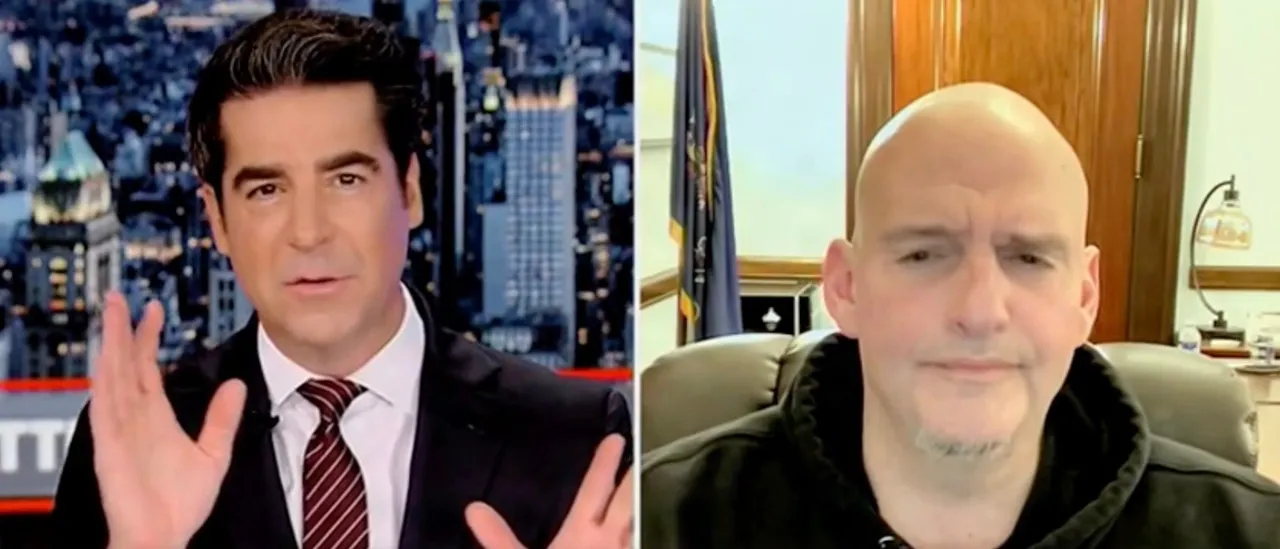
Sen. John Fetterman openly criticized his Democratic colleagues for publicly denouncing President Trump’s strikes on Iran while privately sharing concerns about Tehran’s nuclear ambitions, arguing party loyalty has become a higher priority than national security and urging colleagues to admit when actions make the country safer.
Fetterman, a Pennsylvania Democrat known for breaking with his party, told television audiences he sided with the operation because it reduced the risk of a nuclear Iran and deserves acknowledgment regardless of who ordered it. He said the partisan reflex among Democrats prevents honest assessment of successful military moves, and he framed his stance as choosing country over party. That stance led him to vote against measures that would limit the president’s ability to act in Iran.
“As a Democrat they are afraid to just agree with Trump on anything. Anything at this point,” the senator emphasized during his appearance. “And hey, I’m going to agree with it. I’m always going to pick my country over my party, and I’m always going to acknowledge when good things happen.”
On Fox News, Fetterman faced pointed questions about why fellow Democrats rushed to condemn the strikes after briefings meant to inform them on the facts, and he pushed back on what he described as theatrical fearmongering. He watched the footage that critics referenced and said the images made a clear case that the action had tangible, effective results. That concrete outcome, he argued, should allow honest praise even from those who oppose the president politically.
“I watched the highlights that you showed, especially the ship getting blown out of the water,” the senator replied, referring to footage of the operation Watters had interspersed between clips of critical Democrats. “I remember the Iranian generals were saying that our ships were going to end at the bottom of the ocean, and that is theirs.”
“Look at that again, it’s on the screen right now. Boom!” Fetterman continued. “I love it. So, I don’t know why we can’t … just celebrate that.”
WATCH:
Fetterman pressed the point that members of Congress privately concede Iran can never be allowed to build nukes, and he warned that eliminating key hostile leaders can change strategic calculations in a way that improves regional stability. “But I guarantee you every single member of the Congress that you had there said we could never allow Iran to acquire a nuclear bomb and now … it’s made that impossible right now,” the Pennsylvania Democrat added. “They all now say we won’t grieve that the Ayatollah is gone.
“Why can’t we as a Democrat just say, ‘Hey, I think that’s a good thing. I think the world is safer. I think it’s more just. And I do think we have a possible path for real, true, enduring peace in the region.’ I will say that,” Fetterman told Watters. “I will acknowledge that. Why they can’t? Because they have seen that too, and they all know we can never allow them [Iran] to have a nuclear bomb and that it’s better that he’s [the Ayatollah has] been killed.”
Fetterman didn’t limit his criticism to one network; he also appeared on cable news where he reiterated his frustration with the reflexive Democratic denunciations and urged colleagues to put country first. He used blunt language to call out what he sees as performative opposition, arguing that acknowledging a successful strike is not the same as endorsing all of a president’s policies. That practical approach is consistent with how he has voted and spoken on other national security questions.
His remarks expose a deeper divide inside the Democratic Party between principle and optics, with Fetterman staking out a position that crosses partisan lines and prioritizes tangible security outcomes. He framed praise for operational success as patriotic, not partisan, and challenged colleagues to end the knee jerk of opposing the president at every turn. For voters who place national security above partisan theater, his message lands as a rare call for political honesty.
Whatever one thinks of the strikes, Fetterman’s comments force a conversation about whether political loyalty or safety for Americans should set the tone in moments of international crisis. He invited lawmakers to acknowledge when an action reduces the nuclear threat and to evaluate results without letting party optics override reality. That insistence on pragmatic judgment rather than tribal signaling is what set his remarks apart in a charged media moment.
