
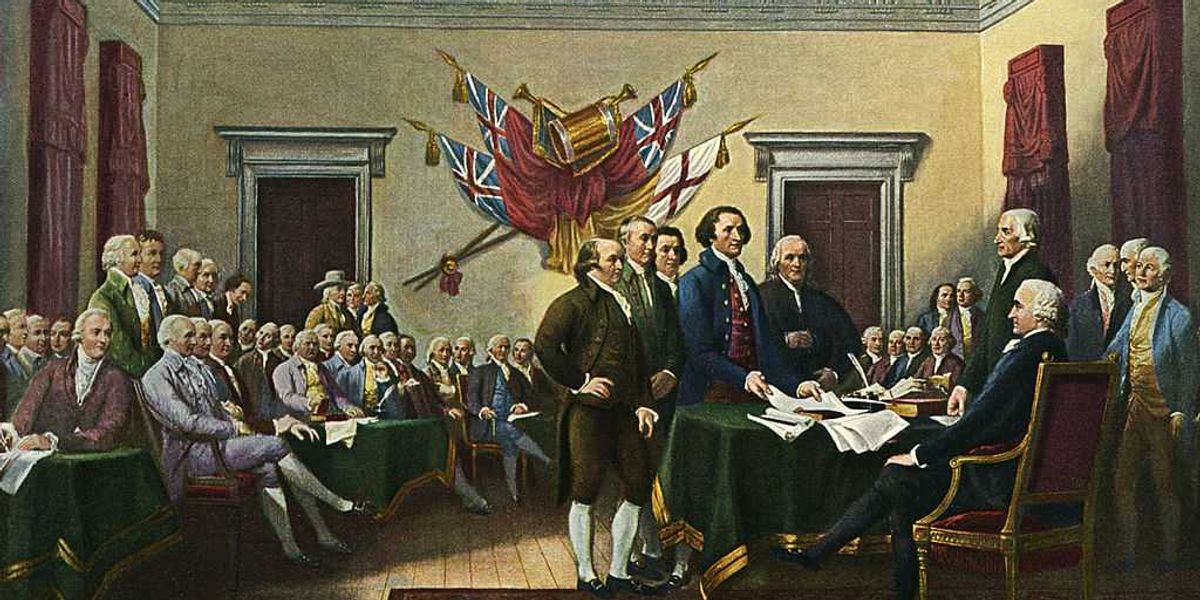
The Declaration of Independence does more than list grievances; it starts with a claim about reality itself, making rights a matter of created order rather than political convenience. This piece pulls apart the Declaration’s three-part logic — self-evident truth, created human nature, and rights — and explains why that framing matters for faith, law, and the future of our country. It also explains why the founders left explicit redemption to churches while grounding public life in natural theology.
Look at how the document opens: it does not launch straight into politics. Instead the founders anchor their case in a metaphysical claim, insisting that the world and human beings are intelligible and that our public life must begin there. This sets a firm limit on what politics can legitimately claim to create or remove.
The rights named in the Declaration are not presented as privileges handed down by government or mere historical conveniences. They flow from a prior reality: that human beings are created. The text ties political legitimacy to an order beyond the state, invoking “the Laws of Nature and of Nature’s God” as the bedrock of its argument.
That famous line, “We hold these truths to be self-evident, that all men are created equal,” is not poetic fluff but a structured philosophical move. First, those truths are declared knowable — self-evident — putting moral knowledge in the realm of human reason. If we deny that some truths can be known, we remove the basis for moral responsibility and make law into mere preference.
Second, the Declaration asserts a created human nature, which gives equality a real foundation instead of treating it as a political fiat. Equality is intelligible because we are equally creatures with the same fundamental status before the creator. From that shared nature springs the moral claim that people deserve equal moral consideration.
Third, the ethical consequence follows: given who we are, we possess rights like life, liberty, and the pursuit of happiness that governments must respect. Rights are not gifts granted or withheld by rulers; they are demands grounded in the human condition. Strip away any of the three steps and the whole claim about rights loses its force.
Remove the claim that truth is knowable and public argument collapses into relativism. Deny creation and equality turns into a political program rather than a moral reality. Reject rights grounded in nature and liberty becomes a whim of whoever holds power. That fragile place is where modern secularism often finds itself and where limited government principles have to do their work.
“The Declaration of Independence is precisely that: a declaration of independence. It is not a confession of faith, a catechism, or a constitution.” The founders knew their document had a narrow political purpose and chose natural theology as the right language for a political indictment of tyranny. They did not intend the Declaration to handle every theological dispute or to serve as a church manual.
That restraint was deliberate. Many founders expected explicit Christian commitments to appear in other civic instruments like state constitutions and in the public practice of churches. The national declaration instead aimed at truths binding on all people, the common ground needed to justify a break with Britain and to provide a public moral foundation.
Natural theology in the Declaration is robust, not thin: it assumes a creator distinct from creation and a knowable human nature. That stance excludes philosophies that deny a creator or treat human nature as purely contingent. It sets public debate on a level that recognizes moral obligations independent of political wills.
At the same time, natural theology cannot do what revealed religion does. Scripture points to redemption and the particularities of faith in Christ in ways reason alone cannot. The founders understood that civil authority imposing specific creeds would corrupt both church and state, so they left questions of salvation and doctrine to churches while grounding public claims in what everyone could reasonably apprehend.
That division matters for modern conservatives: it preserves a vigorous religious life without letting politics become a church, and it keeps government from pretending to create moral reality. If American Christians want lasting influence, they must do the hard, patient work of evangelism and civic formation outside the machinery of power. Politics can protect the conditions for flourishing, but it cannot replace conversion or conscience.
