
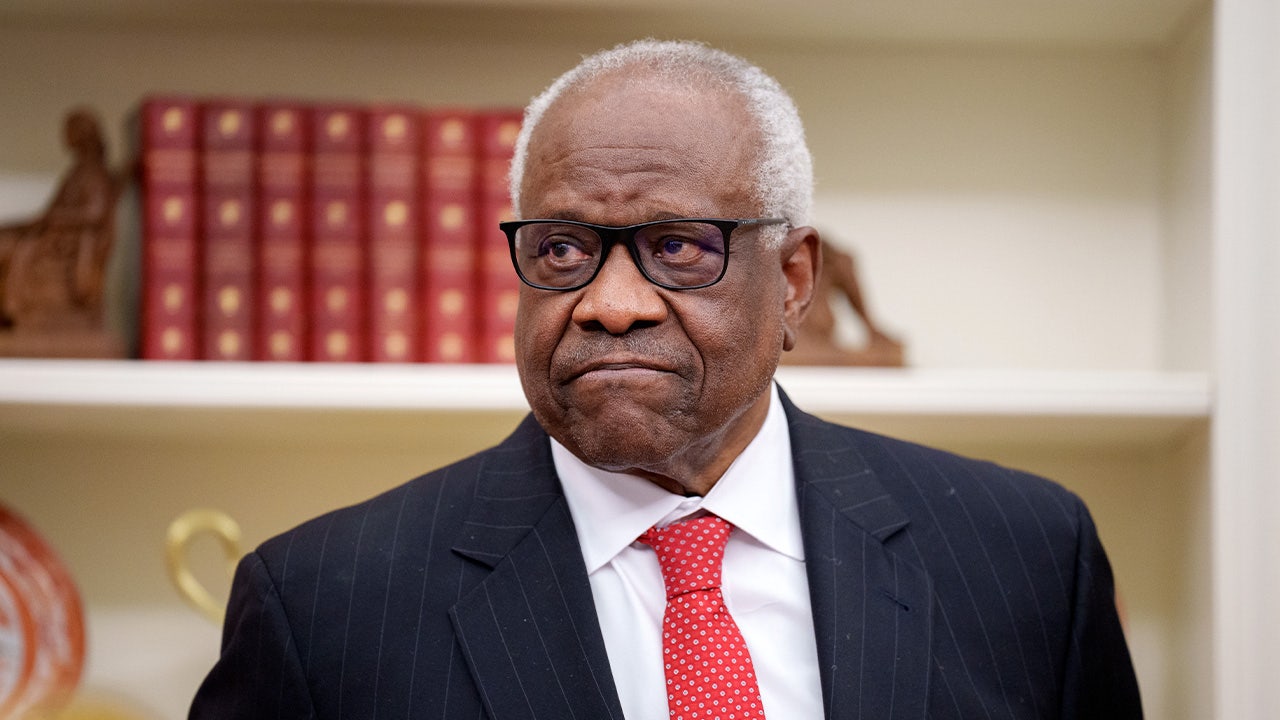
Clarence Thomas opened up about the people who shaped his life, the losses that still hit hard, and the ideas that helped him make sense of it all. In a candid conversation, the Supreme Court justice connected his grandparents’ example of grit and discipline with the influence of Thomas Sowell, while also reflecting on how those lessons stayed with him for decades.
Thomas said the death of both grandparents in 1983 left a deep mark. “When both my grandparents died suddenly in 1983, the decision I made was to live the rest of my life as a memorial to theirs,” he told Hoover Institution fellow Peter Robinson during an on-stage discussion.
The moment clearly mattered. Thomas paused to collect himself before adding, “And the point I’m going to make is that is the way I feel about Professor Sowell,” drawing a direct line between family love and intellectual influence.
Robinson tried to lighten the mood, but the conversation kept circling back to the force of Thomas’ upbringing. He was raised by his maternal grandparents in segregated Savannah, Georgia, after his father left when he was 7, and the family’s background was marked by hard work, poverty, and a stubborn refusal to quit.
Thomas described a childhood shaped by farm life and sacrifice. The land they worked had once been a plantation, and the family spent summers farming there, carrying on with little comfort and even less ease.
His grandparents never went to high school. Thomas said his grandfather, Myers Anderson, had only nine months of formal education, while his grandmother, Christine Anderson, made it only to the sixth grade.
Even with so little schooling, education still sat at the center of their values. Thomas said that for both of them, learning was the crown jewel, not status or money, and that attitude left a lasting imprint on him.
He spoke warmly about the two of them, calling his grandmother a “saintly woman” and his grandfather a “great man.” Their example was not about complaining over what they lacked, but about building the strength to do what had to be done.
That lesson was summed up in one of his grandfather’s favorite lines: “Old man can’t is dead. I helped bury him.” Thomas said that phrase was repeated often in the house, almost like a family anthem against self-pity.
The message was simple and tough. If something needed doing, the answer was not to fold up and feel sorry for yourself, but to get moving and figure it out.
Thomas also credited Thomas Sowell with helping him see that mindset more clearly. Rediscovering Sowell, who is also Black, gave him room to think differently from many of the public voices that dominated conversations about race.
He said Sowell’s writing matched what he had already absorbed at home and in the Catholic nuns who educated him. The common thread was self-reliance, self-discipline, and a belief that character matters just as much as circumstance.
“Well, I think it’s something that Professor Sowell has been trying to stress, that a lot of the groundwork to being able to do difficult things, to achieve, are attitudes. And he talks about other groups,” Thomas said. “And that’s what attracted me initially to ‘Race and Economics,’ because if you go back and you look at ‘Race and Economics,’ he talks about attitude of self-reliance, of self-discipline, etc., how important those were.
“Where did I first hear that? I heard it from my grandfather, the single greatest man I’ve ever known, my grandmother, a saintly woman, my nuns. Same thing. It’s the exact same thing,” Thomas continued.
