I stumbled into a one-chair barber shop as a kid and walked out convinced Archie Andrews had been rewritten as a missionary. This piece traces that odd detour, the artist who drove it, the small Christian imprint that published the tales, and how that experiment fits into shifting American attitudes about faith and popular culture. It is part memoir, part cultural archaeology, and a look at how even light entertainment sometimes doubles as doctrinal freight.
Winn’s barber shop smelled of disinfectant and hairspray and was shaped by ritual. I waited alongside my brothers, flipping through whatever comics were on the rack, and got hooked on Archie because Winn stocked nothing else. The stories were simple, the jokes comforting, and Riverdale felt like a refuge from whatever else was going on outside.
Then one issue tilted into something unexpected. The cover promised the usual gag but inside the tone shifted: a cop scolds Archie about a one-way street and Betty cheers as if witnessing a spiritual conversion. It was the same bright artwork, the same fonts, but the cast had been draped in evangelical language and scenarios that felt out of place for a gag comic.
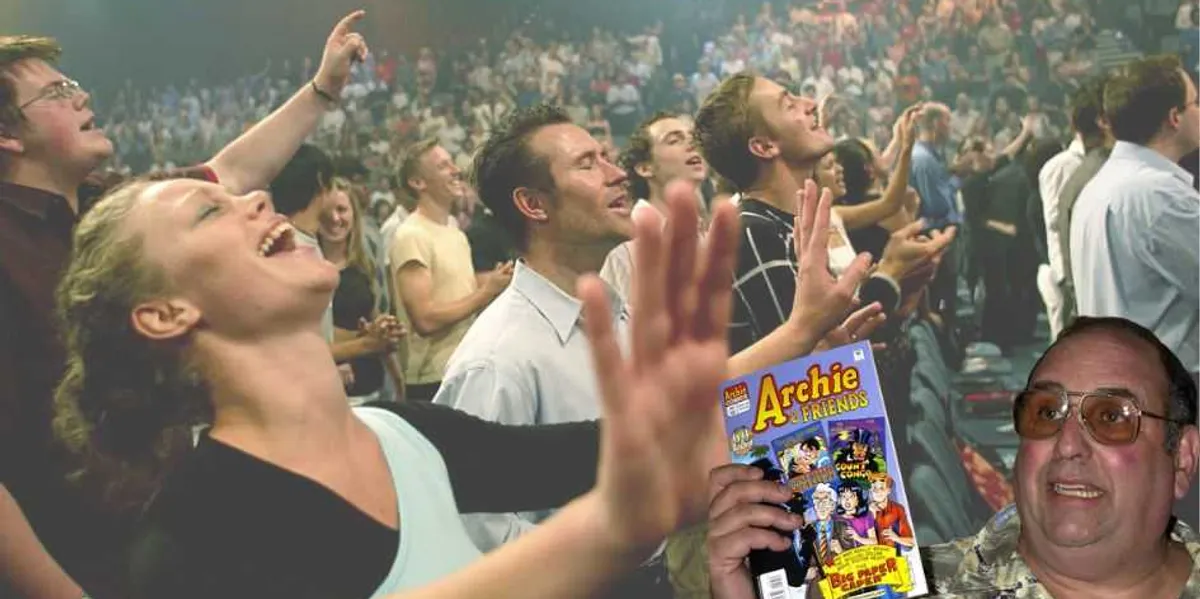
The change wasn’t random. A long-time Archie artist named Al Hartley had embraced a born-again faith and found a way to funnel that energy into licensed Archie material. Those stories ran under a Christian imprint during the 1970s and early 1980s, placed in church bookstores and distributed through networks that bypassed mainstream news. To many readers they arrived like a prank that never got explained.
The narratives were direct about their intent. One issue staged a grotesque Times Square of the imagination, full of lurid movie titles that seemed designed to shock, while another turned Betty into a gospel-sharing figure who helps a troubled classmate find faith after an accident. The comics read like wholesome teen drama that suddenly switched tracks into a sermon.
The experiment with Archie was part of a broader moment when faith and pop culture mixed in ways that now seem surprising. For a time, mainstream comic publishers took on explicitly religious projects, producing biographies of global religious figures and even a few faith-minded superheroes. Those efforts often lasted only briefly, but they show how porous the boundary once was between religious messaging and mass entertainment.
Commercial realities kept the proselytizing titles separate from the regular Archie line, which continued its usual misadventures untouched. The Spire-run entries lived in a parallel lane where readers could choose the secular Riverdale or the evangelizing one, and only a few unsuspecting kids, like me, found the detour by accident. Without social media to amplify surprises back then, these oddities drifted by quietly.
Those quieter days also made it easier to imagine faith in public as permissible rather than controversial. Publishers experimented, religious entrepreneurs took chances, and creators pitched projects that mixed evangelism with entertainment in ways that would be harder to launch today. The cultural shelf space for that kind of crossover narrowed as media fragmented and debates over identity and representation intensified.
One late attempt to imagine mainstream comics with a biblical worldview even involved Stan Lee exploring faith-adjacent storytelling for an online venture. The pitch captured the idea plainly and is worth quoting exactly as it was presented:
This approach would promote belief in God, the example of Christ’s life, the reality of supernatural conflict, strong moral values, and an altruistic lifestyle. Our stories would be fully compatible with the Bible and religious tradition, but without painting ourselves into a corner theologically. The goal of this approach — a goal that’s urgently needed today — is to open young minds to the reality of God, to build a strong case for faith and morality by example, without being preachy or dogmatic. It can help launch youth of all ages on a quest for truth and a personal relationship with God.
That hopeful language points to a persistent motif: storytellers trying to blend narrative with moral formation without losing the audience. Sometimes it worked awkwardly, sometimes it flopped, and sometimes it vanished when commercial tides shifted. The ventures left traces rather than institutions, artifacts for curious readers to stumble across decades later.
Archie Andrews has been a cultural weather vane for decades, picking up trends from jitterbug dances to modern streaming sensibilities. The Spire episodes are a quirky chapter in that history, a reminder that even the most middlebrow comics can become vehicles for conviction. Whether you see that as genius, opportunism, or something stranger depends on where you stand, but the fact that these issues exist is an irresistible little footnote in pop culture history.
Today’s comics follow different currents, and recent moves toward broader representation have reshaped Riverdale in ways Hartley could not have predicted. Still, as taste and culture swing and settle, older experiments with faith and fiction remain worth opening up, if only to marvel at how an everyday waiting room once served as the front row for a curious cultural collision.