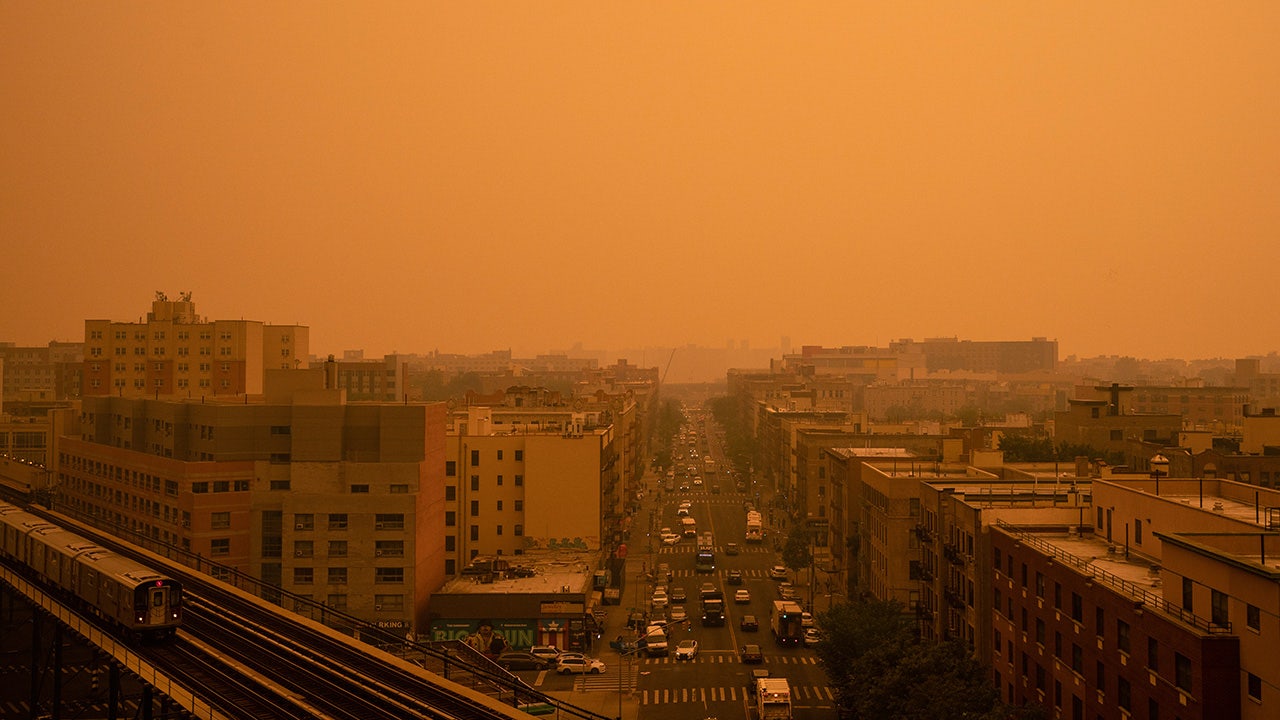
Wildfires, heat waves, and blackouts have put a hard spotlight on what happens when environmental ideology gets ahead of common sense. From choking smoke drifting across borders to deadly European heat and shaky power systems in New York, the message is hard to miss: policies sold as stewardship have too often made life more dangerous without delivering much in return.
Canada offers a glaring example. More than 800 wildfires burned across the country this summer, and the smoke rolled over more than 100 million Americans, from the Midwest to the capital region. Canadian leaders pointed to climate change, but that explanation only raises a bigger question about what years of ambitious climate policy actually accomplished if the fires still rage and the smoke still spreads.
For more than a decade, Canada embraced a polished version of green politics, complete with higher energy costs, more regulation, and constant talk of leadership. Prime Minister Mark Carney, a former U.N. climate envoy, and former Prime Minister Justin Trudeau both pushed that agenda hard. Yet the forests still burned, and ordinary people were left breathing the consequences.
The bigger problem is the mindset behind the policy. Environmental groups have fought practical forest management for years, resisting thinning, firebreaks, and controlled burns as if human intervention were always the enemy. That approach may sound noble in a conference room, but out in the real world it leaves forests packed with fuel and communities one spark away from disaster.
The scale of the damage is staggering. The 2023 Canadian wildfires released nearly 480 megatonnes of carbon, about twice the annual emissions from global aviation. This year’s fires could end up being even worse, and once again it is ranchers, homeowners, and families who carry the cost while climate slogans do very little to stop the flames.
Europe has its own cautionary tale. Roughly 14,000 people died during a heat wave earlier this summer, and while heat was part of the story, the lack of practical adaptation made it far deadlier than it needed to be. In the United States, hot summers are common, but air conditioning is also common, and that makes a huge difference.
That difference is not accidental. In America, about 90% of homes have air conditioning, while in Europe the figure is closer to 20%. Instead of treating cooling as a life-saving tool, some European officials talk as if using it is morally suspect, even though that attitude leaves vulnerable people exposed when temperatures surge.
One European Environment Agency expert told CBS News that more air conditioning should not be the solution anywhere, arguing that it adds heat to the environment and worsens warming. That line of thinking turns reality upside down, because the immediate risk is not a theory about tomorrow, it is people collapsing today. The irony gets even sharper when senior officials keep their own offices cool while regular staff bake below.
America is not immune to this kind of bad judgment. Washington, D.C. hit 103 degrees on the Fourth of July, setting a record for the hottest Independence Day ever recorded, and Philadelphia canceled its parade after several days above 101. New York City officials also urged residents to keep thermostats at 78 degrees to help protect the grid, a reminder that the power system itself is now part of the story.
That grid is under pressure for reasons that should have been obvious years ago. In 2021, activists pushed to shut down Indian Point Nuclear Power Plant, wiping out roughly a quarter of the New York City region’s power supply. Wind and solar could not replace that capacity, so the state leaned more heavily on natural gas, which increased dependence on a single fuel and made the system more fragile when demand spikes hit.
New York’s problem is not that it lacks energy. It is that ideology keeps getting in the way of the energy it needs most, especially dependable baseload power. Nuclear energy offers clean, steady electricity, but green politics often treats that as less important than appearances and talking points.
The common thread across these failures is a worldview that puts people at odds with the natural world instead of treating human ingenuity as part of the solution. Reasonable forest management, practical cooling, and reliable energy are not radical ideas. They are the kinds of basic tools that keep societies functioning when weather turns brutal and the lights start flickering.
A saner approach would start by admitting that human beings are not the problem to be managed away. They are the only ones capable of protecting forests, building power systems that hold up under strain, and using technology to survive extreme heat without turning every summer into a crisis.