
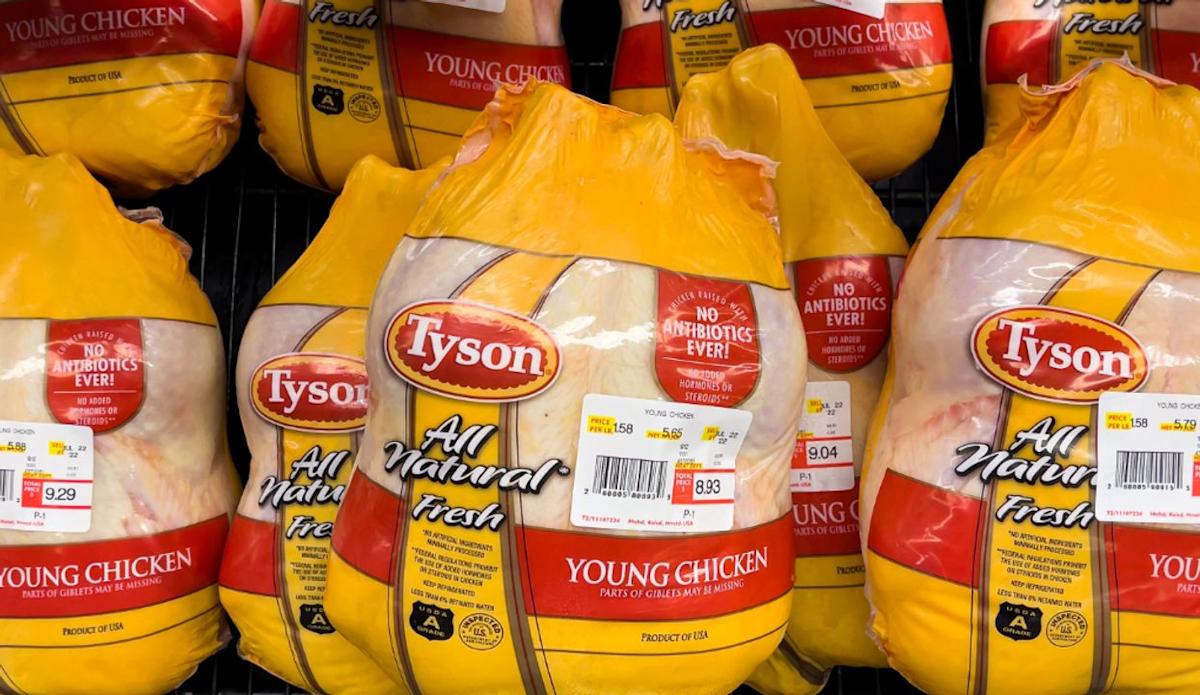
Tyson Foods reported a stronger-than-expected fiscal second quarter, with its chicken business shouldering the company through mixed results elsewhere. The company beat earnings estimates, posted modest revenue growth, and laid out guidance that leans on chicken and prepared foods while acknowledging pressure in beef. Management highlighted disciplined balance sheet moves and plans for capital spending and free cash flow that aim to steady the company as it works through a challenging cattle supply picture.
Tyson Foods Inc reported adjusted earnings per share of $0.87 for the quarter ended March 28, 2026, topping analyst expectations of $0.78. Revenue reached $13.65 billion, slightly above the $13.61 billion street estimate and up 4.4% from $13.07 billion a year earlier. These topline and bottom-line beats offered relief to investors looking for signs of momentum. The results show the company can still deliver in pockets even when parts of the portfolio lag.
Chicken proved the standout, with demand remaining resilient and supporting the overall quarterly performance. Prepared Foods also contributed to momentum, while pork delivered modest profits in line with forecasts. Beef continues to be the sore spot as tighter cattle supplies weigh on margins and volume. Management made clear that beef is expected to drag on the full fiscal year, creating a contrast between protein segments inside a single company.
“We delivered strong results in the second quarter, with our Chicken and Prepared Foods segments driving meaningful momentum,” Tyson Foods CEO Donnie King said. The company pointed to disciplined balance sheet management and execution as factors that help them navigate uneven market conditions. That emphasis on balance sheet discipline underscores a defensive posture while pursuing growth where market fundamentals are stronger.
“Our disciplined balance sheet management, execution and diversified, multi-protein portfolio position us to capitalize on significant growth opportunities ahead.” That statement was repeated by leadership to reinforce confidence in strategy and portfolio mix. Management is signaling it will lean into the parts of the business that are performing and manage down exposure where fundamentals are unfavorable. The messaging is a bet on diversification as a buffer through commodity cycles.
Looking forward, Tyson forecast total company sales growth of between 2% and 4% for fiscal 2026 and adjusted operating income of $2.2 billion to $2.4 billion. The company provided segment-level ranges that reveal where management expects the bulk of profits to come from. Those forward-looking numbers give investors a clearer view of where management sees stability and where risk persists, especially in protein-specific outlooks.
By segment, Tyson expects adjusted operating income of $1.9 billion to $2.05 billion for chicken, $1.25 billion to $1.35 billion for prepared foods, and $250 million to $300 million for pork. International operations are projected to add $150 million to $200 million in adjusted operating income, while beef is forecast to post an adjusted operating loss of $350 million to $500 million. The split highlights how concentrated profits will be in chicken and prepared foods versus the pronounced headwind in beef.
Capital plans include $700 million to $1.0 billion in capital expenditures for fiscal 2026, with free cash flow guidance of $1.2 billion to $1.8 billion. Net interest expense is expected at roughly $365 million and an adjusted effective tax rate near 25%. Total liquidity stood at $3.7 billion in late March, comfortably above the company’s stated $1.0 billion minimum target, which gives Tyson flexibility to manage through the year.
Shares reacted positively to the update, adding about 2% after the report. The beat and the clear segment-level guidance appear to have reassured some investors who worry about cyclical pressures in beef. Going forward, Tyson’s performance will hinge on sustaining chicken strength and managing the beef drag until cattle supply dynamics shift in a more favorable direction. The company is signaling that its multi-protein approach, coupled with financial discipline, will be the lever for weathering the near-term storm.
