
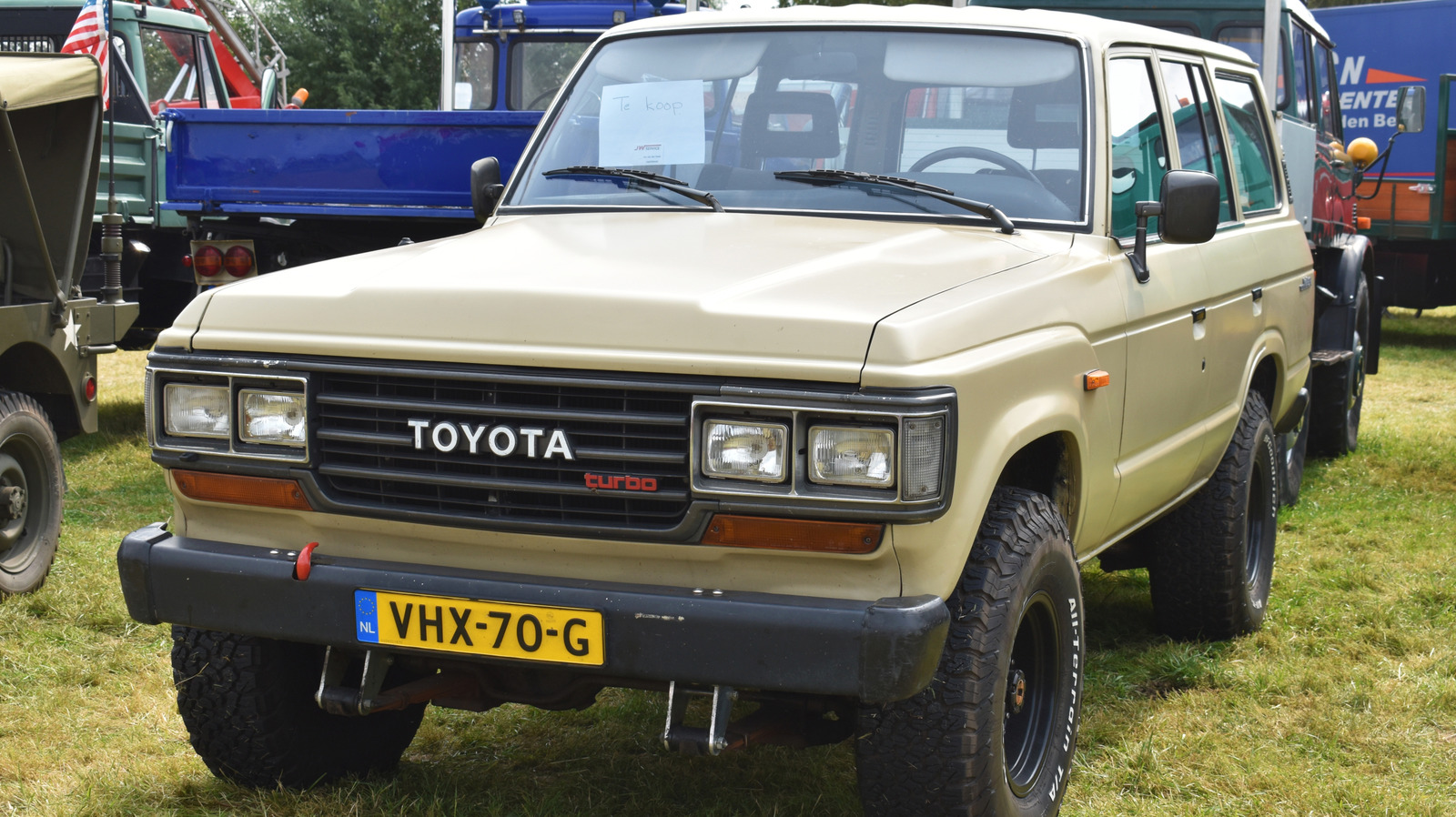
Toyota’s Land Cruiser history is full of oddball engine choices, and one of the strangest is the period when two different inline-five diesels shared the spotlight. That little stretch of time says a lot about how Toyota balanced emissions rules, regional production, body styles, and the simple need to keep the Land Cruiser moving in tough markets. The result was a rugged SUV lineup with more variety under the hood than many people expect.
From 1987 to 1990, the Land Cruiser 70 Series four-door utility wagon in some markets used the VM Motori HR588, a 2.5-liter turbocharged inline-five diesel. It made 98 hp at 4,000 rpm and 162 lb-ft of torque at 2,600 rpm, which was plenty for a heavy-duty off-roader built for work instead of comfort. It was not a flashy engine, but it fit the Land Cruiser’s mission perfectly.
Then Toyota added another inline-five diesel into the mix in 1990, this time the 1PZ-type. With 3,469cc and a peak output of about 113 hp, it gave the 70 Series a Toyota-built alternative that felt more in step with the company’s own engine family. The shift was not just about horsepower, though, since Toyota was also thinking about where the vehicles were built and where they were sold.
The VM Motori HR588 appeared in European-market BJ73 models assembled by Salvador Caetano in Portugal. That setup helped Toyota work around European import quotas, which makes the whole story feel like a clever workaround as much as an engine decision. In other words, the engine choice was tied to logistics and trade rules just as much as to performance.
The 1PZ had a different job. It was developed as a five-cylinder version of the 1HZ, one of Toyota’s most respected diesel engines, and it showed up in models such as the PZJ70 and PZJ77. Its smaller size also made it a smart fit for the shorter-body versions of the Land Cruiser 70, where packaging mattered as much as brute strength.
Toyota’s 1990 updates to the Land Cruiser 70 were not limited to what sat under the hood. That year also brought the model’s first mass-produced four-door body, made possible by stretching the wheelbase to add more passenger space and cargo room. Suddenly, the Land Cruiser was not just a hard-nosed utility rig, but something with a little more flexibility for real-world use.
Two four-door versions stood out at the time: the HZJ77V with the 1HZ engine and the PZJ77V with the 1PZ. The PZJ77V was a semi-long body basic model, which meant buyers could get a four-door Land Cruiser without jumping to the larger diesel setup. That kind of overlap gave Toyota room to serve different needs without changing the basic toughness that made the 70 Series famous.
The 1PZ’s run was fairly short, lasting only about four years before tighter emissions rules pushed Toyota in another direction. Once regulations got stricter, the smaller inline-five lost its place and Toyota moved back toward the 1HZ in models that had used it. By 1994, the Land Cruiser 70 Series had fully shifted to the six-cylinder diesel, closing the book on that unusual five-cylinder chapter.
Modern Land Cruisers look pretty different now, especially compared with the era of the HR588 and 1PZ. Toyota’s current lineup includes the 300, 70, and 250 Series, and the newer Land Cruiser FJ uses a naturally aspirated 2.7-liter inline-four. The Land Cruiser name still carries the same hard-edged reputation, but the engine bay tells a much more modern story.
