
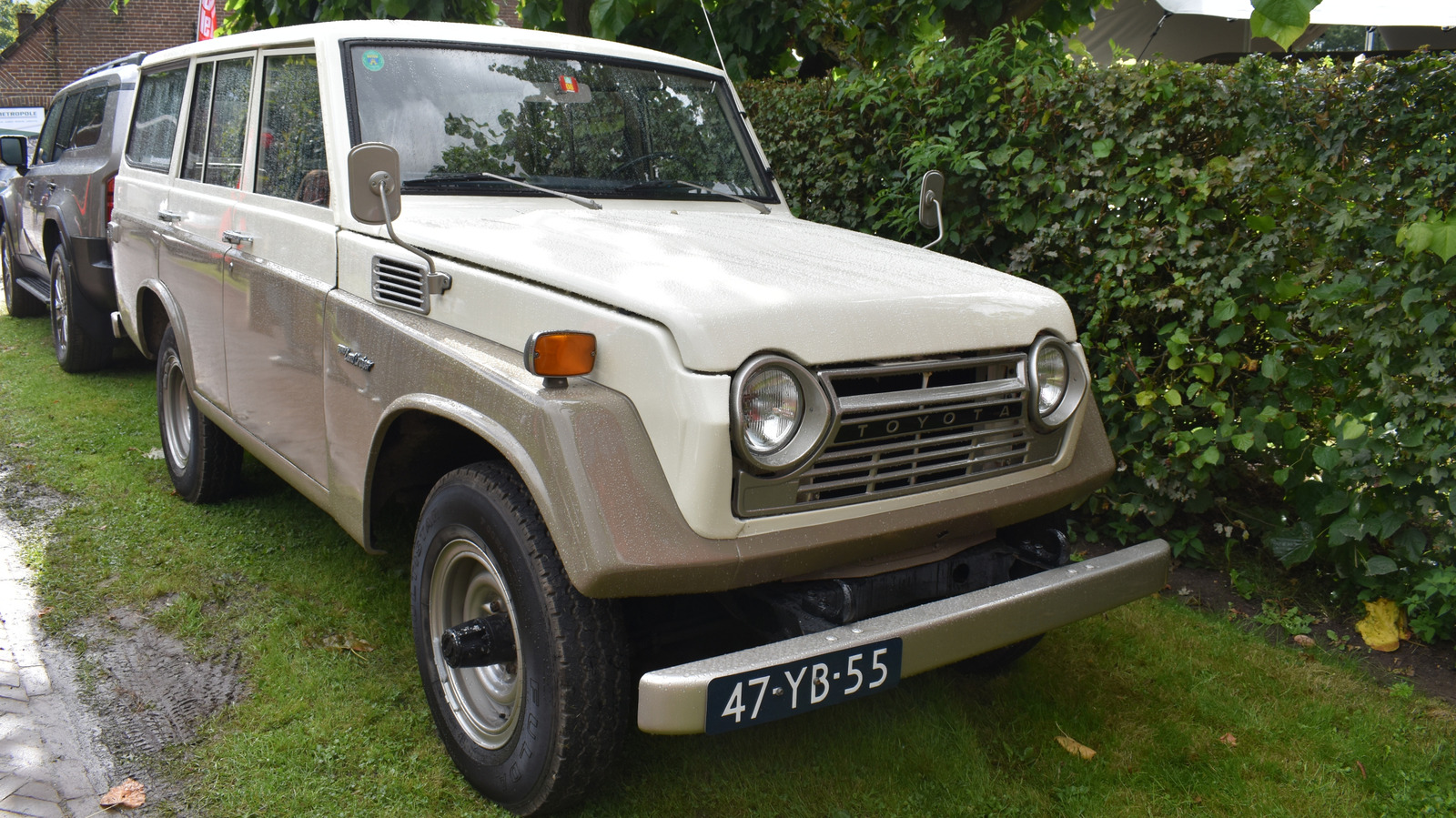
The Toyota FJ55 Land Cruiser earned its “Iron Pig” nickname for good reason, and the story behind it is part design quirk, part rugged legacy. Built from 1967 to 1980, it marked Toyota’s push into a broader kind of four-wheel-drive vehicle, one that could still take a beating off-road but was also meant to work as a practical family hauler. That mix of toughness and everyday usefulness is what helped the FJ55 stand out then, and why people still talk about it now.
Visually, the FJ55 is unforgettable. Its small inboard headlights, broad nose, and boxy shape give it a look that some owners and fans swear resembles a pig’s face, and the nickname stuck with a kind of affectionate stubbornness. It is not a sleek SUV and never tried to be, which is exactly why it has so much character.
Under the skin, the original model came with a 3.9-liter inline-six making 125 horsepower, paired with either a three-speed or four-speed manual transmission. Power went to all four wheels, and the setup was built around solid axles and leaf springs, the sort of old-school hardware that prizes durability over comfort. In 1975, Toyota bumped the engine to 4.2 liters and 135 horsepower, while front disc brakes joined the party to improve stopping power.
That mechanical formula tells you a lot about what the FJ55 was meant to do. This was not a luxury machine, and it was not chasing trends, either. It was built to survive rough roads, carry real cargo, and keep going long after flashier vehicles had given up.
The FJ55 also mattered because it was Toyota’s first successful long-wheelbase, four-door SUV. That made it a more people-friendly version of the brand’s off-road machines, opening the door to a style of vehicle that would become huge later on. In a lot of ways, the Iron Pig helped Toyota prove that a serious trail-ready rig could also serve as a usable daily vehicle.
That balance is a big reason the FJ55 still has fans in the classic SUV world. Collectors, restorers, and Toyota diehards value it because it feels honest. There is no fake toughness here, just a machine that was built to do hard work and wear its scars with pride.
Market interest has kept that reputation alive, too. FJ55 examples still show up for sale, and the prices can swing wildly depending on condition and restoration quality, from rough project trucks to carefully rebuilt showpieces. Even at the upper end, the appeal is not just nostalgia, but the fact that the truck has enough historical weight to justify serious attention.
Part of the reason people keep coming back to the FJ55 is that it still feels relevant. Modern SUVs may be faster, quieter, and more comfortable, but the Iron Pig has a simplicity that remains compelling. It is the kind of vehicle that makes sense the moment you see it, then makes even more sense once you learn what it was built to do.
That old-school charm was on display when a vintage FJ55 was taken out for a drive and found to feel surprisingly composed in the dirt. The fully boxed frame, the straightforward suspension, and the durable layout all contributed to a driving experience that impressed even seasoned observers. For a vehicle this old to still feel this capable says plenty about the original engineering.
And that is really the heart of the FJ55 story. It was weird, sturdy, practical, and tough enough to earn a nickname people still say with a grin. More than a classic SUV, it is a reminder that the best machines do not always look graceful, they just get the job done and somehow become legends while doing it.
