
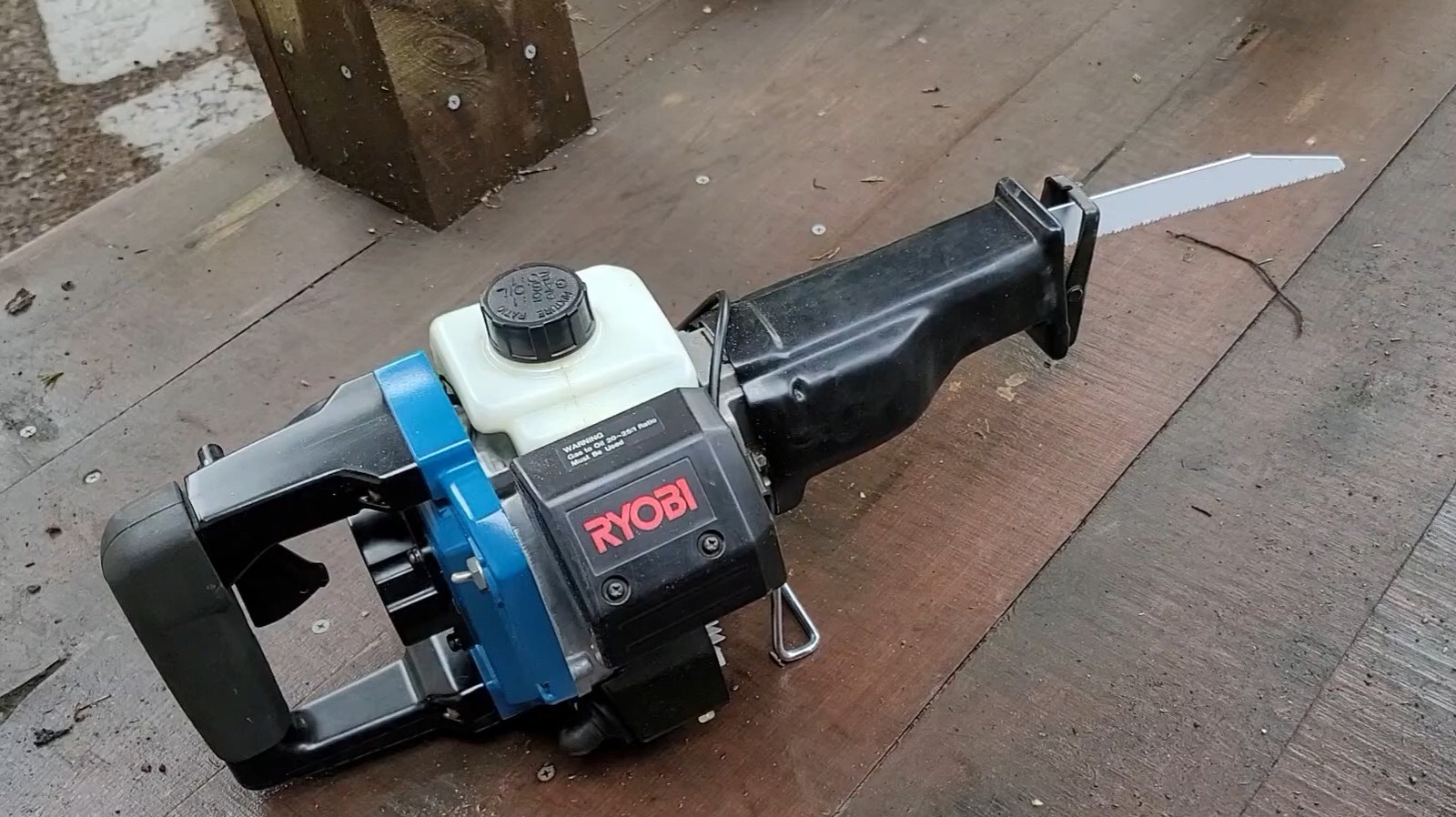
Ryobi’s oddball gas-powered Sawzall from the 1990s is one of those tools that feels almost fictional now. It came from a period when cordless power tools were still fighting weak batteries, so the company tried a very different route to get more portable cutting power. That experiment left behind a machine that is now far more likely to be discussed as a collectible than used on a jobsite.
Back then, battery tech was still crawling toward something practical. Nickel-cadmium packs could do the job in a pinch, but they were bulky, underpowered, and nowhere near the reliable lithium-ion setups that would come later. For a tool like a reciprocating saw, that was a real problem because this kind of saw needs steady muscle to chew through material without bogging down.
A reciprocating saw, often called a Sawzall, is built for awkward cuts in tight spots. Its long, narrow blade moves fast and back and forth, which makes it a go-to tool when a circular saw or other larger equipment simply cannot fit. Ryobi’s answer in the 1990s was a two-stroke gasoline-powered version that delivered freedom from the cord while still trying to give users the cutting force they wanted.
The concept was clever, but it also came with some obvious baggage. Gas power meant exhaust, noise, and a whole lot of mess compared with what cordless tools would eventually become. Even if the saw did the work, it was never the kind of tool that blended into a quiet neighborhood or a sealed indoor space.
Ryobi started moving hard toward battery power in the mid-1990s, and that direction stuck. The company launched its first cordless drill in 1996 and kept building from there, eventually moving into lithium-ion in the early 2000s. Today, the ONE+ 18V lineup has grown into a massive family of tools, and Ryobi even sells electric outdoor equipment, including riding lawn mowers that run on large battery systems.
That shift was not just about convenience. Battery tools fit a cleaner, quieter, more modern approach to home and jobsite work, and that matters when a brand wants broad appeal. Ryobi has leaned into that identity heavily, with its green lineup built around rechargeable power instead of gas cans, pull cords, and fumes.
The old gas Sawzall also had one very loud problem, literally. It reportedly sounded a lot like a gas-powered weed whacker, with noise levels that could be right at home in the 90 to 110 decibel range. That kind of racket is hard to ignore anywhere, and it is one more reason the model feels like a strange relic from another era.
Modern battery-powered reciprocating saws are a much easier sell. Ryobi’s current options include full-size models, standard versions, and compact one-handed tools, giving buyers a range of prices and power levels without dragging a cord behind them. A high-performance version can make 3,200 strokes per minute and cut through hundreds of pieces on a single charge, which is a far cry from the compromises of the 1990s.
They also solve the biggest safety issue that came with the gas model. A battery saw can be used indoors without filling the space with exhaust, while a gas-powered tool can create a carbon monoxide risk almost immediately in an enclosed area. That difference alone makes the old Ryobi gas Sawzall feel less like a practical option and more like a curiosity from the messy, experimental days before cordless tools truly hit their stride.
