
America is standing right at the edge of a huge tech breakthrough, and the fight over artificial intelligence is quickly turning into a fight over the country’s future. One side sees faster innovation, stronger manufacturing, better medicine, and a shot at lasting global dominance. The other wants to slow it all down with rules, bans, and criminal penalties that could choke off the next wave before it even starts.
President Donald Trump has made clear that AI belongs at the center of America’s economic playbook. His team has pushed for fewer regulatory roadblocks, more data centers, and the energy buildout needed to keep advanced systems running at scale. That approach treats technology like an engine for growth, not a threat to be buried under red tape.
That optimistic view lines up with the broader promise of a new American golden age. Elon Musk has argued that artificial intelligence and robotics could create an era of abundance, where ordinary people eventually get access to tools, services, and even medical care that are now reserved for the wealthy. The idea is simple enough: if the United States leads, the whole country can benefit.
There is also a hard economic case behind that optimism. Advanced robotics and smart factories could make American manufacturing competitive again, while AI could speed up drug discovery, improve logistics, and lift productivity across nearly every major industry. Instead of shipping opportunity overseas, the country could build, invent, and produce at home.
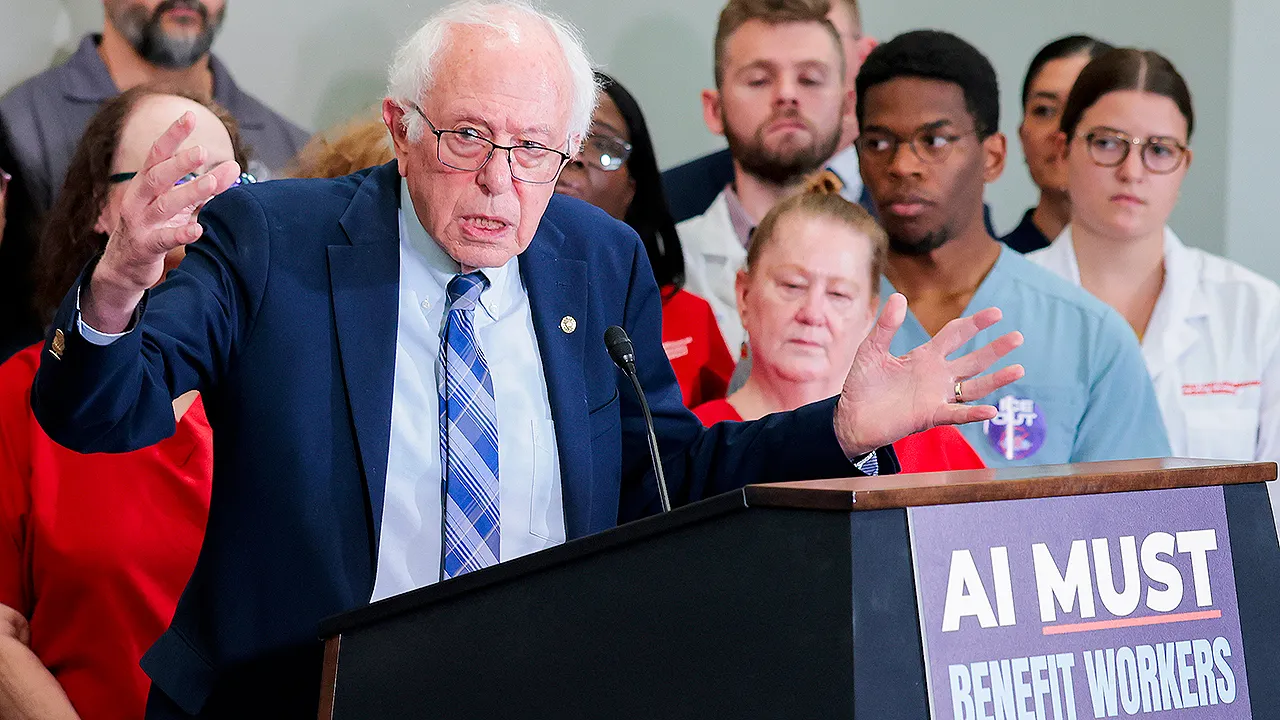
That is exactly what makes the push from the far left so jarring. Vermont Sen. Bernie Sanders and allies like Rep. Alexandria Ocasio-Cortez have backed limits on data center growth, framing the industry as something that needs a heavy hand from Washington before it can be trusted. Democratic Socialists of America circles have helped make that kind of thinking increasingly mainstream on the left.
Sanders has gone even further with a plan that would put the government squarely in the middle of the AI industry. His proposal would effectively take a massive federal stake in leading AI companies, while also giving government-picked appointees a role in steering decisions from the inside. That is not a light touch, and it is not exactly a vote of confidence in private innovation.
Then came the newest and most aggressive step. Sanders introduced legislation that would permanently ban the development of artificial superintelligence, create a new federal AI agency, and stop advanced work unless regulators say it can continue. Under that approach, people who cross the line could face up to 20 years in prison, which is a stunning threat for a field built on research and experimentation.
Concerns about AI are real, and nobody serious is pretending otherwise. Job displacement, privacy abuses, manipulation, and misuse all deserve attention, but there is a big difference between smart guardrails and outright suppression. Once Washington starts punishing innovation itself, the country stops solving problems and starts freezing in place.
The risks of that kind of freeze are enormous. AI could help scientists identify better treatments for cancer and Alzheimer’s, improve farming output, streamline supply chains, and give elderly and disabled Americans more independence through better assistive technology. Those are not sci-fi fantasies, but they do depend on the country letting the work continue.
Standing still would be dangerous enough on its own, but the geopolitical angle raises the stakes even more. China is racing ahead in AI with all the urgency of a global rival that understands the prize, and the gap between American and Chinese models has already narrowed dramatically. If the United States slows down while Beijing pushes forward, the fallout would be felt in economic strength, military influence, and long-term leadership.
That is why the debate is so much bigger than a single industry fight. If America chooses bold development, the country can shape the next era on its own terms and keep the benefits flowing to workers, families, and small businesses. If it chooses fear, the most powerful technologies of the century may be handed to rivals while Washington congratulates itself for having “protected” the future.
