
Republicans have a rare opening to make the next election about something bigger than a single policy fight or a short burst of economic noise. The stronger message is about confidence, growth, and a future worth believing in, especially when wages are moving up and jobs are still being created.
That kind of pitch matters because voters do not just buy facts and figures. They respond to energy, direction, and whether a party sounds like it trusts America or keeps talking as if decline is the only possible ending.
The recent Republican convention leaned hard into that hopeful lane. President Trump, J.D. Vance, and Robert Kennedy Jr. all highlighted the same broad theme: manufacturing and construction jobs are improving, investment is flowing, the border is tighter, and crime has eased in many places.
That message has a built-in contrast with Democrats, who often seem more comfortable criticizing the country than selling its strengths. The argument is not just that Republicans have better numbers, but that they have a better story, one that sounds like forward motion instead of grievance.
Donald Trump’s latest economic pitch adds more fuel to that case, with talk of $5,000 dividend checks for adult citizens if Republicans keep control of Congress. Whether voters see that as a serious promise or a big political jab, it shows how aggressively Republicans are trying to connect policy, pocketbook relief, and election turnout.
Still, the sharper point is not the check itself. It is the broader climate of confidence around lower taxes, stronger business activity, and a labor market that has kept surprising people who expected the wheels to fall off.
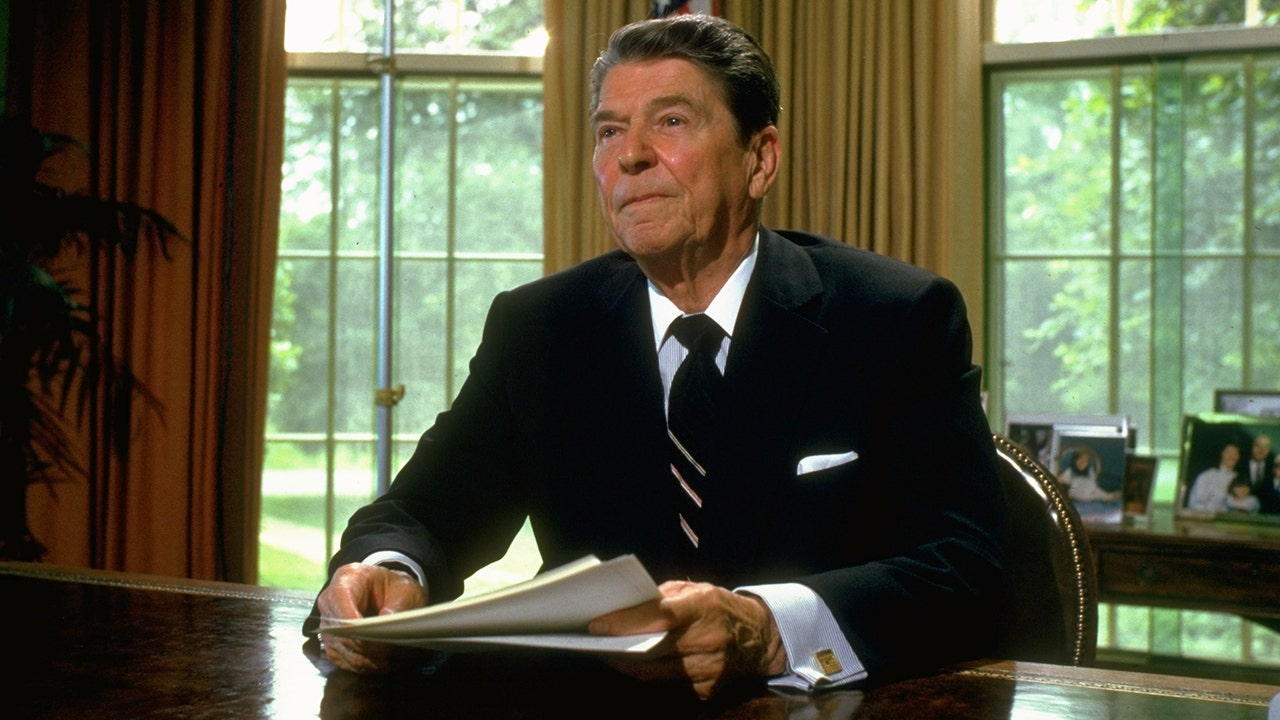
That is where Ronald Reagan comes back into the picture. Reagan understood that Americans do not rally behind a party that sounds tired, defensive, or scared of its own ideas. He sold optimism like it was oxygen, and he made patriotism feel practical, not corny.
He did that in brutal conditions, too. Interest rates were punishingly high, inflation had chewed through family budgets, unemployment jumped, and the economy was nowhere near smooth when he entered office in 1981.
Yet Reagan kept talking about the promise of American freedom and the power of individual initiative. His famous line about unleashing “the energy and individual genius of man” still works because it taps into something voters recognize instantly: the sense that people do better when government gets out of the way and trust is placed in workers, builders, and risk-takers.
The payoff came later in the decade, when growth roared back, unemployment improved, and America’s confidence returned with it. That era gave Republicans a model for how to talk about prosperity without sounding robotic, and without turning every speech into a spreadsheet.
Today’s GOP has its own chance to do the same thing, but only if it speaks in human terms. A factory worker, a waitress, a small business owner, and a machine tool operator are far more persuasive than a stack of talking points about macroeconomic improvement.
That is especially true in places where people can see the change around them but have not yet connected it to politics. If wages are climbing faster than inflation in some areas, and if tax policy or business growth is helping households feel less squeezed, that deserves to be shown plainly and often.
Small businesses matter just as much. They hire people, take risks, and keep local economies alive, which is why Republicans have to speak directly to owners who want lower taxes, fewer headaches, and a government that understands how hard it is to build something from scratch.
There is also a sharper edge to the fight over socialism, but it works best when it comes from people who have actually lived under it. Americans who escaped Cuba, Venezuela, Vietnam, the former Soviet Union, or North Korea can make the case better than any slogan ever will, because they know exactly what happens when the state gets too much power.
That kind of testimony hits harder than name-calling alone. Voters can smell lazy messaging from a mile away, and they know the difference between a party offering hope and a party selling resentment with a fresh coat of paint.
Republicans do not need to reinvent the wheel here. They need to sound like the party that believes America still has a future worth fighting for, and then keep saying it until it lands in every town, every district, and every kitchen table conversation.
