
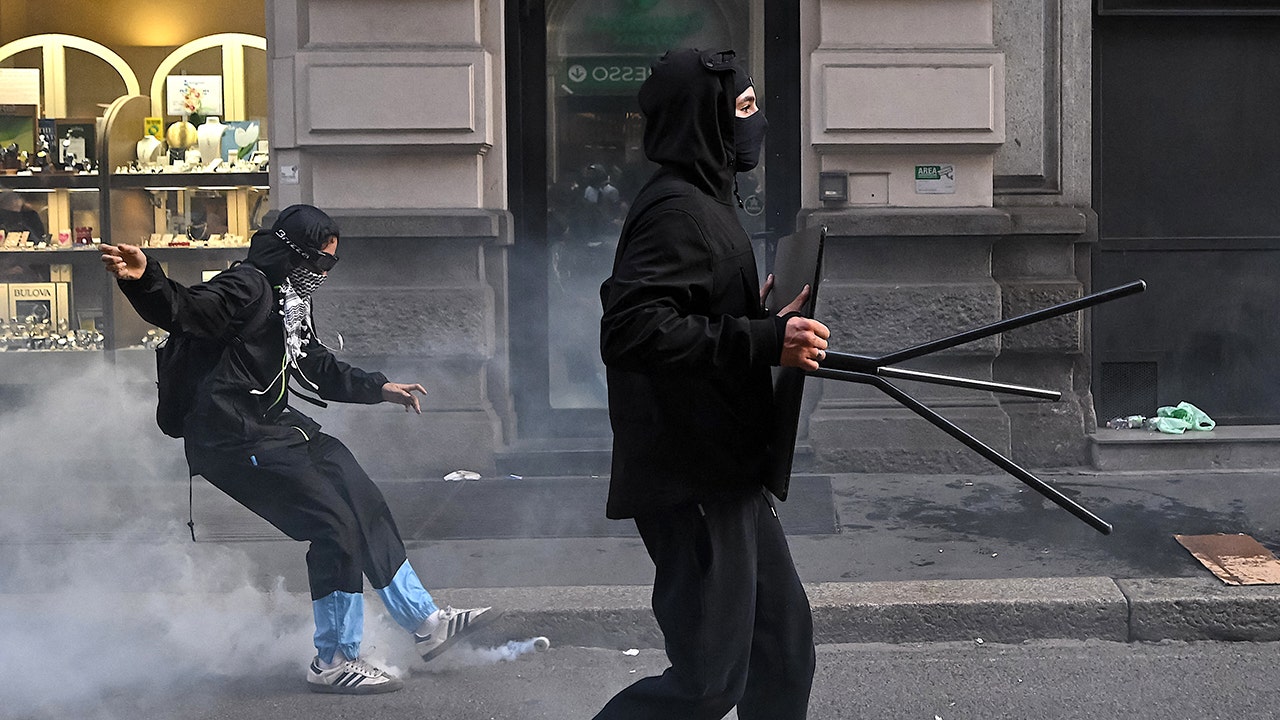
Italy and France are both tightening the screws after violent street unrest rattled major cities, with Rome choosing a sharper military-backed response while Paris leans on a bigger security footprint. The scenes have been ugly, the damage expensive, and the politics are getting hotter by the hour as governments try to restore order before the next round of unrest erupts.
Over the weekend, videos from Milan and Paris showed clashes between police and demonstrators, burning debris, shattered storefronts, and officers being pushed back. In Paris, a small police line faced a much larger crowd and struggled to make arrests, while in Milan, rioters hurled firecrackers, bottles, and metal barriers as authorities tried to hold the line.
Italy’s answer has been blunt. Prime Minister Giorgia Meloni pledged to send 500 troops to Milan, pairing that move with expanded powers that give the state more muscle on the streets.
That decision stands out because it signals a willingness to treat the unrest as a serious public-order threat, not just a protest problem. When crowds start turning city centers into battlegrounds, the instinct to restore visible authority tends to win out fast.
France is heading down a similar road, just with a different tone. Weeks of unrest have already worn down police resources, and officials are now turning to the Sentinelle force to help shoulder the load and free up gendarmes and interior security units.
The French response is built around the same hard reality: regular police cannot be everywhere at once when violence starts spreading from one neighborhood to the next. As the interior minister put it, the military presence is being used to backstop the state’s ability to maintain order.
The unrest has not been cheap. Financial analysts have pegged damage from the French riots at more than $1 billion, and the destruction has included burned schools, looted shops, and streets left littered with the wreckage of another night gone wrong.
There is also a clear political edge to all of this. French elections are on the horizon, and the violence is feeding arguments from voters who think the country has been too slow to respond to years of disorder tied to migration, identity politics, and weak enforcement.
Images from the chaos have only sharpened that mood. Protesters in France were seen waving Palestinian flags, while in Milan, an Albanian flag appeared in the crowd, adding another layer to an already combustible mix of anger, symbolism, and street politics.
Italian reporting also pointed to many first- and second-generation migrants among the rioters in Milan. That detail has pushed the debate beyond simple law enforcement and into questions about social cohesion, integration, and whether city leaders have let tensions simmer too long.
France’s use of gendarmes last weekend showed how quickly the response has been moving toward a more hardened posture. The latest troop increase suggests officials expect the unrest to keep rolling, especially with another wave of demonstrations already being planned.
Meloni’s move in Milan fits into that same pattern of no-nonsense urgency. Once public squares start slipping out of state control, governments often have only a narrow window to show they still run the streets, and both Italy and France are now trying to make that point in full view of the public.

1 Comment
Italy plans on protecting the public, France is blaming the public