
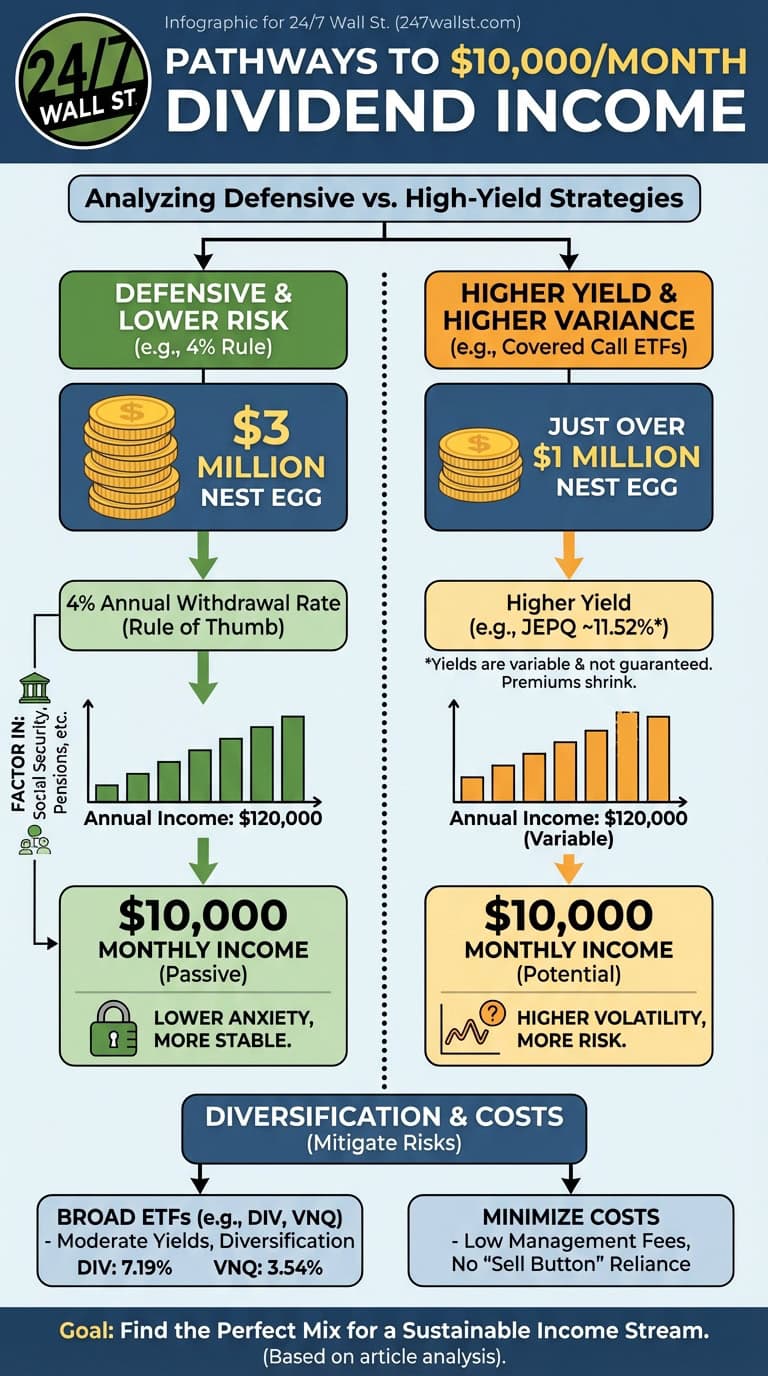
This piece breaks down how much capital you need to replace a $60,000 salary with dividend income, walks through three yield tiers and the math behind them, weighs the tradeoffs between safety and yield, and offers practical steps to model your own situation before committing to a strategy.
Start with the simple equation: required capital equals $60,000 divided by the yield you target. That arithmetic is clean, but the consequences are not, because higher yields usually bring higher risk or weaker long‑term growth. Your choice of yield determines whether you buy durable, growing income or immediate cash that may erode in value.
Conservative income sits in the 3 to 4 percent range and leans on broad dividend funds, blue‑chip payers, and quality ETFs like SCHD and VYM as examples of the category. At a 3 percent yield you need $2,000,000 in capital; at 3.5 percent you need about $1,714,000; at 4 percent you need $1,500,000. That’s a lot of upfront money, but you’re buying income that’s most likely to grow and least likely to be cut.
Durability is the conservative tier’s main selling point: these portfolios tend to be diversified, have long dividend histories, and often deliver price appreciation in addition to distributions. For context, price returns over the past decade for some large dividend funds have been strong, illustrating how total return can transform the income picture. The tradeoff is purely capital intensity—you pay more today for a steadier, expanding income stream tomorrow.
The moderate tier targets roughly 5 to 7 percent yields and includes covered call ETFs, preferred shares, REITs, and high‑dividend equity funds. That moves the capital requirement sharply lower: at 5 percent you need $1,200,000; at 6 percent you need $1,000,000; at 7 percent you need around $857,000. You get more cash now, but different sources in this band carry distinct durability issues.
Covered call strategies generate premium income but cap upside, which can limit a portfolio’s ability to outrun inflation over long retirements. Preferred shares typically pay fixed distributions that don’t grow, and REITs are sensitive to interest‑rate swings. In a rising or volatile rate environment that sensitivity matters because it affects both principal and future payout stability.
Aggressive income lives in the roughly 8 to 14 percent range, with players like leveraged covered call funds, business development companies, mortgage REITs, and high‑yield bond funds. On paper the capital math looks attractive: 8 percent requires $750,000; 10 percent needs $600,000; 12 percent needs $500,000. That appeal comes with a steep tradeoff around principal preservation.
Many high‑yield strategies distribute a mix of income and return of capital, which can mask erosion of the asset base that actually produces income. If principal shrinks, the high yield becomes a diminishing engine rather than a sustainable payout source. Distribution cuts and principal losses are common in stressed markets, so the headline yield is not the whole story.
A key counterintuitive point: lower yields with growth often outperform higher static yields over a lifetime. A 3.5 percent yield that compounds its dividend at 7 to 8 percent annually doubles the income in about ten years without adding capital. By contrast, a 12 percent yield with no growth—especially if principal declines—can leave you with the same nominal dollars but much less purchasing power over time.
Inflation dynamics matter to this choice. Recent price indexes have continued to rise, meaning a fixed nominal payout loses real value if it does not grow. A stable or growing dividend stream protects purchasing power far better than an unchanged high yield that pays out today but does not expand with the economy.
Real examples show the compounding effect: a fund that started with small quarterly payouts in an earlier decade can now pay several times more per share, so a position sized to generate $60,000 then may produce much more today. That historical income growth demonstrates why total return and dividend growth should be central to your planning, not just the current percentage yield.
Before you pick a tier, take three actions. First, calculate your actual spending, not your gross salary—your real needs may be far lower than $60,000, which changes the capital math dramatically. Second, compare total return, not just yield: a lower‑yielding, growing vehicle can outperform a high‑yield option when price appreciation and reinvested dividends are considered.
Third, model taxes on expected distributions: qualified dividends, ordinary income, and nonqualified distributions are taxed differently and can change after‑tax yield materially. If retirement or transition is near, run these scenarios through your real tax situation to understand how much gross yield actually translates into spendable cash.
