
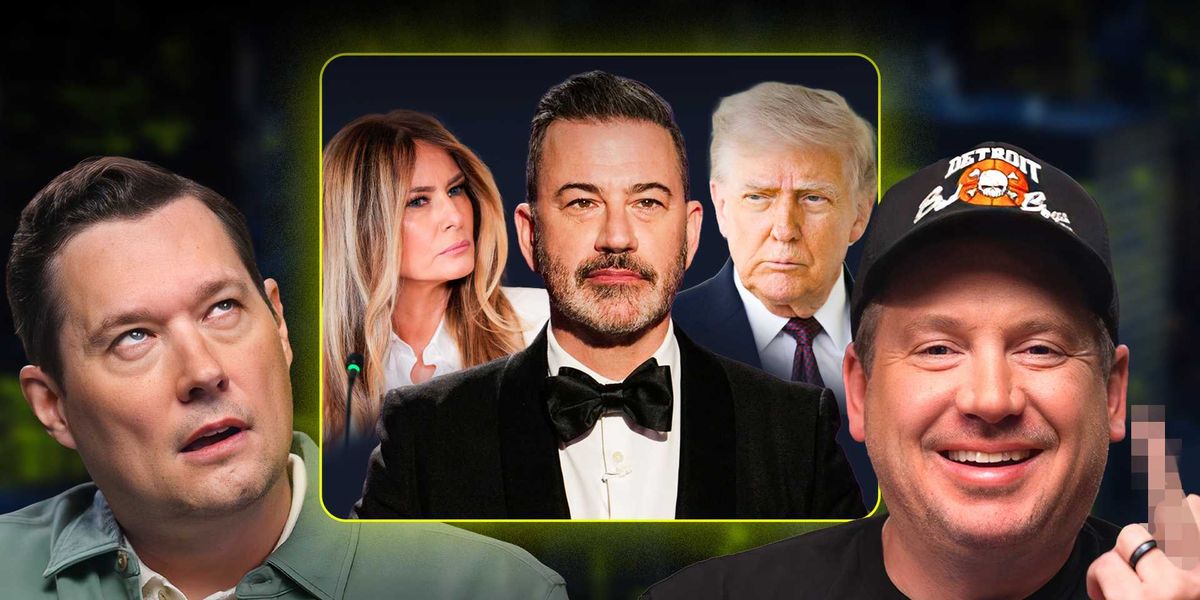
The late-night quip that called Melania Trump an “expectant widow” has stirred sharp reaction from the White House and conservative circles, and it reopened debate about where satire ends and danger begins. The administration publicly demanded accountability, arguing the joke was reckless given recent threats, while some comedians defended the line as fair game for humor. This piece lays out the exchange, the administration’s rebuke, and the split among commentators without hiding the clear political stakes.
Jimmy Kimmel’s joke landed during a monologue and immediately landed him in hot water with the Trump team. “Our first lady, Melania, is here. … So beautiful. Mrs. Trump, you have a glow like an expectant widow,” Kimmel said in his monologue. The line was short, sharp, and intended to provoke laughs, but timing matters and the White House saw danger where late-night saw a punchline.
The administration did not treat the remark as harmless comedy and made its objections public within days. “As the first lady of the United States pointed out this morning, just two days prior to the shooting, ABC’s late-night host Jimmy Kimmel disgustingly called first lady Melania Trump an ‘expectant widow,’” White House press secretary Karoline Leavitt said after the most recent attempt on President Trump’s life. That statement framed the joke as not only tasteless but dangerously tone-deaf.
Leavitt pushed the argument further and questioned the ethics behind such jokes about potential violence against a president. “Who in their right mind says a wife would be glowing over the potential murder of her beloved husband?” Leavitt continued. Her language was direct and designed to force a network and a comedian to explain why that joke was acceptable at such a volatile moment.
The White House then added a personal note to underscore the gravity they attach to the episode. “And having experienced what I did with the first lady on Saturday night, I can tell you that she was anything but that. This kind of rhetoric about the president, the first lady, and his supporters is completely deranged,” she added. Those words framed the joke not as isolated bad taste but as part of a broader pattern of hostile rhetoric targeting the president and his family.
Not every conservative voice joined the call to cancel Kimmel, and that split tells you something about the messy alliances around free speech. While members of the Trump administration have made it clear they’re not happy with Kimmel, BlazeTV host and comedian Dave Landau has a controversial take. He told co-host Stu Burguiere that, despite understanding the sensitivity, he still views the remark as a joke within the bounds of satire.
“I’m going to go ahead and say that’s a funny joke,” he tells co-host Stu Burguiere. “You like the joke,” Stu comments, surprised. Landau defended the right to push boundaries in comedy, arguing that bad taste alone is not the same thing as a provable threat or incitement.
Landau tried to distinguish between distasteful humor and calls for actual violence, a line that often divides comment sections and editorial rooms alike. “It’s fine. You keep trying to kill him, so they’re saying you have a good look for an expectant widow. I understand that people don’t like the guy who’s saying it, but there’s logic and reason to the joke, and it’s a still a joke,” Landau says. He emphasized the slippery slope of canceling performers for individual jokes instead of evaluating context and intent.
That argument met an easy rebuttal from those who say context matters more than intent when threats or attempts on a president’s life are recent. “You don’t have to like it, but I will never be on the side of throw somebody off of TV or cancel them based on something that was a joke,” he continues. “We agree on that,” Burguiere says, adding, “I’m totally with you.” Supporters of the White House response counter that some lines should not be skirted when national safety is in question.
What this episode exposes is a bigger cultural tug-of-war over responsibility in media and comedy. Networks, talent, and public officials are each staking claims about what is permissible after violent incidents or credible threats. The Trump administration has chosen a straightforward, no-nonsense posture: draw the line where jokes appear to celebrate or trivialize harm to national leaders.
For viewers and media consumers, the debate raises practical questions about accountability, satire, and standards. Comedy has a long history of punching up and shocking, but public officials are increasingly unwilling to accept shock value when physical safety is involved. Expect the argument to resurface any time a late-night quip intersects with real-world violence or credible threats against public figures.
