
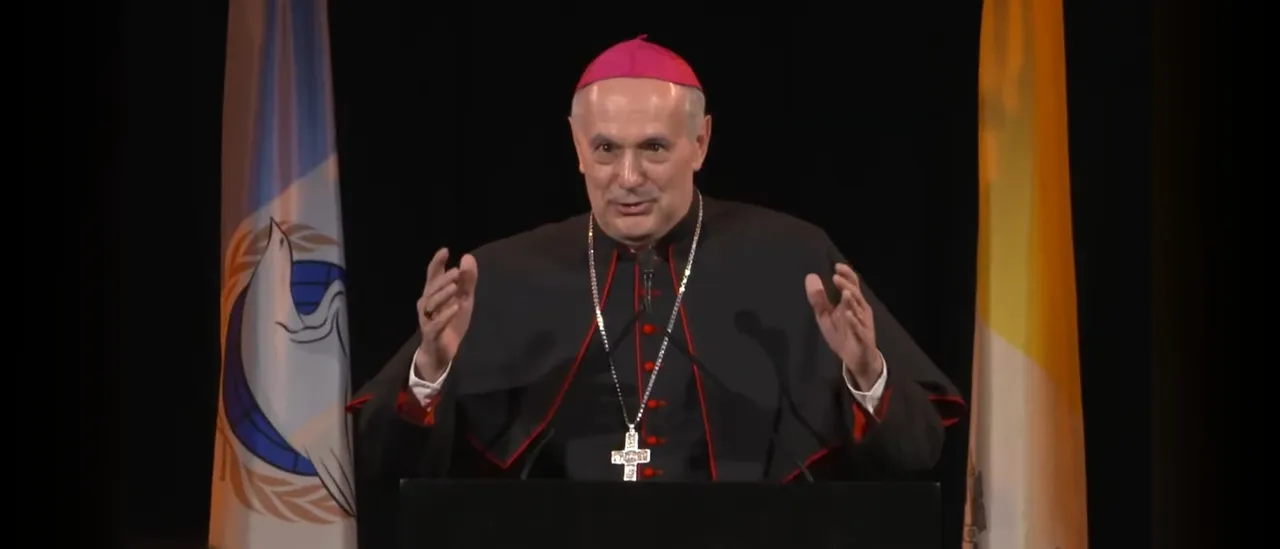
Pope Leo XVI, who hails from the United States, has named Archbishop Gabriele Caccia as his apostolic nuncio and personal representative to the U.S., a move that reshuffles Vatican ties with Washington and the American Church. The choice signals a careful balancing act between pastoral care, diplomatic reporting, and influence over episcopal appointments, set against the backdrop of the nation’s 250th anniversary and a charged political moment. Voices across the American Catholic leadership and diplomatic corps have already weighed in, highlighting both welcome and caution. This appointment offers a clear window into how this papacy intends to engage the United States—firm on principle, careful on politics.
The pope’s pick, Archbishop Gabriele Caccia, is a seasoned Vatican diplomat who served as the Holy See’s permanent observer at the United Nations in New York. He described the assignment in his own words, saying, “I receive this mission with both joy and a sense of trepidation.” He framed his work as a “mission at the service of communion and peace,” language that underscores pastoral priorities even as political expectations swirl.
Caccia’s move to Washington is as much about relationships as it is about protocol. He’ll be the conduit between Rome, the White House, and the United States Conference of Catholic Bishops, reporting on political and ecclesiastical developments and advising on the selection of bishops. That last role matters more than many realize, because the nuncio’s recommendations carry weight when Rome names local shepherds.
The appointment landed at a symbolic moment for the United States, arriving during celebrations of the country’s 250th anniversary and amid a fast-changing domestic landscape. Conservatives will watch whether the nuncio defends religious liberty and the Church’s moral teachings when public policy and culture collide. At the same time, the Vatican looks eager to avoid being boxed into partisan rows, insisting on a broader mission beyond American politics.
Leaders in the U.S. Catholic hierarchy expressed cordial support while signaling the practical work ahead. Archbishop Paul Coakley welcomed the news and offered prayers for the new nuncio’s ministry, pointing to the need for steady collaboration across dioceses. That cooperative tone matters: the nuncio must build trust with bishops locally while representing Rome’s vision.
U.S. Ambassador to the Holy See Brian Burch has pushed back against charges that Vatican engagement is “anti-America,” noting the many common commitments shared by both institutions. He summarized that shared basis around truth, justice, and human dignity, and underscored the practical value of talking through thorny issues with the United States. His perspective suggests the diplomatic lane remains open if handled with respect for national sovereignty and moral clarity.
The pope himself has been explicit about his posture on domestic politics. As the ambassador recalls, the pope said, “I don’t want to be seen as an American who’s trying to meddle in the domestic political fights in the United States.” He added bluntly, “I’m not an American Pope. I’m a Pope from America for the world.” That distinction matters: it promises a focus on universal pastoral concerns rather than partisan alignment.
Archbishop Caccia replaces Cardinal Christophe Pierre, a veteran diplomat who reflected on his decade in America as “very beautiful years, difficult years.” Pierre warned against letting societal polarization infect Church life, saying, “The mission of the Church is precisely not to reproduce in our Church the polarization of the society but to be a kind of place where we can heal, you know, and help the people to rediscover [a] kind of unity.” Those are sharp words for a Church navigating culture wars.
For conservatives who prize religious liberty and clear moral teaching, the appointment is a test and an opportunity. The new nuncio’s record at the U.N. shows diplomatic caution and a focus on multilateral issues, but his role in the U.S. will put him closer to hot-button decisions about bishops, schools, and conscience protections. The next months will reveal whether his stewardship preserves a robust voice for faith in public life while resisting partisan entanglement.
The broader point is simple: the Vatican wants influence without overt political theater, and the American Church wants a representative who understands local realities. This pope’s move is calibrated to both concerns, yet it will be judged by how effectively the nuncio navigates culture, politics, and pastoral care. Expect vigilant oversight from both bishops and lay conservatives as this new chapter unfolds.
