
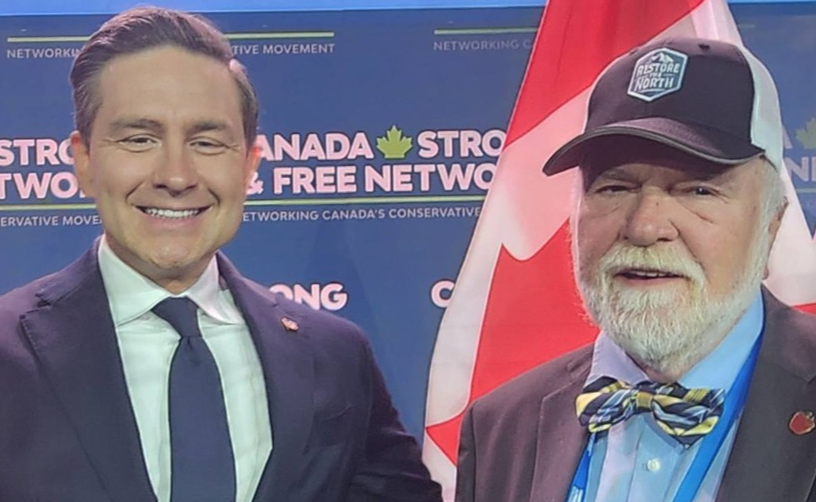
Pierre Poilievre publicly backed Barry Neufeld after Neufeld faced a massive fine from a human rights body for speaking against gender ideology, and Poilievre made a clear, plain statement of agreement that sparked debate and drew attention to free speech and common-sense definitions of sex.
Pierre Poilievre stepped into a controversy that many see as about basic free speech and the role of public institutions. With courts and tribunals increasingly policing speech around gender topics, Poilievre’s comment landed as a direct pushback. He didn’t mince words when he told Barry Neufeld, “I agree with you. There are only two genders.”
That line matters because it signals a wider political stance beyond one case: a commitment to defend straightforward biological claims and to resist what many conservatives call overreach by administrative tribunals. In this fight, Poilievre frames Neufeld as someone penalized not for harm but for expressing an opinion about sex and society. For Republicans who value free debate, the case looks like a warning about silence-by-fine becoming the new normal.
The fine itself has become a flashpoint for questions about proportionality and fairness in enforcement. Opponents argue that public officials and citizens alike should be able to state views grounded in biology without fear of punitive financial penalties. Supporters of the tribunal’s action say such remarks can harm marginalized people, but many conservative voters worry that the remedy is worse than the supposed offense when it means gagging debate.
Poilievre’s statement was both political and principled from a Republican perspective: defending speech is part of defending democratic debate. He used a short, blunt sentence to stake a position that is easy for voters to understand and hard for bureaucracies to misinterpret. That simplicity has appeal in a culture war where clarity often gets lost in jargon and process.
The case also raises broader questions about how society handles disagreements over identity and law. When tribunals become the arbiter of acceptable opinion, the space for open disagreement shrinks, and elected officials feel the need to respond. Poilievre’s intervention can be read as a signal to the electorate that his camp will push back against institutions that increasingly police everyday speech.
From a Republican viewpoint, the stakes go beyond this single fine; they touch on institutional balance and who decides what is allowed in public life. If human rights bodies can levy huge penalties for expressing certain beliefs, then political actors must push to restore common-sense boundaries. That argument is not meant to dismiss real concerns about dignity and safety, but to insist that remedying those concerns should not come at the cost of crushing ordinary discourse.
The reaction to Poilievre’s support shows how polarized this area has become. Some celebrated the clarity and courage of a leader resisting what they see as bureaucratic overreach. Others warned that simple declarations could inflame tensions and miss opportunities for respectful engagement. For conservatives, however, the priority remains defending speech and preserving a public square where established definitions are not treated as criminal speech.
Where this goes next depends on politics and process: will elected authorities step in to limit tribunal power, or will courts continue to shape the boundaries of acceptable speech? Republicans tend to favor legislative fixes and clearer rules rather than leaving the matter to unelected panels. Poilievre’s voice in this moment is intended to nudge policy and public opinion in a direction that protects candid discussion without fear of crippling fines.
The exchange between Poilievre and Neufeld is a reminder that fights over culture and language are now legal and political battles, not just academic debates. For those who prioritize free expression and biological clarity, the message is straightforward and resolute. “I agree with you. There are only two genders.”
