
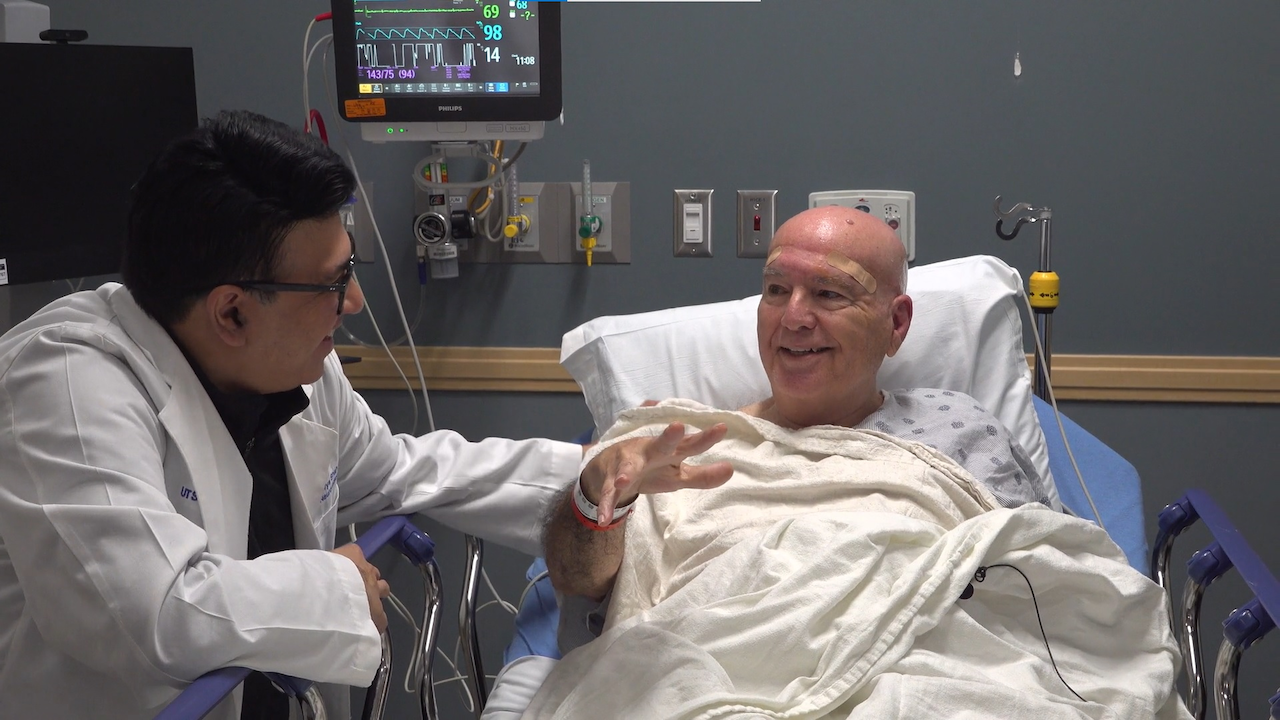
Bud Leavell spent years living with a tremor that kept getting in the way of everyday life, from simple tasks to a favorite hobby in the garage. Then a new focused ultrasound treatment changed the picture fast, calming the shaking in minutes and giving him back a steadier hand. The case is drawing attention because it shows how precise, non-invasive brain treatment is starting to reshape Parkinson’s care.
Leavell, a 72-year-old retired salesman and Air Force veteran from Arlington, Texas, had dealt with Parkinson’s since 2017. The tremor in his right hand made it tough to use a mouse, work on binoculars or handle the fine movements needed to repair antique radios. What used to feel like a small nuisance slowly became a daily barrier.
The treatment he received at UT Southwestern Medical Center uses focused ultrasound to hit a very specific target deep in the brain. Instead of opening the skull, doctors aim high-energy sound waves through it and use heat to alter the tissue tied to Parkinson’s symptoms. That difference matters, because it gives patients another option without the baggage of a traditional operation.
Dr. Bhavya Shah, a neuroradiologist at UT Southwestern, explained that the technology is designed to be exact. Doctors can test the target first with lower-energy ultrasound and watch whether symptoms improve before making the effect permanent. That step helps teams confirm they are aiming at the right spot, since Parkinson’s does not always hit every patient the same way.
Leavell said the change was obvious right away. After the April procedure, he noticed that his tremor was gone, and at follow-up it remained under control. His response summed it up in a single line: “What tremor?”
The relief also reached beyond the exam room. He could hold a spoon steady, bring food to his mouth more easily and get back to the kind of precise handwork that Parkinson’s had stolen from him. Repairing radios, which had become frustrating and nearly impossible, was suddenly back on the table.
Parkinson’s patients are often started on medication, but those drugs do not always hold up forever. When symptoms grow harder to manage or side effects become a problem, doctors may talk about more advanced choices such as deep brain stimulation or focused ultrasound. That makes the new approach especially interesting for people who want something less invasive than implant surgery.
Still, the procedure is not free of tradeoffs. Shah noted that possible side effects can include numbness, tingling, balance issues, trouble walking or speaking, swallowing problems and even weakness in an arm or leg. Some patients may also deal with memory-related issues, though those effects often improve over time.
Another big difference from deep brain stimulation is flexibility. DBS can be adjusted later if symptoms change, while focused ultrasound does not leave behind a device that can be reprogrammed. If symptoms return, another treatment may be needed, and long-term data are still limited because the therapy is so new.
Even with those questions still open, the procedure is already offering something powerful: a new way to fight one of Parkinson’s most stubborn symptoms without surgery. Shah called it a promising option for people who want an alternative to an implanted device, while Leavell is back to doing what he loves with much more confidence. In his garage, the steady work of bringing old radios back to life now looks a lot less out of reach.
