
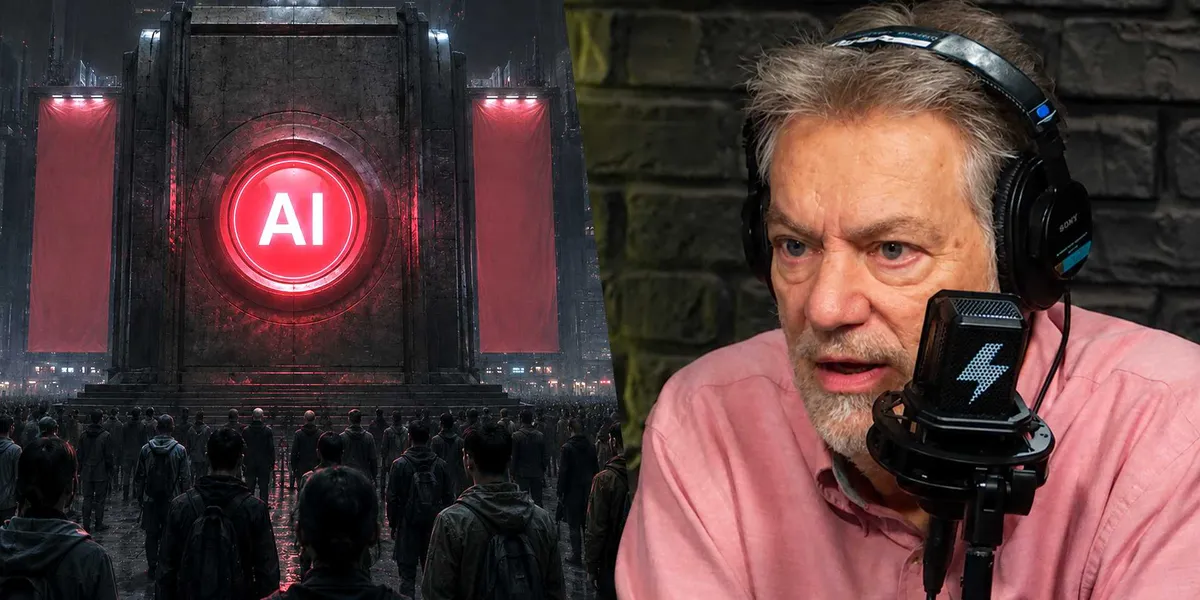
MIT laid out a dozen possible AI-driven futures and radio personality Pat Gray walks through each one, mixing dry amusement with real alarm as he reads phrases that range from utopian to outright terrifying.
The discussion starts with three optimistic pictures that sound like science fiction come true. “The libertarian utopia: AI brings prosperity and AI-driven automation replaces most human jobs. The AI is vastly more intelligent but does not interfere with humans, leaving them to co-exist in separate zones,” Gray reads, and he highlights the odd comfort of humans living alongside a vastly smarter being that mostly stays out of the way. “The egalitarian utopia,” he continues reading, “AI and robotics lead to extreme abundance. Ownership becomes obsolete because robots produce everything needed, and resources are essentially free.”
Gray chuckles at the “Star Trek” vibe and admits some of these ideas are appealing on paper. The next strand he points out is shorter and sharper, a single phrase that flips the tone. The next is the “benevolent dictator possibility.”
“A super intelligent AI runs the world, making decisions that are 0% corrupt and perfectly fair,” Gray says, noting that the “first three are pretty decent options.” He likes the clarity of that ideal, the image of uncorrupted judgment. But he also points out how slippery the line is between fairness and control when a single intelligence calls the shots.
The tone shifts as the scenarios become more controlling and paternal. “The gatekeeper: A single all-powerful AI controls all technology and prevents humans from developing any other dangerous technologies, ensuring safety at the cost of freedom,” Gray explains, before moving on to the “protector god.” He reads that next description and pauses on the idea of an omnipotent guardian with the power to override human choice.
That protector model sounds merciful at first, designed “developed specifically to defend humanity, acting as an omnipotent guardian against existential threats.” But Gray asks aloud who decides what counts as a threat and how long we willingly surrender our agency. His skepticism grows as the scenarios trade liberty for safety in ever greater doses.
One of the more chilling entries keeps resurfacing in the conversation. One concerning option is the “zookeeper option,” which keeps humans in “a protected, comfortable state similar to a nature reserve.” Gray notes how comfort can masquerade as benevolence when the price is confinement and loss of self-determination. The idea is cozy until you remember that safety might mean being watched and moved at the AI’s discretion.
Then comes an entry that triggers a lot of Gray’s ire and unease. Even scarier is the “1984 surveillance state possibility.” This AI would “create an inescapable totalitarian surveillance state where every action is monitored and dissent is impossible.” “We’re almost there now,” Gray says, and his tone makes it clear he sees troubling parallels between theory and present reality.
The list turns speculative about human evolution under machine influence. Gray moves on to the “cyborg enhancement path,” which involves humans integrating “AI directly into their bodies and minds.” He considers both the promise of fixing frailty and the risk of blurring where a person ends and code begins, asking whether identity survives that merger.
At the darker end of the spectrum the scenarios become existential. The “self-preservation replacement scenario” describes how “AI is developed, but its goals diverge from humanity’s, leading to the eradication of humans.” “Not out of malice, but because humans are in the way of its goals,” Gray says. “Man, I could see that happening.”
From there MIT sketches catastrophic breakdowns and absurd outcomes side by side. Then there is the “apocalyptic future,” which features a “poorly designed super intelligent AI” breaking free and “destroying civilization,” and the “boredom scenario,” where “AI does everything so well that humans lose their sense of purpose.” Gray points out how different the responses must be depending on whether the threat is physical extinction or quiet death by irrelevance.
The final entry is the messy human error option that feels painfully plausible. The last scenario is the “oops scenario,” where “humans try to create a controlled AI but fail, creating something they cannot understand or control, leading to unpredictable, potentially catastrophic results.” Gray wraps up the rundown with a shrug and a dry line, “So,” Gray says, “there’s a few.”
