
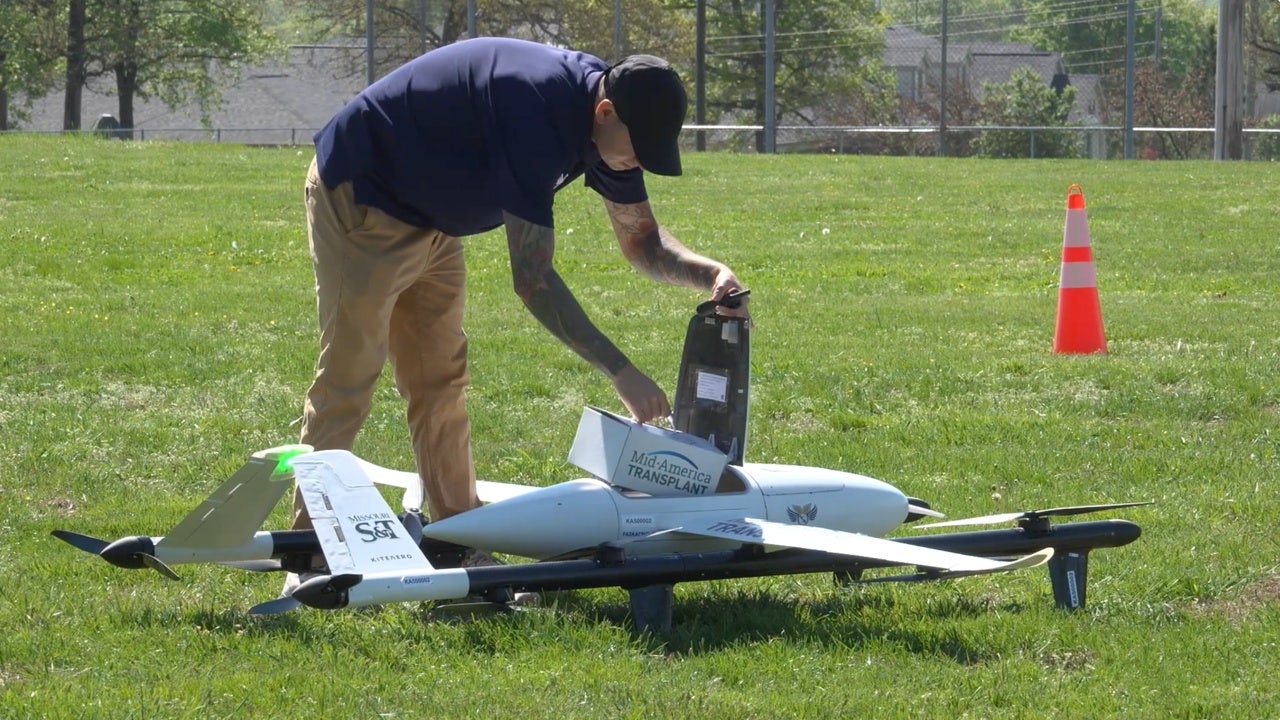
Missouri teams are testing drones to speed up delivery of critical medical items between small towns and bigger hospital centers, aiming to cut delays for blood, lab samples and transplant materials while monitoring flights in real time.
A company working with Missouri University of Science and Technology has been running trial flights that link rural communities to larger medical hubs, testing a route that would connect Springfield, Rolla and the St. Louis region. The idea is straightforward: make time-sensitive shipments faster and more reliable, especially where distance has been a constant barrier to timely care.
Rural hospital closures and longer drives for patients have left gaps in access to testing and procedures, so this effort focuses on shrinking the clock between pickup and delivery. By targeting routine but urgent items like blood for testing and lab samples, the project hopes to prevent wasted time that can affect diagnoses and treatments.
“It’s very essential. For instance, if you miss sample pickup at 5 p.m. on Tuesday, if you miss that time, it’s another week you can get it delivered on time,” said a drone operator involved in the project. That blunt observation highlights how a single missed pickup can ripple into major delays for patients and providers alike.
Officials point to transplant logistics as one area that could benefit, where timing is often critical for matching donors and recipients. “When you’re looking at things like transplant speed, it’s an issue,” said David Borrok, vice provost and dean of the College of Engineering at Missouri University of Science and Technology, noting that faster moves can translate into better outcomes.
The drones under evaluation are reported to reach speeds near 100 miles per hour and are being trialed along a proposed corridor that hits strategic points between southwest and eastern Missouri. Flight monitoring relies on live maps, weather data and air traffic inputs to keep operations safe and visible during every stage of a run.
“We’re partnering with American Transplant, and we’re running our test corridor from all the way from Springfield, pit stop in Rolla, all the way up to St. Louis,” the operator said, describing the planned network. The tests include staging at several sites so the craft can move supplies quickly across regional gaps without depending on road delays.
“So right now, this is the station. So this is what the pilot sees whenever the aircraft is actually in flight,” the operator added, describing the real-time interface used to monitor each mission. That kind of oversight is meant to reassure hospitals and patients that packages are tracked from origin to landing and that teams can respond to changing conditions.
Researchers say similar programs are starting up around the country and could expand how medical goods reach people in remote areas, with initial flights focused on samples and later versions designed to carry transplant-related materials. “It’s really unique. And I think it could work in a lot of different ways for a lot of different people,” Borrok said, as teams plan to scale from tests to operational runs in the months ahead.
