
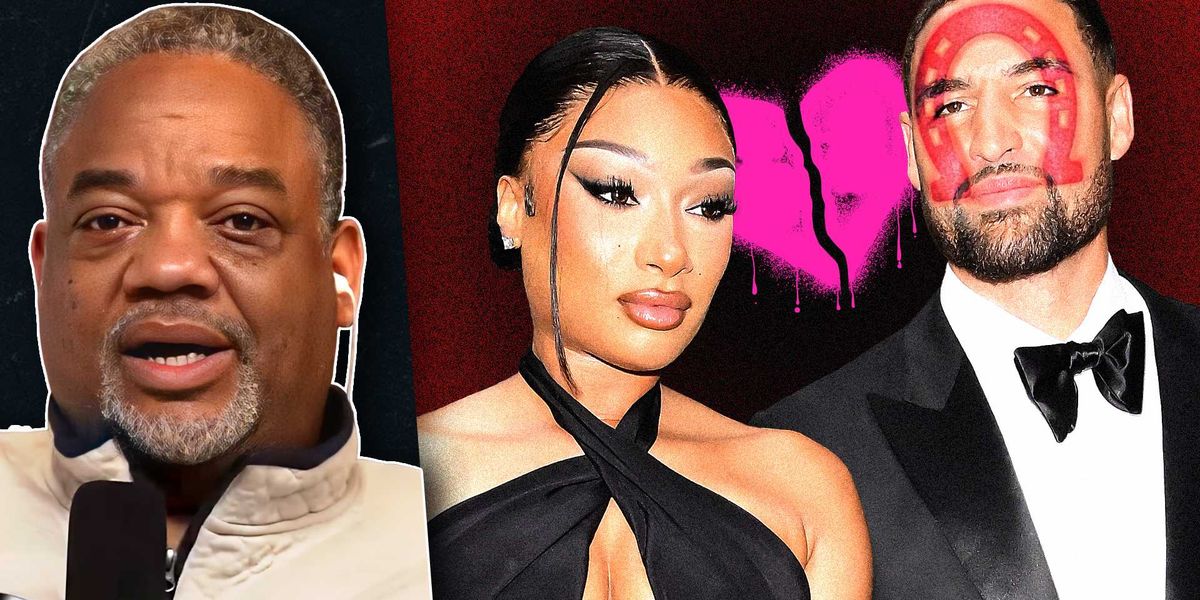
Megan Thee Stallion and Klay Thompson have quietly called it off, and the split has quickly turned into a cultural conversation. Megan’s public statement cited trust, fidelity, and respect as nonnegotiables, while commentators and hosts weighed in with harsh takes. Voices across the cultural spectrum argued this breakup touches on gender identity, dating expectations, and long-running tensions between Black men and women.
Megan made the decision public with a clear message about boundaries and standards. “I’ve made the decision to end my relationship with Klay,” Megan said. “Trust, fidelity, and respect are nonnegotiable for me in a relationship, and when those values are compromised, there’s no real path forward. I’m taking this time to prioritize myself and move ahead with peace and clarity.” The statement landed as a decisive end to a relationship that had only recently been visible to the public.
Reaction moved fast and fierce. BlazeTV host Jason Whitlock did not hold back, arguing that the split was avoidable and layered with performative signals about identity. “Don’t date a woman who calls herself a stallion, an uncastrated male horse. Megan the horse, that’s not what you want, gentlemen. She’s telling on herself,” Whitlock says, explaining that Thompson “made the mistake here.” His language is blunt and meant to provoke a larger debate about image and expectation in modern dating.
Whitlock pressed further into identity and intent, framing the relationship through a lens of personal presentation. “One of these two people did not falsely advertise. She sees herself as a man,” he explains. “Klay Thompson, you’re a man. You don’t want to date a woman who sees herself as a man,” he adds. Those sentences landed like a challenge to cultural norms and sparked pushback and support in equal measure.
Not everyone agreed with the harsh tone, but some commentators echoed parts of Whitlock’s point while criticizing the intensity of the coverage. “I just think it’s so ridiculous,” Shemeka Michelle tells Whitlock, pointing out how the story ballooned into a trend where people use the split to stake cultural claims. Her reaction is less about the individuals and more about how quickly private breaks become public morality plays.
Others framed the split as part of a deeper pattern with real social consequences. “This particular split continues a decades-long cycle of sowing discord between black men and black women. And part of the reason that concerns me is because you can’t build strong families. You can’t build a culture of marriage and strong families in any community where the default is discord between men and women,” Delano Squires tells Whitlock. He connects a celebrity breakup to structural issues around family formation and cultural cohesion.
Squires expanded the critique to the relationship market as a whole, calling out archetypes he believes are damaging. “So that to me is the bigger thing, and I think both of these individuals represent two archetypes of what is wrong in the relationship marketplace,” he adds. The thrust of his argument is less about blame for any single party and more about the cultural signals that shape how people pair up and commit.
At the center of the story are two public figures who already carry larger narratives: a rapper whose persona is bold and a professional athlete who comes from a spotlighted team. The end of their relationship fed immediate social commentary, and the conversation quickly shifted from who did what to what this moment says about broader values. The result is a messy mix of personal choice, public performance, and cultural anxiety, all unfolding in real time.
