
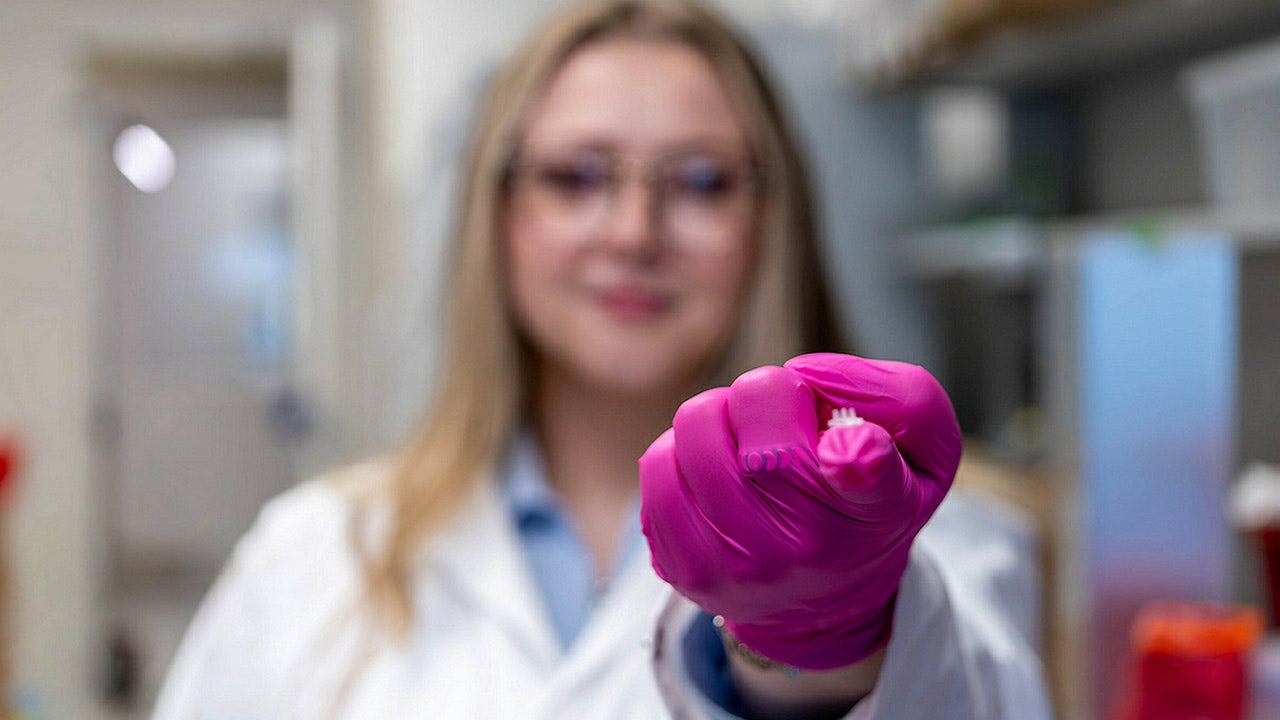
This article introduces a new “living bandage” developed at Rice University that uses engineered cells to deliver healing proteins directly to wounds, explains how it works in lab animals, and outlines the platform’s flexibility and next steps toward human testing.
Researchers at Rice University have built a patch that behaves like a tiny factory sitting on a wound and delivering therapeutic proteins around the clock. The idea is simple but powerful: keep a steady, local signal at the injury site so the body knows to repair itself. This is a big shift from one-off ointments or injections that fade or wash away.
Chronic wounds resist treatment because fragile signaling proteins break down fast and diffuse away, leaving the tissue without direction. Doctors need a way to concentrate healing cues exactly where they matter. The engineered patch aims to provide that continuous, local guidance.
Inside the device, scientists placed cells programmed to secrete three targeted cytokines: IL-10, IL-12 and Transforming Growth Factor-beta. Those molecules are key messengers that control inflammation and tissue repair. They’re released steadily, rather than dumped in a single dose, which changes how the wound responds over time.
The living cells sit inside protective material that acts like a shield, letting nutrients and therapeutic proteins pass through while keeping the immune system from destroying the engineered cells. That selective barrier is essential for safety and longevity. It allows the patch to work as a persistent treatment rather than a disposable dressing.
The patch also uses a hydrogel base that bonds well with the wound surface and blends into the tissue environment. The research team says the design could later be linked with electronics to tune delivery. Right now the focus is on proving the biological concept and showing consistent benefit in preclinical models.
In lab tests on rodents and pigs the device sped up healing and triggered the molecular programs needed for repair. Genetic analysis of tissue from treated wounds confirmed that the therapy activated pathways associated with recovery. The study was published in the journal Nature Biomedical Engineering.
“The findings show how continuous, localized cytokine delivery can support key biological pathways involved in tissue repair,” Veiseh said, according to SWNS. That statement captures the core advance: sustain signals where they are needed to steer the body’s natural healing processes.
He said genetic analysis “revealed coordinated upregulation of genes associated with tissue regeneration and immune modulation, providing a mechanistic basis for the functional improvements observed.” Those molecular readouts give researchers confidence that the patch is doing more than cosmetic repair; it’s changing biology at the gene level.
The platform is built to be adjustable, so the engineered cells can be swapped or reprogrammed to produce different protein mixes for different patients. Study co-author Christian Schreib, Ph.D., noted that “the ability to tune both the type and timing of cytokine delivery opens the door to more precise control over the healing process.” That adaptability could make the technology useful across a range of wound types.
Schreib said that “future work will focus on expanding the flexibility of the platform, including approaches such as optogenetic control” — using light to control cell activity — “to regulate cytokine secretion in real time.” The team is clear this is early-stage work and human trials have not yet begun. Further research will have to prove safety, durability and clinical benefit before this living bandage reaches patients.
