
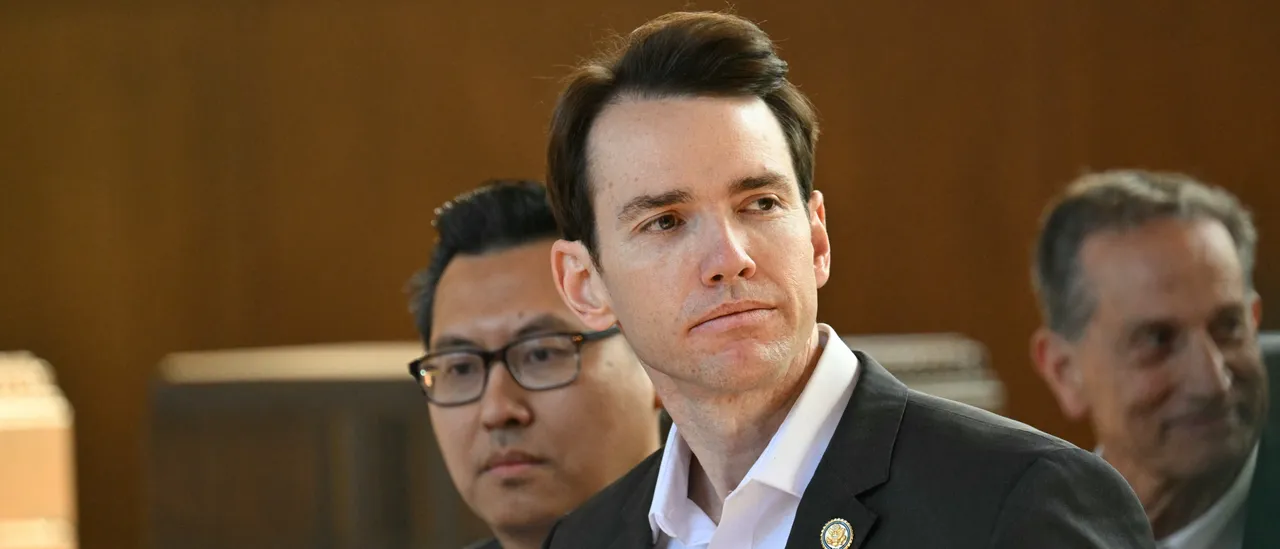
Kevin Kiley says he’s fighting back after California’s new maps, backed by Governor Gavin Newsom, sliced up his district and handed Democrats a major advantage. The congressman announced he will run as “No Party Preference,” arguing the redistricting scheme is a partisan power play that undermines voters. His move is a high-stakes gamble meant to appeal to independents and frustrated voters fed up with Washington’s gridlock.
Kiley framed his switch as a stand against what he called a partisan takeover of California’s congressional map. “Gerrymandering is a plague on democracy, one that Gavin Newsom has brought back to California,” Kiley began his video statement. “But there’s a way we can fight back and protect our democracy from his partisan games: by removing partisanship from the equation. Today, I filed for reelection as ‘No Party Preference.’”
He made it clear he wants to ditch the label that parties use to divide voters and instead present himself as a representative focused on local concerns. “This means I will not have a party affiliation on the ballot or as an officeholder,” he said, pointing out that many local officials win office without party tags. For a lawmaker in a state where the top-two primary can eliminate parties before the general, that logic is meant to resonate with the broad swath of unaffiliated voters.
California’s new lines, approved by voters after a ballot measure, threw many incumbents into unfamiliar terrain and reshaped political math across the state. Kiley’s old district was split and parceled into several new districts, forcing him into a race that now looks far more Democratic on paper. He reminded voters that maps drawn in Sacramento have real consequences for who picks winners and who gets heard.
“As an elected representative, I’ve always seen my role as being an independent voice for our community, holding politicians in Sacramento and Washington accountable to serve my constituents. I answer to you, not party leaders,” he said. “That’s the kind of representation I believe the newly-drawn Sixth District deserves.” Those lines hit home with voters tired of party-first politics and broken promises from both sides of the aisle.
Kiley also used the moment to critique Congress for its dysfunction, listing recent failures voters notice in their daily lives. He referenced the long government shutdown and rising costs that households face as proof that partisan warfare doesn’t deliver. “If there is one thing Americans agree on, it is that political division has become a serious problem for our country. We need to find ways for politics to bring us together as Americans rather than tear us apart as partisans. That means, for example, finding pragmatic solutions to make life more affordable rather than each side blaming the other for why it isn’t,” he said.
The congressman has proposed federal limits on mid-decade redistricting, but the effort stalled in Washington. He argues that maps should not be tools for party advantage and that a bipartisan fix is overdue. “The epidemic of gerrymandering has spread from Texas to California to states all across the country. Both parties are complicit,” he noted, calling for structural change rather than more political theater.
Practical questions remain about how Kiley will operate if reelected without a party label, and whether he would still caucus with Republicans on day one. For now he remains a registered Republican and a member of the GOP conference, while signaling a desire to appeal to a wider electorate. Voters will decide if that message carries in a map engineered to favor Democrats.
The fallout of the redraw has already pushed other incumbents to step back rather than face tougher, reconfigured seats. One fellow Republican opted not to run again after a newly drawn district shifted decisively toward Democrats. Kiley’s choice to run as an independent is a clear challenge to the mapmakers and a bet that voters will choose local representation over party labels.
WATCH:
Kiley’s announcement is a test of a new political reality in California, where voters and politicians alike must adapt to altered lines and shifting majorities. His pitch is simple: reject partisan manipulation and return to constituency-driven representation. Whether that pitch wins is the next chapter in a fight over how American districts are drawn and who gets the upper hand in the next Congress.
