
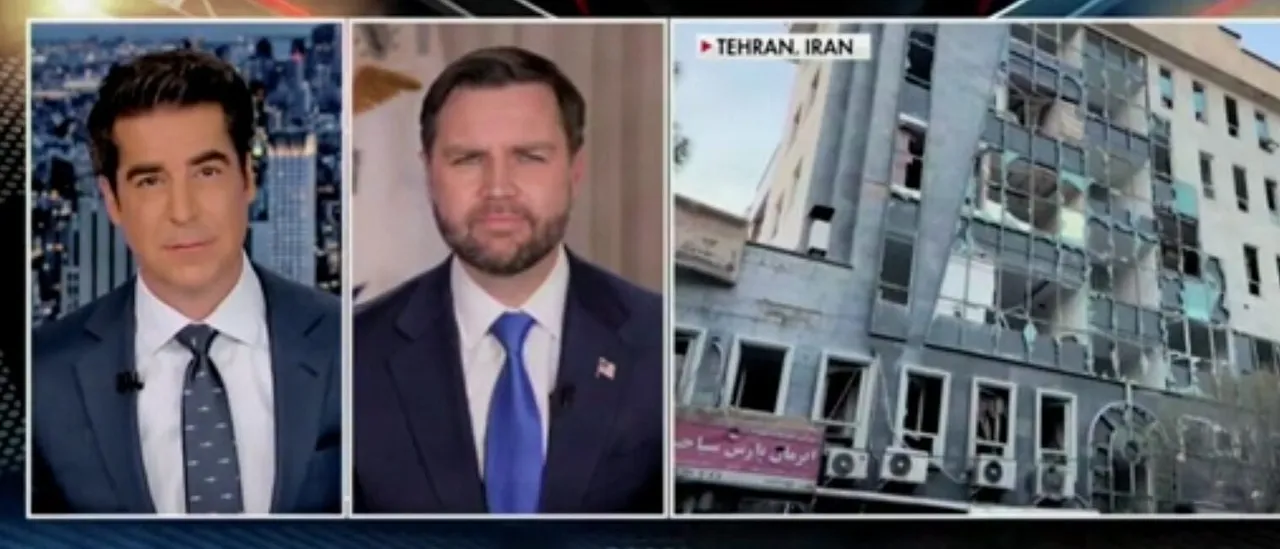
On Fox News, Jesse Watters put Vice President JD Vance on the spot about whether America is headed back into the kind of open-ended quagmires we saw in Iraq and Afghanistan after the new strikes on Iran. Vance pushed back, arguing the Trump administration has a sharp objective and will avoid mission creep, but the strikes have nonetheless split conservatives with prominent voices demanding limits and a formal congressional role. The debate mixes policy, principle, and politics — and it’s still unfolding as Operation Epic Fury continues.
Watters began bluntly, asking whether the country risks repeating past wars. “After Iraq and Afghanistan, some people say, ‘Here we go again.’ Is that something here you’re thinking about?” he asked, putting the central worry plainly and forcing a quick, direct response on air.
Vance answered in the same blunt tone the audience expects. “Well, Jesse, if you think back to Afghanistan, 20 years of mission creep, 20 years of not having a clear objective and 20 years of the United States trying to bring liberal democracy to Afghanistan. Iraq was a little bit shorter, but we were still in that country for nearly a decade with no clear mission, no clear definition,” he said, arguing the current approach is different because the president has a clear, limited aim.
He doubled down on that contrast with prior administrations and stressed a commitment to avoid ground entanglements. “I said this before the conflict started. I’ll repeat it again. There’s just no way Donald Trump is going to allow this country to get into a multi-year conflict with no clear end in sight and no clear objective,” Vance said, insisting the administration will define success and refuse open-ended deployments.
The administration’s stated goal is narrow and strategic: prevent Iran from getting a nuclear weapon and neutralize the tools it uses against the U.S. and allies. Officials describe the strikes as calibrated to degrade Tehran’s nuclear and missile infrastructure and reduce its missile, drone, and conventional strike capabilities so Iran can no longer project the kind of power that threatens regional stability.
Still, not everyone on the right is convinced this action fits an America First, non-interventionist frame. Former Georgia Rep. Marjorie Taylor Greene slammed the strikes as a betrayal of the movement’s promises, warning that the rhetoric on the campaign trail about “No More Foreign Wars, No More Regime Change!” can’t be tossed aside without consequence. “We said ‘No More Foreign Wars, No More Regime Change!’ We said it on rally stage after rally stage, speech after speech. Trump, [Vice President JD] Vance, basically the entire admin campaigned on it and promised to put America FIRST and Make America Great Again,” Greene in a lengthy Saturday X post.
The Daily Wire’s Matt Walsh also pushed back hard and called out what he sees as sudden conservative rationales that only appeared after the strikes began. “I can’t take the gaslighting, guys. I really can’t. Conservatives are now running around saying ‘Iran has been waging war on us for 47 years.’ Okay then why didn’t any of you call for an attack on Iran at any point until now? Why didn’t you make a case for Trump ‘ending the war, not starting it’ until precisely the moment when Trump did it? You and I both know that you are latching onto a talking point you never used until 45 seconds ago,” Walsh in an X post Monday.
There’s also a constitutional angle getting traction in Congress, with Republican Rep. Thomas Massie opposing the strikes and pushing for a vote to authorize any extended action. Massie argues, correctly from a constitutional standpoint, that Congress should weigh in before the nation moves from strikes to a broader campaign, and he’s lining up with lawmakers across the aisle to force that choice. He voiced his opposition publicly and signaled plans to demand legislative oversight and debate on the scope of any military commitment .
The practical question now is whether political pressure and institutional checks will keep Washington from slipping back into the old habits of vague goals and endless timelines. On one side you have a president and team promising a narrow, measurable objective and a refusal to send troops into a grinding occupation; on the other, skeptical conservatives urging caution and constitutional restraint. This debate isn’t academic — it will shape how long and how deeply the U.S. stays engaged, and whether the president sticks to the defined mission he has announced.
https://x.com/FmrRepMTG/status/2027746247684075987?s=20
