
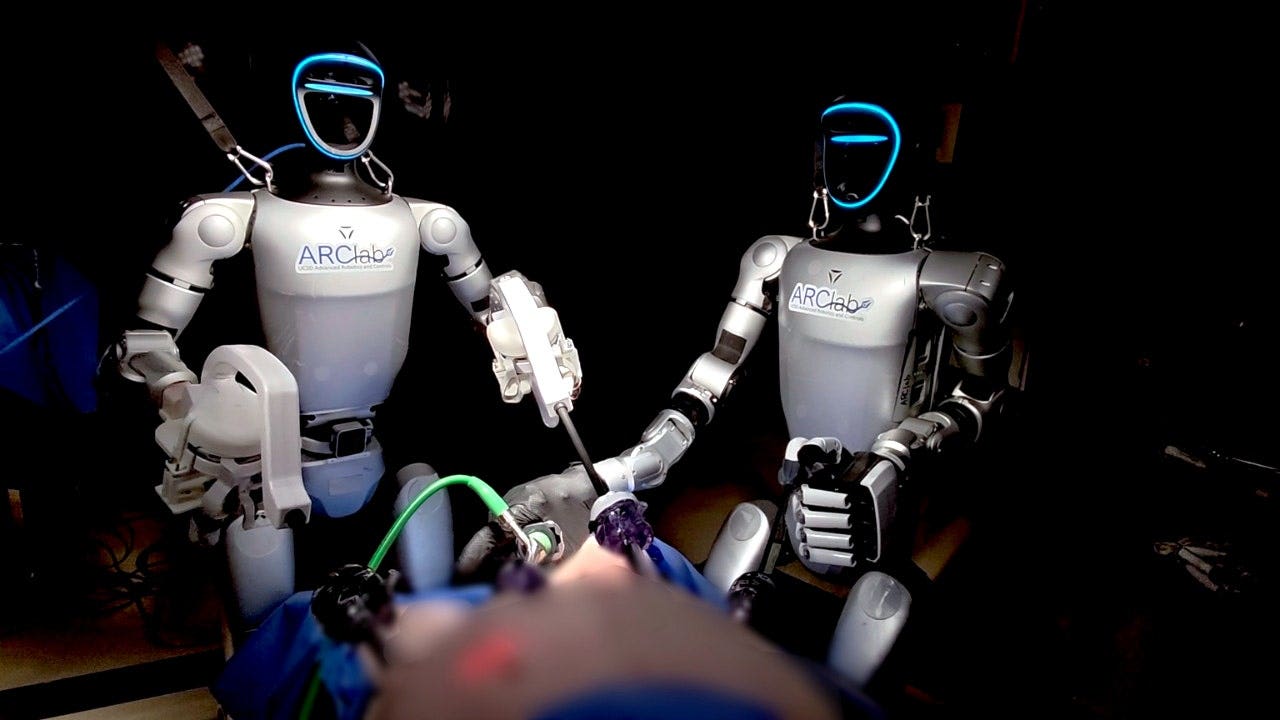
Researchers at UC San Diego have pulled off a striking medical milestone: two humanoid robots helped carry out live gallbladder surgeries in a preclinical trial. The setup was simple in concept but big in ambition, with surgeons guiding the machines remotely while the robots copied each movement inside a standard operating room. It is a glimpse of a future where robot-assisted care could reach places that are short on specialists, without turning medicine over to machines.
In the study, the team tested the robots on pigs during two laparoscopic gallbladder removals. One procedure used a single humanoid robot with a human surgeon assisting nearby, and the other used two humanoid robots working side by side. No human patients were involved, but the operation still required delicate handling, from moving tissue to clipping and removing the gallbladder.
What makes this experiment stand out is the kind of robot used. Instead of a fixed, bulky surgical platform, the researchers used five-foot humanoid machines that could stand in a room built for people and use standard surgical tools. That flexibility matters because it could let hospitals bring the technology into existing spaces rather than redesigning an entire operating suite around it.
The robots were built by modifying commercially available Unitree G1 units, then adding adapters so they could grip laparoscopic instruments. Each one weighs roughly 60 pounds, which is a far cry from many surgical systems that can weigh close to 1,800 pounds. That size difference could make a huge practical difference in clinics, smaller hospitals, or temporary medical sites that do not have room for massive equipment.
The remote setup was the real key. A surgeon sat at a console and moved the controls, and the robot at the table matched those motions in real time. That copycat design does not make medical decisions on its own, but it does suggest a path toward remote surgery in places where a skilled specialist is miles away.
Researchers say the appeal is not just technical, it is logistical. A mobile humanoid could someday travel to rural clinics, field hospitals, or other hard-to-reach settings where access to care is thin. In that kind of model, the surgeon stays in charge while the robot handles the physical work at the patient’s location.
The study also highlights a sharp contrast in cost and scale. The base robot used in the project starts at a much lower price point than many surgical robots, though the full system still includes extra hardware, tools, and remote-control gear. Even so, the idea of using a general-purpose humanoid instead of a purpose-built machine has a lot of people paying attention.
That does not mean the road ahead is smooth. The researchers had to recalibrate the robots during surgery, and the procedures took longer than those done with established robotic systems. In surgery, a little delay is not a minor annoyance. Even small latency can matter when precision is the whole game.
Safety is the other big issue. Before anyone even thinks about human trials, the system has to prove it can repeat this performance reliably, handle connection problems, and give medical teams a fast way to take over if something goes wrong. Hospitals would also need strong cybersecurity protections, since remote systems open the door to software and communication risks.
The bigger question is where this technology is heading next. For now, the robots are not making independent decisions, and the researchers are not pretending they are. But they do want to move toward an autonomous surgical assistant that could help with smaller tasks, like identifying instruments or supporting routine steps under supervision.
That future may sound futuristic, but the demand behind it is very real. Many communities struggle to bring in enough surgeons, and patients often end up traveling far just to get basic specialty care. If mobile humanoid robots can eventually deliver precise remote assistance safely, the operating room could start looking a lot less local and a lot more connected.
