
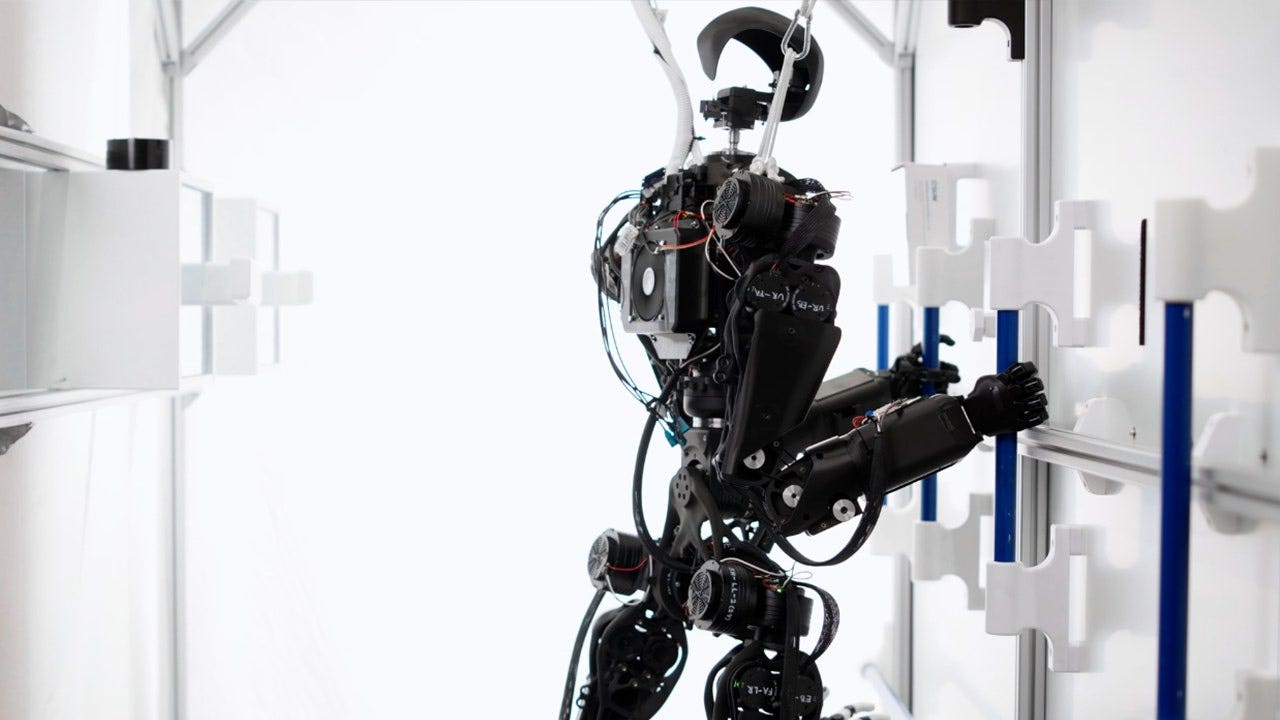
Robots built for space think and move differently than the ones we see on Earth. Helios, a four-armed spacecraft assistant from a Swiss lab spinout, trades legs for grips so it can brace, hold and work inside microgravity where floating wrecks stability. This piece walks through why that design matters, the engineering choices behind it and how machines like Helios could free astronauts to focus on high-value science while taking on the routine and risky chores in orbit.
On Earth, legs help with balance and walking, but in microgravity those advantages vanish. Designers at Orbit Robotics opted for four arms so the robot can anchor itself and manipulate objects at the same time, using two limbs to hold fast while the others carry tools or cargo. That approach turns movement and work into the same capability instead of adding useless hardware.
Stability in orbit is everything because even a small jerk can send tools or parts drifting into expensive gear. Helios addresses that with smooth joints and careful motion control, including a rolling-contact elbow joint that reduces sudden motions. Smooth actuation isn’t just comfort, it is a safety feature when delicate hardware and humans share a tight cabin.
The robot uses a tendon-driven architecture that keeps many motors nearer the shoulder rather than at every joint, routing force through cables and pulleys. That lowers weight at the limb tips and reduces inertial kick when the arms swing, which is critical for controlled handling in a confined spacecraft. Less mass at the ends of arms means less torque and finer control when moving supplies near sensitive equipment.
Before Helios, the team tested core ideas with an earlier platform named IKARUS, which explored teleoperation, imitation learning and dual-arm tasks in space-like conditions. Those trials taught the developers how robots should mimic human tasks without wasting human form factors, and how to keep behavior predictable around crew members. Learning on the ground-first reduces the chance that a robot in orbit will become a hazard instead of a helper.
Orbit Robotics frames Helios as a tool to free astronauts rather than replace them, a distinction that is both ethical and practical. A big share of crew time aboard stations goes to routine maintenance and logistics, tasks that are costly when performed by highly trained, expensive personnel. Offloading sorting, hauling and repetitive inspections to a robot could cut operational costs and let astronauts spend more hours on experiments that truly need human judgment.
Initial missions for Helios are likely to be interior-focused: unloading cargo, repositioning equipment, managing supplies and assisting with routine fixes. Those chores may seem mundane, but they consume time and carry risk when humans climb into awkward spaces. A compact, bracing-capable robot can move through narrow corridors and hold tools steady while a human handles the decision-making.
Looking further ahead, robots like Helios could support satellite servicing and in-space construction as commercial stations and orbital habitats multiply. Falling launch costs mean more hardware in orbit and more maintenance demand, which creates a steady market for machines designed from the start for microgravity tasks. Specialized designs that fit their environment will likely outperform humanoid copycats in speed, safety and reliability.
Humans remain central to exploration, but their bodies are limited by radiation, bone loss and other physiological effects from long missions. Robots do not require life support and can accept risks that would be unacceptable for crew. That difference lets engineers assign dangerous or tedious work to machines and preserve astronauts for research, troubleshooting and decisions that need human insight.
Designing machines around their environments rather than forcing them into human shapes is a broader trend, visible on Earth in warehouses and disaster response where odd-looking robots often do the job best. Helios is part of that shift, showing that a form tailored to microgravity—one that can grip, brace and handle objects—can be far more useful than a humanoid silhouette. As space habitats grow, practical robots may become as essential as power and communications to keep stations running smoothly.
