
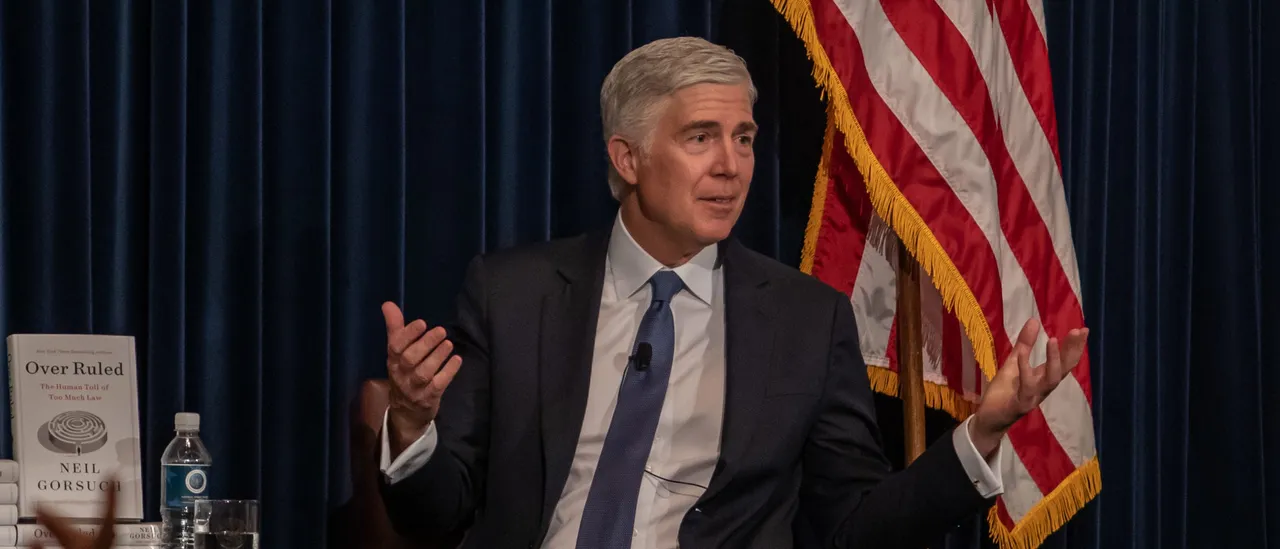
The Supreme Court grappled with whether people who use marijuana can be banned from owning guns, and Justice Neil Gorsuch pushed back hard on the government’s historical defense. Arguments centered on how the nation’s past treated habitual drunkards versus modern definitions of substance use, and whether Congress can permanently disarm someone for nonviolent drug use. The case highlights the clash between originalist history and expansive modern regulation, and it raises real Second Amendment concerns about overreach.
At oral argument, Justice Gorsuch framed the question in plain terms that land well with anyone who favors original meaning. He pointed out that the historical test for disarmament was tied to extreme, demonstrable behavior, not casual or occasional consumption. That distinction matters when a statute can label a person an “unlawful user” for admitting to using marijuana a few times a week.
Gorsuch quoted historical sources directly to underline his point: “The American Temperance Society, back in the day, said 8 shots of whiskey a day only made you an occasional drunkard…To be a habitual drunkard, you had to do double that.” He then reminded the court that many founding figures drank regularly without being labeled dangerous. “John Adams took a tankard of hard cider with his breakfast everyday,” he said. “James Madison reportedly drank a pint of whiskey every day. Thomas Jefferson said he wasn’t much of a user of alcohol, he only drank 3-4 glasses of wine a night. Are they all habitual drunkards who would be properly disarmed for life?”
The government defended its law by pointing to a historical category for habitual intoxication, but the modern definition the statute uses is far broader. Under the administration’s reading, someone who uses marijuana a few times a week could be treated the same as a person who is uncontrollably drunk every day. That stretches historical practice into a tool for lifetime disarmament and raises serious constitutional flags.
The defendant in the case, Ali Danial Hemani, is charged with possessing a handgun while admitting to recent marijuana use. The Justice Department has painted a darker portrait by alleging other, unrelated national security concerns, but the legal question here is narrower. It asks whether a nonviolent user can be stripped of a fundamental right under a statute that lacks a clear historical analogue.
Justice Ketanji Brown Jackson warned that under the court’s Bruen framework, modern legislatures get only the policy judgments that historical ones made. “The modern legislature, under our Bruen test, only gets to do the policy judgments of the historical ones,” she said. “We have to see that the historical legislature, going back to Justice Gorsuch’s point, was making a determination that someone who only drinks or takes an intoxicant once every other day and is not doing so while he’s using a firearm can be disarmed. If we don’t see that, the fact that today’s Congress thinks that person is dangerous is irrelevant.”
From a conservative perspective, that argument resonates because it protects individual liberty against vague statutory labels. The Second Amendment is not meant to be nullified by modern rediscriptions of old harms. When the government can write a definition broad enough to sweep in ordinary conduct, we lose the bright-line protections the founders intended.
Justices Samuel Alito and John Roberts showed more willingness to accept the government’s concerns about modern drugs. “The most commonly used illegal drugs either had not been invented at the time of adoption of the Second Amendment or the adoption of the 14th Amendment,” Alito said. “Heroin was invented in 1874, cocaine 1855, methamphetamine 1893, fentanyl 1959, marijana existed, but my understanding, hemp was grown for industrial purposes, my understanding is it was not consumed to any degree by people in the United States until at least the beginning of 20th century.”
Alito’s point about novel substances is real, but it does not automatically justify a wide net that permanently disarms people for nonviolent behavior. Conservatives who respect the Constitution want clear historical hooks for restrictions, not post-hoc policy rationales. Otherwise, any new social problem becomes a pretext to chip away at constitutional guarantees.
The Fifth Circuit previously tossed the indictment at issue, reflecting skepticism about the government’s theory. That decision highlights the tension between enforcement instincts and constitutional limits. Courts must balance public safety against legal standards that protect citizens from lifetime penalties for commonplace conduct.
There are sensible ways to respond to modern drug issues without stripping rights indiscriminately, and Republicans often favor targeted, evidence-based policies over sweeping bans. If the government can show clear historical analogues for disarming those who pose a genuine danger, that’s one thing. But treating routine marijuana use as equivalent to chronic intoxication is a bridge too far.
This case will test whether the court remains faithful to the historical approach it announced in prior decisions or allows contemporary policy to reshape constitutional protections. For many conservatives, the right outcome is straightforward: stick to history and the original public meaning. Anything less risks turning the Second Amendment into a policy tool rather than a protection.
The stakes are not abstract. If the court accepts a broad definition of “unlawful user,” millions could find their rights curtailed based on admissions or arrests unrelated to violence. That is a dangerous precedent for liberty and due process. Republicans who care about individual rights and limited government should be watching closely.
The oral arguments revealed a court wrestling with history, public safety, and the scope of congressional power. Justice Gorsuch’s reliance on historical practice and his pointed examples of founding-era drinking habits framed a clear, principled objection to the government’s position. How the justices resolve that tension will matter for how America treats guns, drugs, and constitutional rights going forward.

1 Comment
That’s the ticket; “not casual or occasional consumption!”